 Social Suit
Educational information, not individual medical or legal advice. Practical examples are hypothetical and do not describe clients or study participants. This article is not represented as reviewed by a clinician or attorney. How we prepare our guides.
Start with the part of life you want to protect
A useful social media limit begins with a reason. You may want an uninterrupted meal, a more predictable bedtime, a study session that begins when planned, or a break that ends without another half-hour of browsing. Name that outcome before choosing a number. “Use my phone less” can turn into a repeated argument with yourself because it does not tell you when the boundary applies or what it should accomplish. “Keep entertainment feeds closed until I finish breakfast” describes a sequence you can observe and a purpose you can recognize in the middle of an ordinary morning.
This guide offers practical planning examples, rather than a validated treatment program or a clinical prescription. A boundary may support a routine, but it cannot diagnose an addiction, resolve every emotional concern, or determine whether a person has experienced legally actionable harm. Frequent use can include necessary communication, disability access, work, and ordinary enjoyment. The question is which part repeatedly conflicts with what you intended to do. That narrower question lets you preserve useful functions while addressing the pattern you actually want to change.
Choose one example from the last few days. What did you mean to do? What happened instead? Where did the session begin, and what should have signaled its end? If the answer is vague, observe a few similar situations before adding restrictions. A limit selected in frustration may be dramatic but poorly matched to your circumstances. A limit selected from a concrete example is easier to evaluate. For a fuller examination of interference, read When social media use starts to feel out of control. Return with one protected activity, then choose the boundary that fits it.
Understand why an arbitrary minute target can fail
A daily minute target can be useful when it supports a specific decision, but a number chosen without context can create unnecessary problems. Twenty minutes may be enough for entertainment on one day and insufficient for a necessary group conversation on another. An app total may combine direct messages, school coordination, searches, and recommendations. If the target treats all of these as interchangeable, you may repeatedly override it for legitimate reasons and then continue browsing. The repeated override does not automatically mean you lack discipline. It may show that the rule does not distinguish useful use from the pattern you intended to address.
Ask what the target is supposed to protect. If your concern is bedtime, a boundary around the final evening period may answer the question more directly than a daily total. If notifications interrupt a report, a protected work interval may be more relevant. If a feed repeatedly expands a short break, an explicit stopping point could matter more than the number accumulated across the day. A time total can remain one measure, but it should not become the only definition of success when your actual goal concerns placement, purpose, or continuity.
Avoid interpreting a lower total as proof that everything improved. Browsing may have moved to another device. The remaining sessions may still disrupt sleep or expose you to upsetting material. Conversely, a total can remain similar while a useful change occurs: you might browse intentionally after lunch instead of during dinner. Evaluate the protected activity as well as the minutes. See Building a screen-time baseline that is actually useful for a method that adds context. A realistic limit should answer a decision you care about, not merely produce a smaller number on a report.
Choose between time, place, and activity boundaries
A time boundary applies during a defined period: entertainment feeds after lunch, no optional browsing during a work interval, or a planned evening check. A place boundary applies in a setting: phones away from the dinner table, no feed at the study desk, or a charging place separate from the pillow. An activity boundary applies to a sequence: finish breakfast before opening, answer the necessary message and leave, or watch one saved tutorial without entering recommendations afterward. These are planning categories, not a ranking of methods. The useful choice depends on where your unwanted pattern begins.
Consider three examples. Someone who loses the morning after checking a feed may choose an activity boundary tied to getting dressed. Someone who repeatedly checks during a conversation may choose a place boundary for the table. Someone who needs work communication but drifts into optional content may choose a time boundary around a short task interval, preserving an urgent route. Each plan protects something different. Copying a friend's rule because it worked for them can miss the circumstances that made it workable. Describe your own cue and consequence first, then select the simplest boundary that addresses them.
You can combine categories later, but begin with one clear rule. A complicated combination of daily minutes, locked periods, device locations, and app exceptions can be hard to remember and harder to review. If it fails, you may not know which part was impractical. A simple first experiment gives you a more interpretable result. If your main issue is opening automatically, read Why you open an app without deciding to. If it is remaining in a short-video stream, see Recognizing the short-video rabbit hole. Different mechanisms deserve different starting points.
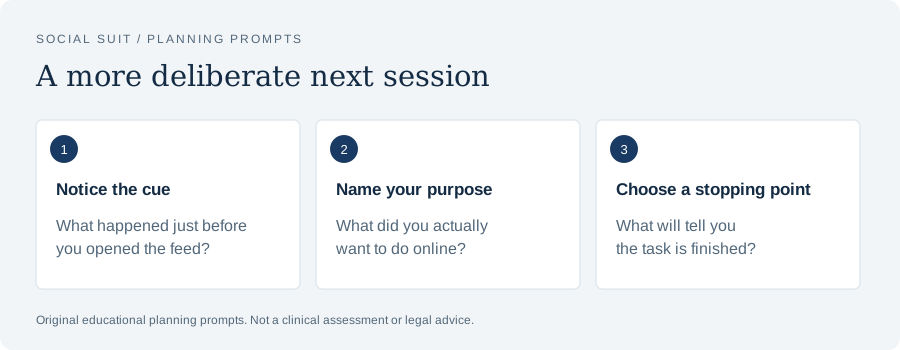
- Notice the cueWhat happened just before you opened the feed?
- Name your purposeWhat did you actually want to do online?
- Choose a stopping pointWhat will tell you the task is finished?
Make the beginning and end unmistakable
A boundary needs a beginning you can recognize. “During study” may be unclear if you move between preparing materials, messaging classmates, and attempting questions. “From opening the practice sheet until completing the first three questions” is more concrete. “Before bed” may mean different things on different nights. “After checking tomorrow's schedule until getting dressed in the morning” describes a sequence, though you should adapt it to necessary overnight functions. The clearer beginning reduces the need for a fresh decision every time the phone is nearby.
The end matters equally. A break can expand when there is no chosen signal to return. Decide whether the boundary ends at a clock time, a completed task, a meal, or an external event. If you choose a timer, decide what you will do when it appears. If you choose a task, make the task small enough to complete. “Finish the entire project” may be too broad. “Draft the opening paragraph” may be workable. The endpoint should be something you can observe rather than a feeling such as “when I am productive enough,” which can remain uncertain all afternoon.
Write the rule in one sentence and read it as though someone else will follow it. Can they tell when it applies and when it stops? If not, revise it. An example could be: “For the first twenty-minute homework interval, I will keep optional feeds closed; afterward I will check the class group and choose whether to take a break.” That does not prescribe twenty minutes for everyone. It illustrates a bounded interval with a planned transition. Your duration may differ. Choose a period that fits the task, your circumstances, and any accessibility or caregiving needs that affect how you work.
Identify essential functions before restricting access
List what the phone or app needs to do during the protected period. You may need an alarm, a message from a caregiver, an authentication tool, transport information, a medical interface, or communication support. A boundary should preserve those functions where possible. An arrangement that blocks necessary access can create a larger problem than the browsing you wanted to change. This is especially relevant when advice assumes that everyone can leave a device in another room. Some people have genuine reasons to keep it available, and a practical plan should respect them.
If the needed function and unwanted feed share an app, focus on the route. A student might need a project group but not the home feed afterward. A person coordinating care might need direct messages but not recommendation alerts. A worker might need a phone to sign in but not a social shortcut beside the authentication app. You can test a direct bookmark, a planned check, an alert exception, or a visible exit action, depending on current device and platform options. Do not assume a route works until you have tried it in a low-stakes situation.
Explain relevant changes to people who rely on your response. Tell them which channel remains available for urgent matters and when other messages will be checked. Verify that they understand. A silent assumption can create unnecessary worry or missed information. At review, ask whether the boundary preserved essential use and whether the exception stayed limited to its purpose. If not, revise that part. Read Making your notifications less demanding for a practical alert review. Necessary access is part of the design of a realistic limit, not an inconvenience you should ignore to make a rule look stricter.
Write purposeful exceptions
An exception should name a real need. “I can check if something matters” may allow every alert to become urgent. “I can answer a direct call from the person caring for my child” is clearer. “I can use the transport app to check the arrival time” separates a useful function from optional browsing. “I can reply to the class group if it concerns tomorrow's deadline, then close the app” describes both entry and exit. You do not need to anticipate every event, but a few known exceptions can make the boundary more practical and less open to repeated renegotiation.
Avoid treating a legitimate exception as failure. If you answer an important call during a protected meal, the rule can still be useful. Record that the exception occurred and whether you returned. The relevant question is whether the boundary supports the purpose, not whether the day remained perfectly uniform. A plan for ordinary use should leave room for ordinary responsibilities. If necessary exceptions occur so frequently that the rule rarely applies, choose a different period or clarify the communication arrangement. Repeated conflict with a real obligation is information about the plan.
Also notice when an exception opens a second route. You may answer a needed message and remain in unrelated content afterward. In that case, the exception itself is appropriate, but the return action needs attention. Decide where the phone goes after replying or what task you resume. Keep that next step visible. A boundary is not just a barrier to opening; it can include a sequence that brings you back after necessary use. This distinction allows you to preserve communication without turning every essential message into permission for an open-ended session.
Start smaller than the frustration suggests
When a pattern feels upsetting, it is tempting to choose the strongest possible restriction. You might promise no social media for a month, no phone after sunset, or a tiny daily allowance that excludes necessary contact. A dramatic rule can feel decisive while remaining poorly suited to an ordinary difficult day. Begin with one period you can realistically protect. You can expand a useful boundary later. A modest experiment that reveals what works is more informative than a severe rule you repeatedly abandon without understanding why.
Choose the period by looking for a recurring mismatch with a clear consequence. Perhaps the first ten minutes after waking become a long feed session. Perhaps a short study interval is interrupted by several openings. Perhaps dinner conversations repeatedly lose continuity. One protected period can produce a visible benefit. It also limits the inconvenience while you test necessary exceptions. You are not promising that the rest of the day will become perfect. You are learning whether a specific boundary changes a specific pattern under ordinary conditions.
Set a review date rather than a permanent identity. “I will test this for seven days and review whether it helps breakfast” is easier to evaluate than “I am now someone who never scrolls in the morning.” A short experiment can still be meaningful. If it works, keep it. If it creates a problem, revise it. If it addresses the wrong cue, replace it. See Designing a seven-day digital reset for a fuller format. Starting small is not an excuse to ignore serious concerns; it is a way to make a practical habit change observable while recognizing when broader support is needed.
Prepare the task the boundary will protect
A boundary may fail because the protected activity is unclear. You put the phone away to work, but the report has no defined first step. You close the feed to study, but you do not know which material to begin. The app offers a ready action while the task requires a decision. Prepare the next step before the interval starts. “Write the sentence explaining the result” is clearer than “be productive.” “Attempt questions one through three” is clearer than “study everything.” A task that can be started immediately gives the boundary something concrete to support.
Set out what you need. This could mean opening the document, placing the book on the desk, writing the next action on a card, or making the materials available in an accessible form. If you need the phone for the task, identify the function and a route that avoids unrelated browsing where practical. If the task is beyond your current understanding, ask for clarification from a teacher, colleague, or another appropriate source. A device restriction will not make missing instructions appear. The practical obstacle should be addressed alongside the interruption pattern.
At review, ask whether you began the activity and whether it had a manageable endpoint. If the boundary held but you sat unsure what to do, the next adjustment may concern task preparation. If the task was clear but alerts repeatedly interrupted it, the next adjustment may concern notifications. Keep the explanation matched to the observation. Read Single-tasking when your phone is nearby and Social media boundaries during study sessions for more examples. A realistic limit is one part of a routine; it cannot replace the information, materials, or support that the protected activity itself requires.
Choose a replacement that serves the same moment
If you remove an optional feed from a break, decide what the break will contain. The app may provide contact, amusement, a pause from concentration, or a way to fill waiting time. A replacement should fit that function and the setting. A complicated new hobby may not suit a five-minute work break. A walk may be impractical for someone with mobility limits or in a setting they cannot leave. A direct message may serve a wish for contact better than an endless feed. The point is to choose an available option, not an activity that sounds virtuous in the abstract.
Prepare it before the cue occurs. Put the book near the chair, keep a pencil and paper beside the desk, save the one video you intend to watch, or decide which friend you might contact. If the alternative requires several decisions, the already-open app may remain the easiest route. Keep the option modest enough to use when tired. A break can also be a quiet pause without another task. You do not need to replace every minute of browsing with an output. Rest and ordinary pleasure can be legitimate parts of the day.
Observe whether the alternative has an end. If it becomes another open-ended stream, the original problem may remain. You might finish one saved article, get a drink, or step away briefly and return. If the replacement feels unhelpful, ask what need it failed to meet. A lonely evening may need connection; a difficult assignment may need clarification; a tiring day may need rest. Read Choosing breaks that do not become another feed for bounded examples. A limit is easier to keep when the period it creates contains something realistic, rather than only the absence of the app.
Use reminders with a planned response
A timer or app limit can make a boundary visible, but the reminder needs a response. Decide beforehand what happens when it appears. You might finish the current message, close the app, and put the phone in its place. You might bookmark the item and return to the task. You might take a brief pause to decide whether continued use serves the original purpose. Without a response, the reminder can become another button to dismiss. The setting itself does not explain why you should stop or what comes next.
Check the current device behavior. Labels, exceptions, and available controls vary and can change. A limit may apply to one app but not its browser version or another device. A focus mode may allow certain alerts but suppress others. Test the arrangement before relying on it during an important responsibility. You do not need a complicated lock to benefit from a reminder. A simple prompt that arrives at the relevant point may be useful if it supports a clear purpose and a feasible return action. The strongest setting is not automatically the best fit.
When you dismiss a reminder, note why without immediately lowering the target. Was a necessary conversation unfinished? Was the period unrealistic? Did the alert appear at an awkward point? Did you continue automatically? These cases suggest different adjustments. You could move the check, preserve a necessary function, choose a more appropriate stopping point, or prepare the return activity. If the same reason recurs, address it directly. Repeatedly tightening the number without examining the override can produce a cycle of restriction and abandonment while leaving the actual obstacle unchanged.
Use friction in proportion to the problem
Friction is a small extra step that creates a pause before an opening. Moving an app into a folder, using a direct bookmark, logging out of an optional account, or keeping the phone beyond immediate reach can support a boundary. Begin with one change. The purpose is to interrupt the unwanted route while preserving useful functions. If the adjustment is inconvenient in ways that affect work, accessibility, caregiving, or safety, revise it. A boundary should not require you to accept avoidable practical problems merely because inconvenience makes it appear more serious.
For example, moving the feed icon can help someone who opens it while checking the weather. A separate charging place can help someone whose bedtime browsing begins because the device rests beside the pillow, provided necessary overnight access remains available. Hiding recommendation badges may help someone who needs direct messages but does not need content prompts. A paper task note can interrupt the route from uncertainty to a feed. These examples are different because the cues are different. Choose based on the sequence you observed, not a universal claim about what every phone user should do.
Evaluate the pause itself. Did you notice the impulse? Did the extra step give you time to choose? Did you simply find another route? Did the arrangement preserve important access? A successful friction change may not eliminate every opening, but it can make the moment more deliberate. Read Using friction to interrupt a scrolling habit for a deeper review. If the problem persists because of distress, unclear expectations, or an essential app function, adding more obstacles may not be the relevant next step. The practical explanation should remain connected to what happened.
Make morning limits about a sequence
A morning boundary can protect the first part of the day without treating every early phone use as unwanted. You may need an alarm, transit information, a weather check, or a message from family. Identify those functions and distinguish them from optional feeds. Then choose one activity that comes before entertainment browsing: getting dressed, breakfast, preparing a bag, or reviewing the day's first task. The sequence gives you a visible stopping point for the boundary and a reason that does not depend on an arbitrary daily total.
An example could be: “I will check transport information once, then prepare breakfast before opening recommendations.” Another could be: “I will answer an urgent family message, then leave the app until I finish getting ready.” Keep the exception and return action clear. If the necessary use repeatedly leads into the feed, change the route or the place where the phone rests afterward. A person with a variable work schedule may need the sequence to follow waking rather than a fixed clock time. Fit the plan to the real morning, including caregiving and accessibility needs.
Review whether the start feels more deliberate and whether you leave on time. Do not demand a perfect morning to count a useful change. A brief necessary check can coexist with a protected routine. If the plan does not help, ask whether the first activity was realistic, whether the app route remained too open, or whether another issue disrupted the morning. Read Starting the morning without an immediate feed check for more detailed examples. The boundary should help you begin the day you intended, not become another source of pressure before the ordinary tasks of the morning have started.
Make evening limits respect safety and rest
An evening boundary should identify the point where optional browsing ends and the next routine begins. You may need to finish work communication, arrange tomorrow's essentials, check a schedule, or remain reachable for a dependent person. Keep those needs visible. A rule that simply says “no phone after eight” may be impractical for a night shift, a caregiver, or a person using the device for accessibility. Choose a sequence or period that fits the evening you actually have. The aim is to reduce unwanted crowding, not impose a schedule copied from someone else's life.
Prepare the transition. Check necessary information, write tomorrow's first task if helpful, place essentials together, and choose a quieter activity with a clear end. If the phone is also an alarm, consider whether another arrangement is practical, but do not assume one is available or necessary. If you move the device, test essential contacts and functions. A boundary that creates worry about missing a genuinely important call may need a clearer exception rather than more distance. The setup should support rest while keeping safety needs intact.
Observe the result without promising a sleep cure. Did browsing end at the planned point? Was the routine practical? Did you feel anxious about unfinished communication? Did the next morning become easier? Persistent sleep difficulties deserve appropriate professional attention rather than a conclusion that one app explains everything. Read Protecting the last hour before bed and Keeping the phone away from the pillow for related approaches. An evening limit can be one useful support, while the broader circumstances affecting sleep may require a different conversation or assessment.
Agree on social expectations instead of guessing
Limits can be difficult when you believe every message requires an immediate answer. Clarify expectations where possible. Ask colleagues which channel is urgent and which messages can wait. Tell friends when you usually check social messages. Agree with household members on how to reach you during a protected period. You do not need a dramatic announcement about quitting technology. A simple explanation of the practical change and the route that remains available can reduce repeated checking driven by uncertainty about what others expect.
For example: “I am protecting the first study interval, so I will check the group afterward; call if something is urgent.” Or: “I am turning off recommendation alerts, but direct family calls remain available.” At work, you might ask: “Is this channel intended for immediate responses, or can I check after finishing the task?” These statements make the boundary reviewable. If a job genuinely requires on-call availability, preserve that function and focus on unrelated browsing around it. If expectations are unclear or unreasonable, the communication issue may need attention separately from a device setting.
Avoid assuming that a delayed reply automatically damages a relationship or that every contact will accept the same arrangement. Listen to practical concerns and revise where appropriate. A person coordinating care may need a different urgent route. A class project may have a deadline that requires a planned check. A friend may not have understood the distinction between calls and social messages. Test the agreement rather than rely on assumptions. Read Making work messages less constant for questions to discuss. A realistic limit includes the relationships and responsibilities around the device, not only the controls on its screen.
Keep family boundaries clear and proportionate
When a parent and young person are setting limits together, begin with the activity that needs protection and the useful functions that remain. “Homework keeps starting late after the class-group check” is a specific observation. “You are always addicted to your phone” is a global accusation that gives little guidance. Ask what happens online and what the app provides. School coordination, friendships, support communities, and distressing interactions may all matter. A boundary can be age-appropriate while still accounting for the young person's actual experience and developmental needs.
Choose one shared experiment and a review date. A family might test a device place during dinner, a planned check around homework, or a quieter bedtime period. Explain what the rule is for and how exceptions work. Adults can model the same boundary where practical. Avoid using private screen-time reports to shame the child or compare them with siblings. If the young person describes harassment, threats, or serious distress, address those concerns directly rather than assume a generic time limit is sufficient. Safety and support take priority over maintaining a neat experiment.
The APA advisory on adolescent social media use emphasizes individual context, developmental capabilities, and differences in content and functions. That supports careful tailoring rather than a claim that one time allowance is right for every young person. A family boundary is not a clinical assessment. If symptoms are persistent or daily functioning is affected, seek appropriate professional guidance. Keep the conversation open enough that a young person can disclose a problem without expecting every disclosure to produce immediate punishment or the loss of a useful source of connection.
Plan for difficult days before they happen
A realistic boundary should have a response for ordinary disruptions. Stress, illness, travel, a deadline, or an unexpected family message may alter the routine. You do not need a complicated contingency plan for everything, but identify the most likely obstacle from your baseline. If work runs late, will the evening boundary move with it? If a needed conversation continues, what happens afterward? If you are too tired for the replacement activity, what simpler option is available? A modest backup can prevent one disruption from making the entire rule feel unusable.
Keep the backup purposeful. “On difficult days anything goes” may erase the boundary, while “I will keep the same protected meal but shorten the later experiment” preserves the main outcome. “If the study task is unclear, I will write the question I need answered before taking the break” addresses an obstacle. “If an essential message interrupts, I will answer and return to the task card” describes a route back. These are examples, not rules you must adopt. Choose the backup that matches the event you expect and the responsibilities you need to maintain.
After a difficult day, record what happened without escalating the restriction automatically. Did the backup help? Was the exception necessary? Did the problem involve the device or another issue? The answer can guide a revision. A boundary that works only under ideal conditions may need simplification. A boundary that consistently conflicts with a real need may need a different setting. A pattern connected to significant distress may require broader support. Planning for ordinary variation makes the experiment more honest and prevents success from depending on a version of your day that rarely occurs.
Respond to an override with a question
When you override a limit, ask what you needed at that moment. Was there an important message? Were you avoiding an unclear task? Did the replacement fail to provide a break? Was the reminder badly timed? Did you continue without noticing? Describe the event before choosing a response. These cases are different. A necessary conversation might call for a planned check elsewhere. An unclear task might call for preparation. An automatic dismissal might call for a more visible return action. The override is information about the plan and situation, not proof that every attempt is pointless.
Restore the next ordinary boundary rather than try to compensate through an extreme ban. If you stayed late one night, the next step may be to keep the following evening's normal transition. If a lunch break expanded, return to the next task rather than abandon the rest of the day. A severe response can make necessary use difficult and encourage another override. Keep the review focused on the recurring obstacle. You are allowed to retain what worked and change only the part that did not. There is no requirement to redesign the entire routine after one difficult session.
Read What to do after a scrolling setback for a detailed review format. Count deliberate choices as well as unwanted sessions. If you protected several study intervals and lost one, the successful intervals still provide useful evidence about the arrangement. If the same problem repeatedly affects functioning despite reasonable adjustments, consider professional support. A limit is a tool for a defined habit problem. It should not become a demand that you handle every emotional, health, family, or work difficulty alone before you are allowed to ask for assistance.
Measure the outcome you chose
At review, ask whether the boundary protected the activity named at the start. Did breakfast occur before entertainment browsing? Did the first study interval begin on time? Did the dinner conversation remain more continuous? Did optional browsing end before the evening routine? These outcomes connect directly to the reason for the experiment. The device total can provide additional context, but it should not replace the practical result. A lower number is not inherently meaningful if the remaining use still causes the same mismatch, and a stable number can coexist with a better placement of intentional leisure.
Record costs as well as benefits. Did you miss necessary information? Did the arrangement make accessibility functions harder to use? Did it create uncertainty for someone who depends on you? Did the replacement require too much effort? A useful plan should be feasible and proportionate. If a benefit came with a practical problem, revise the problem rather than ignore it. If other circumstances changed during the experiment, note them. A quieter workweek or a holiday may affect use independently of the boundary. Describe the result honestly instead of attributing every change to the setting.
Choose one of three actions: keep, revise, or replace. Keep the boundary if it helps and fits ordinary life. Revise a specific exception, cue, or return action if a clear obstacle remains. Replace it if it addresses the wrong pattern or creates a larger problem. You can test a second protected period later. The first experiment should make the next decision clearer. It does not need to establish a permanent rule for every context. A realistic limit evolves from observation, practical needs, and review, rather than from a promise made once during a frustrating night.
Recognize the limits of habit planning
If your concern includes persistent distress, significant changes in sleep or appetite, loss of interest, or difficulty completing ordinary responsibilities, a device boundary may be insufficient. You can seek a healthcare professional's help without proving that social media caused the symptoms. The NIMH guide on deciding when to seek help emphasizes severity, duration, and effects on daily life. Bring observations about the pattern and what you have tried, while remaining open to an assessment that considers several factors. A broader explanation can coexist with a useful boundary.
Prepare a short account: what changed, roughly when, how daily activities were affected, and what online patterns you noticed. Avoid presenting a screen-time number as a diagnosis. If the concern involves a child, include observations while allowing space for the young person's description. Professional support may address more than device controls, because a feed can be part of a larger situation involving mood, relationships, sleep, or other difficulties. The boundary can remain one support without being expected to solve the entire problem.
If there are thoughts of suicide or urges to self-harm, seek immediate help. In the United States call or text 988, or call 911 for a life-threatening emergency, as described by NIMH. Do not wait to finish a seven-day experiment, review a report, or investigate legal options. A resource article and website support email are not crisis services. Safety and appropriate care come first. A limit should never become a reason to delay urgent help or a claim that someone must solve a serious situation through willpower and phone settings.
Keep legal options separate from the boundary experiment
Some readers want information about potential claims related to serious social media harm. That question requires an individual legal review of accurate facts and applicable law. A habit experiment cannot determine eligibility, filing deadlines, causation, or compensation. A symptom, a high total, or difficulty keeping a limit does not by itself establish a viable claim. Keep the practical question about daily routines separate so that you do not feel pressure to describe an experience in a particular way. The boundary can be worthwhile whether or not any legal process proceeds.
If you choose to document concerns, preserve original information and mark approximate dates honestly. Do not invent missing details, edit screenshots to strengthen an account, or access another person's private account without authority. A concise timeline may help you understand the sequence, but ask a qualified professional what records are actually needed before collecting a large archive of sensitive material. More information can create privacy burdens without improving a review. Do not email medical records or detailed private messages to ordinary website support.
Social Suit's social media harm information page provides general information and an optional link to an independent intake destination. It does not establish a professional relationship with Social Suit or guarantee eligibility, compensation, or an outcome. Read the recipient's privacy information before sharing sensitive material. Continue to prioritize healthcare and safety while exploring options. An informational link should remain an option, not pressure to interpret every difficulty as a claim. Your most useful account is truthful and specific, including what you know, what you observed, and what remains uncertain.
Put your first realistic limit on one page
Write the protected activity, the beginning, the end, the essential exception, the return action, and the review date. Add one replacement if the boundary creates a break that needs a purpose. An example could be: “For seven days, I will protect the first homework interval after dinner. The boundary begins when I open the practice sheet and ends after the first three questions. An urgent family call remains available. After a needed call, I return to the task card. I will review whether the interval starts on time and whether the arrangement is practical.” Adapt the example rather than copy its details automatically.
Keep the page short enough to read at the relevant moment. If it contains many categories and exceptions, simplify it. You should be able to explain what the rule protects in one sentence. Prepare the setting before the period begins, test necessary functions, and tell relevant people how to reach you. Then observe a few ordinary opportunities. If the boundary is useful, keep it. If a specific part fails, revise that part. If the problem belongs to a broader concern, seek appropriate support rather than repeatedly increase the strictness of a rule that addresses only one piece.
Your first limit does not have to transform your whole day. It should help you make one recurring choice more deliberate and protect something you care about. Preserve useful connection, access, and enjoyment while reducing the pattern that conflicts with your intentions. Learn from exceptions and setbacks without turning them into judgments about your character. Review the practical outcome, keep the explanation honest, and choose the next step from what actually happened. A realistic boundary is one you can understand, use, and revise in the life you have, including the difficult days when a plan needs support rather than a harsher promise.
Sources and further reading
These primary resources provide context. Our practical examples and planning suggestions are original educational material, not validated treatment protocols. Linked organizations do not endorse Social Suit.