 Social Suit
Educational information, not individual medical or legal advice. Practical examples are hypothetical and do not describe clients or study participants. This article is not represented as reviewed by a clinician or attorney. How we prepare our guides.
Treat the week as a question you can answer
A seven-day digital reset can be a bounded experiment in how you use technology. It does not need to be a dramatic withdrawal from every device or a promise that life will change in a week. Start with a question you can observe. Perhaps you want to know whether postponing entertainment feeds until after breakfast makes mornings easier, whether removing recommendation alerts protects a work interval, or whether a different evening route helps you leave browsing at the intended time. Each question connects a change with an ordinary activity. That is the useful work of the reset.
Avoid defining the week only as endurance. If the plan asks how long you can tolerate deprivation, it may teach little about the arrangement you need afterward. A useful reset should reveal what technology provides, what it interrupts, and which adjustment can preserve one while reducing the other. Online connection may support friendship, work, accessibility, learning, or caregiving. Those functions belong in the design. You can narrow an unwanted route without treating every device use as a problem. The experiment should fit your actual life closely enough that its results matter beyond the final day.
Write the question in a single sentence and give the experiment a beginning and an end. A hypothetical participant might choose, 'For seven days, I will keep entertainment feeds closed during breakfast and note whether getting ready feels less reactive.' This names the period, the route, and the intended effect. It does not claim that morning phone use is universally harmful. Another person may need a different period because of shift work, family coordination, or accessibility. Choose based on the mismatch you have observed, not a schedule borrowed from someone whose responsibilities differ.
Define what you will decide at the end. You might keep the boundary, shorten it, change the route, or conclude that another problem deserves attention. All are legitimate outcomes if they follow the observations. The week is not successful only when you maintain the original rule unchanged. It is successful when it gives you useful information and a reviewable next step. That standard allows honest notes about inconvenience and benefits. It also prevents the final day from becoming a choice between a permanent restriction and a return to exactly the old arrangement.
Choose one mismatch instead of every digital habit
A broad plan to change all screen use can hide important differences. A video call with a distant friend, a calendar check, a work task, and an open-ended feed are not interchangeable. Select one recurring mismatch between intention and action. You might intend to read one message and remain in recommendations, intend to take a brief break and lose the return point, or intend to settle down and reopen news updates. Describe the sequence and the activity affected. This gives the week a specific target and makes its results easier to interpret.
Use a small baseline if you do not yet know the pattern. For a few ordinary days, record the initial purpose, approximate duration, and practical effect of selected sessions. Device reports can add context, but they do not explain the reason for use. You do not need a perfect measurement system before beginning. A few representative examples may be enough to select the question. The guide on building a screen-time baseline that is actually useful explains how to connect totals with purpose, timing, and impact.
Choose a target you can influence. A workplace system may require particular alerts. A school may rely on a platform for assignments. A caregiver may need direct contact available. Those constraints do not make a reset impossible; they define where it can operate. You could change recommendation delivery, a leisure window, or the route into an essential tool. If a desired change requires agreement with someone else, clarify it before relying on it. The experiment should not quietly remove a responsibility and then treat the resulting problems as evidence that boundaries are impossible.
Keep the scope small enough to distinguish cause from coincidence. If you delete several apps, change bedtime, begin a new exercise routine, alter work hours, and stop reading news simultaneously, the week may feel different but reveal little about any individual change. That might still be a deliberate broader choice, but it is less useful as a narrow experiment. For a practical reset, start with one route or period. Add another change only when the first observation gives you a reason. A focused week can produce clearer information than a dramatic plan with many moving parts.
List the functions you must preserve
Before changing access, list what the device or platform does that you need to keep. Include communication, accessibility, navigation, calendar reminders, caregiving, work, school, authentication, and useful communities where relevant. The list should reflect your circumstances rather than a generic checklist of presumed essentials. Some functions may be optional but highly valuable, such as a supportive group or creative collaboration. Include those too. A reset should not make you choose between useful connection and a less demanding feed when a narrower arrangement could preserve both.
For each preserved function, identify the route and timing. Who needs to reach you? How quickly must you respond? Where will an assignment appear? Which reminder must still work? A hypothetical participant might keep direct family contact available while reducing recommendations during a study period. Another might use a direct bookmark to a community while avoiding the broad home feed. These are examples to adapt, not rules for everyone. Test the preserved route at a low-stakes time, particularly when focus settings or placement changes could affect an important signal.
Consider the people affected by the change. A household member may assume that you see a group message immediately. A collaborator may rely on an app you intend to remove temporarily. A friend may use shared clips as a form of contact. Explain the relevant part of the experiment and the alternative route if one is needed. You do not need to make a public announcement or justify every preference. A brief practical explanation can prevent uncertainty and repeated checking. It also allows others to identify a genuine coordination problem before the week begins.
Avoid building a fragile workaround. If the alternative route is difficult to use, unfamiliar to someone who depends on it, or unreliable in your environment, revise the plan. A reset is not useful because it creates inconvenience. Its value lies in clearer choices and better support for ordinary life. Preserve account access securely and avoid irreversible changes merely to create a seven-day test. Moving a shortcut, adjusting an alert category, or defining a window may provide enough difference to answer the question without putting a needed resource at risk.
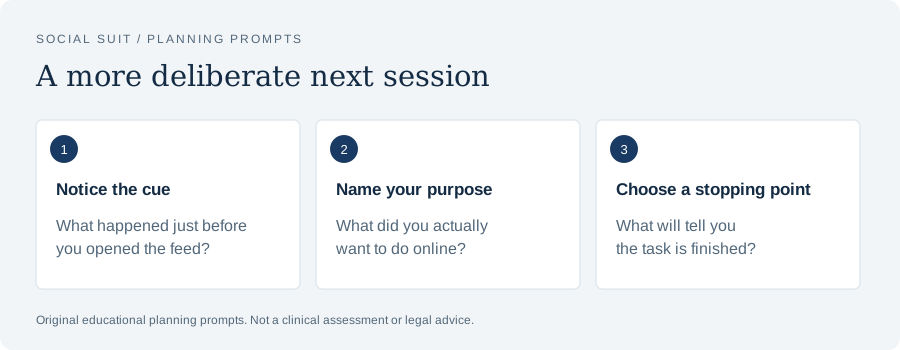
- Notice the cueWhat happened just before you opened the feed?
- Name your purposeWhat did you actually want to do online?
- Choose a stopping pointWhat will tell you the task is finished?
Write a boundary with a clear start and end
A boundary should specify the behavior and the period. 'Use my phone less' leaves both unclear. 'Keep entertainment feeds closed until I have finished breakfast' gives the day a recognizable transition. 'Check routine news through selected sources after lunch' defines a route and opportunity. 'Keep recommendation alerts silent during the work interval' targets delivery. Choose wording that describes what you will actually do. The boundary should be simple enough to remember at the moment it matters and specific enough that you can review whether it served the intended activity.
Include necessary exceptions explicitly. A purposeful message, a required work task, or an urgent update may need attention during the protected period. State how you will handle it without entering unrelated browsing. For example, you could reply through the direct inbox and return to the routine. The exception should describe a function, not a vague permission to browse whenever something seems important. This distinction keeps the plan realistic without making it impossible to observe. A week with several legitimate exceptions can still reveal whether optional drift changes.
Give the boundary a next action. If feeds are closed during breakfast, what does the morning include? If the phone moves from the desk, what work step is visible? If a news session ends, what ordinary activity begins? The alternative should fit the circumstances and require little preparation at the moment of choice. It can be rest or a simple routine, not necessarily productivity. You are creating an available route after the pause. Without one, the boundary may leave an empty decision that the old habit readily fills.
Choose a reminder only if it helps. A timer, a note, or a changed shortcut can support the boundary, but it should not become another stream of alerts. Decide what you will do when the reminder appears. If you repeatedly dismiss it, inspect the plan rather than adding more reminders automatically. The endpoint may be unrealistic, the task may be unclear, or the route may continue to invite browsing. The guide on setting limits you can realistically keep explores how purpose and exceptions make a boundary more usable.
Prepare the environment before the first day
Make the small setup changes that support the question. If recommendations interrupt the protected period, review their alert categories. If an icon prompts automatic opening, move it or choose a direct route to useful tools. If phone placement matters, select a practical location and test necessary signals. If the next activity needs materials, prepare them. These actions should follow the target you selected. Avoid spending the preparation period redesigning every setting. The experiment needs a workable environment, not an elaborate system whose maintenance becomes the main digital activity of the week.
Check all relevant devices. A quieter phone may still leave the same alert on a watch, computer, or tablet. A closed app may remain open in a browser. Duplication can make the boundary appear ineffective when the route simply moved. Identify the surfaces that matter to your target. You do not need to make every device silent; you need to understand where the selected interruption arrives. Preserve accessibility and necessary contact. A review of actual delivery is more dependable than assuming one switch affects every connected device in the same way.
Prepare a simple note format. You could record the day, whether the boundary was useful, one benefit, one cost, and a relevant exception. A few lines are enough. Avoid turning reflection into a lengthy diary unless that is something you independently value. The notes serve the final decision. They should capture what a screen-time report misses, such as feeling less reactive, missing a needed update, or discovering that a community provided important support. The aim is evidence about fit, not a record designed to make the experiment look successful.
Choose the start date with ordinary responsibilities in mind. A week of travel or an acute family situation may require a different design, but there is no need to wait for a life without interruptions. If unusual circumstances are central to the question, include them. If they would overwhelm a narrow test, choose a more representative period. State the context in the notes. This helps you avoid applying a result from an exceptional week too broadly. The reset should teach you about the situation you actually want to improve.
Day one: observe the first opportunities
On the first day, focus on whether the boundary can be carried out. Notice the cue, the preserved function, and the next activity. Do not expect the arrangement to feel automatic immediately. If you reach for the old route, use the moment as an observation. Did the reminder or changed placement create a pause? Did you know what to do next? Was something essential unexpectedly difficult to access? These questions reveal setup problems before you interpret the whole week. Make necessary practical corrections, and note them so the final review knows what changed.
Keep the first note factual. A hypothetical participant might write, 'I checked the transit tool and left without opening the feed, but I was unsure whether a family message would alert.' That note contains both a useful result and a reliability concern. They should test the family route rather than conclude that the whole morning boundary is either excellent or impossible. Another participant might discover that a school task requires the app during the protected period. They can define a direct task route instead of treating the requirement as a breach.
Avoid using the first day to predict the final outcome. Novelty can make a change easier to notice, and unfamiliarity can make it more awkward. Either may change as the week continues. The first day supplies information about implementation. It does not establish a lasting habit or a clinical effect. Keep claims proportional to what happened. If the morning felt easier, note that. If a work interval remained difficult, note the task and interruptions involved. A concrete description will be more useful later than a broad declaration that digital resets always work or never work.
Restore the normal routine after an overrun. One extended session does not require restarting the calendar unless you deliberately choose that for a practical reason. The seven days can include imperfect use and still answer the question. Describe where the session changed and prepare one repair. A rigid restart rule can make the experiment longer and less informative while encouraging you to hide exceptions. Honest observation is the resource you need. The plan should make it possible to learn from the first day rather than demand that the first day resemble the final routine immediately.
Days two and three: distinguish benefit from novelty
As the arrangement becomes familiar, notice whether the useful effect continues. Perhaps the protected breakfast still feels less reactive. Perhaps the moved icon no longer creates a pause. Perhaps a planned checking window reduces uncertainty, while a quiet phone alone increases manual checking. Those are different mechanisms. Record them separately. A reset becomes more informative when you identify what is doing the work. The apparent benefit may come from a clearer task, fewer alerts, a direct route, or a social expectation you clarified before the week began.
Pay attention to useful technology you miss. Missing a supportive exchange or an accessible tool is not evidence that you should ignore the concern. It is evidence about a cost the next arrangement must address. Ask whether a narrower route can preserve the benefit. A direct message, a scheduled community visit, or a specific reference may work. If not, the boundary may need to change. The goal is a sustainable adjustment after the week, and sustainability requires an honest account of value as well as interruption.
Watch for displacement. You might reduce one feed and begin checking another, replace phone browsing with browser browsing, or repeatedly inspect the device report instead. The target was a mismatch, not merely an app name. Describe whether the protected activity actually improved. If it did not, inspect the new route and the cue behind it. A change in platform totals can look impressive while leaving the underlying sequence unchanged. Conversely, totals may stay similar because useful tasks continue, while unwanted interruptions during the selected period decrease. Context determines the meaning.
Keep revisions modest. Correct an essential access problem promptly, but avoid changing every element because one afternoon was difficult. If you revise, state what changed and why. For example, you might move the checking window later because a recurring responsibility makes the original time impractical. The final review can then compare the arrangements honestly. An experiment does not have to remain perfectly fixed to be useful, but unrecorded changes make it harder to know what you learned. A brief note preserves the connection between the adjustment and the observation.
Day four: review the middle without declaring victory
At the middle of the week, ask whether the original question still fits. Has the target become clearer? Are necessary functions working? Is the boundary too broad, too narrow, or misplaced? Read the first few notes and identify one pattern rather than a general impression. You might find that alert changes helped more than a strict time window, or that the window works on ordinary days but needs a defined exception for a recurring duty. The middle review is a chance to make the remaining days more informative.
Do not add dramatic restrictions merely because the plan is becoming familiar. Familiarity may be exactly what a usable arrangement needs. If the protected activity is improving and the cost is acceptable, continue. If the pause has disappeared, inspect the cue and task. The guide on using friction to interrupt a scrolling habit explains why more inconvenience is not always the answer. A small step should create recognition. If it becomes automatic, a purpose question or clearer next action may help more than making access increasingly difficult.
Check emotional and social costs in concrete terms. Are you feeling isolated because an important group is unavailable? Are you anxious because urgent contact is unclear? Are you frustrated by a boundary that conflicts with work? Those concerns deserve practical attention. They do not automatically prove that the old arrangement was ideal. Clarify the route, preserve the useful contact, or adjust the scope. The reset should reveal a workable balance rather than force you to choose between all access and no access. A narrower plan may answer the original question better.
Keep the remaining days ordinary. There is no need to stage a perfect weekend or fill every recovered minute with ambitious projects. Use the space for the activity you intended to protect, including rest. If the experiment makes a meal, a conversation, or a routine easier, that can be enough. A demand to become maximally productive may replace one pressure with another. The question is whether the digital arrangement fits your priorities, not whether seven days produce a dramatic before-and-after story suitable for public display.
Days five and six: test the boundary under variation
The later days often include different schedules or levels of fatigue. Notice how the boundary responds to those changes. A weekday plan may need a weekend version, or an evening routine may need an exception for a late shift. Do not assume that one rule must describe every day identically. The durable part may be the purpose: protect breakfast, finish a work interval, or avoid reopening recommendations after settling down. The timing and route can adapt while the purpose remains clear. Record how the variation affects the result.
If a significant event requires more information, distinguish purposeful monitoring from open-ended browsing. Use the appropriate source and preserve necessary updates. A reset should not prevent you from responding to real circumstances. At the same time, an event can create a broad permission to remain in a feed long after the useful question is answered. Name the question, the source, and the next review point. The guide on a practical way to reduce doomscrolling explains how to handle uncertainty without treating continuous refreshes as the only form of informed attention.
Review a setback through the sequence. What began the visit? What was the original purpose? Where did it change? What support was missing? Restore the next normal boundary and add one practical adjustment if needed. You do not need to compensate with an extreme restriction for the remaining days. A setback can reveal the conditions the final plan must handle. If you hide it or turn it into a sweeping judgment, the week loses useful information. The review should make tomorrow more workable, not make yesterday look acceptable after the fact.
Also notice when the plan works without much effort. Perhaps a direct bookmark now leads to a useful group and back to the next activity. Perhaps the family urgent route is clear enough that manual checking decreases. Perhaps preparing the hobby materials makes the phone less relevant during the selected period. Those observations identify supports worth keeping. A sustainable routine often depends on several ordinary conditions lining up, not on a constant feeling of determination. The later days can show which conditions remain useful after the novelty of the experiment has faded.
Day seven: compare the question with the evidence
On the final day, return to the original sentence. What did you want to learn, and what do the notes actually show? Summarize the protected activity, useful access preserved, inconvenience encountered, and changes made. Avoid claiming more than the week supports. If mornings felt easier during the test, say that. Do not infer a medical improvement or a permanent habit from seven days. If the arrangement did not help, identify whether the target, route, timing, or next activity needs reconsideration. An honest inconclusive result can still guide a better next question.
Use both qualitative notes and any relevant device numbers. A lower total can support the observation that optional visits decreased, but it cannot establish why. A stable total may reflect continued work or communication while the selected boundary improved. Read the report in context. Compare similar days where possible and note unusual events. The result should describe your experience, not rank you against another person's usage. Different responsibilities and benefits make those comparisons unreliable as a practical guide. The important comparison is between your intention and the arrangement you tested.
Choose one of three next steps: keep the useful boundary, revise it, or remove it and pursue another approach. Keeping can mean preserving only part, such as quieter recommendations and a direct source route. Revising can mean changing the period or restoring a useful community through a narrower path. Removing can be sensible if the cost outweighed the benefit. The experiment is not a contract to defend the original idea. Its output is a concrete decision based on observations, with any uncertainty made visible.
Write the next arrangement in simple terms. Include the purpose, the preserved functions, the response route for urgent contact, and a review point if one is needed. This turns the week's lesson into something usable. Avoid a large list of rules assembled from every successful moment. Choose the smallest arrangement that addresses the mismatch. A simple plan is easier to remember, explain, and adapt. It can become part of ordinary life rather than a permanent reset that demands daily proof of commitment.
Interpret sleep and mood observations carefully
You may notice changes in evening ease, sleep, mood, or concentration during the week. Those observations matter, but many factors can influence them. A different schedule, stress level, workload, illness, or social event may have changed too. Describe what you noticed without assuming the digital boundary caused it. A personal experiment can identify a useful routine and questions to discuss, but it is not a controlled study or a clinical assessment. Keeping that distinction allows you to value the experience without building a stronger claim than the evidence supports.
The National Heart, Lung, and Blood Institute's healthy sleep guidance discusses supportive routines and avoiding bright artificial light near bedtime. That is relevant background if your reset targets evenings. It does not promise that moving a phone or closing a feed will resolve a sleep problem. Keep the practical question narrow: did the boundary make the evening sequence easier to follow, and did necessary overnight access remain reliable? Persistent sleep concerns deserve appropriate healthcare advice rather than a longer or harsher digital experiment by default.
Similarly, if the week reveals distress or difficulty stopping that affects everyday functioning, seek qualified support. Bring specific examples of intention, behavior, impact, and the changes you tried. Mention useful online connections you want to preserve. A professional can consider the broader situation, including sleep, mood, stress, relationships, and other circumstances. You do not need to prove an addiction label before asking for help. The reset's notes can make the conversation clearer, but they should not be treated as a self-administered diagnostic test.
Avoid turning a good week into a universal prescription. An arrangement that fits your work, household, and accessibility needs may not fit someone else. Share the question and the practical reasoning if you discuss the experience, rather than presenting the schedule as a guaranteed solution. A person who needs frequent device access may still benefit from a narrower change. Another may find a different target more important. The useful lesson is how to design and review a question, not that everyone should reproduce the same seven days.
Design a family reset without making it a contest
If several household members participate, decide what each person wants to learn. They may not need identical boundaries. A child might focus on recommendations during homework, an adult on work messages after hours, and another person on a calmer breakfast. A shared activity can provide a common purpose, while individual functions remain available. Talk about school, work, accessibility, caregiving, and supportive contact before setting the week. The household should understand what is changing and why. A contest over who has the lowest total is unlikely to capture those differences fairly.
For children and teenagers, include their account of useful and difficult experiences. The U.S. Surgeon General's advisory on social media and youth mental health discusses potential benefits, risks, and protective action. It does not assess an individual child's reset. Use that broader concern as context for practical decisions about sleep, schoolwork, safety, and connection. Adults can model their own boundary and review rather than asking only young people to change. A shared purpose is more credible when the adults' use is also open to ordinary discussion.
Keep the daily review short and nonpublic. Ask what became easier, what was missed, and what needs a different route. Do not require a child to present embarrassing details or distressing content to prove a difficulty. If a safety concern emerges, respond with appropriate support and careful handling rather than treating it as a rule violation. The reset is one part of a relationship in which a young person can ask for help. Settings and schedules cannot resolve every harmful interaction or health concern by themselves.
At the end, choose a household arrangement that reflects the actual findings. Perhaps the shared meal boundary helped while a blanket app restriction blocked school coordination. Keep the meal routine and revise the app access. Perhaps the urgent contact route needs to be clearer. Test it. The review should not automatically extend the strongest restriction because the week was quiet. Quiet may have a cost the notes reveal. A useful family experiment balances protected activities with reliable access and gives each participant understandable reasons for the next plan.
Account for work and school obligations
A reset should distinguish required digital tasks from optional browsing around them. If you need a platform for assignments, define the direct task: find the instruction, submit the work, or contact the relevant person. If you need it for employment, define the required response window and work product. Do not assume that a general wellbeing experiment overrides those responsibilities. Where expectations are unclear, ask for clarification before relying on silence or absence. The practical target may be redundant notifications or recommendation drift rather than access to the essential service.
Use a visible completion point for required tasks. A student could write the assignment requirement in a separate note and return to the work outside the feed. A worker could record the next action in the task system rather than continuing to monitor reactions. These examples are hypothetical and need to fit actual rules and tools. Their shared principle is to move from information delivery to the work it supports. The platform should not remain open merely because it supplied the starting instruction. Completion gives the visit a reason to end.
Consider schedules that vary. Shift work, on-call duties, examination periods, and deadlines may require a boundary tied to activity rather than a clock time. 'After my shift ends' or 'During the selected study interval' may be more useful than a conventional evening rule. Preserve the necessary alert route and test it. If your role leaves little room to alter delivery, focus on the parts you control and acknowledge the limitation in the final review. A reset that claims control you do not have will produce frustration rather than useful evidence.
After the week, discuss any coordination lesson with the appropriate person if needed. Perhaps routine messages do not require immediate replies, or several systems deliver the same task. A clear agreement can support a sustainable change more than a private setting alone. Keep the discussion concrete: what information must arrive, when it must be reviewed, and which route is authoritative. The guide on making work messages less constant explores those expectations. The reset can reveal the question, but workplace or school arrangements may need their own review.
Keep the final plan lighter than the experiment
An experiment may require more observation than the routine that follows. Once you know which change helps, reduce the recordkeeping. You do not need to continue writing a daily report unless it serves another useful purpose. Keep a brief note of the arrangement and the reason for it. Review when a responsibility changes, an app behaves differently, or the original mismatch returns. This lets the plan become ordinary. The attention you recover should not be permanently consumed by monitoring the success of the recovery.
Allow a reasonable exception without reconstructing the whole week. Travel, illness, a family event, or an unusual duty may justify temporary access. State what changed and when the ordinary arrangement will be reconsidered. A clear temporary plan is more useful than pretending an exception did not happen or allowing it to erase every boundary indefinitely. The purpose remains your guide. If the exception serves a real need, preserve it. If it leads to unrelated drift, address that route specifically after the need has passed.
The social media resource collection connects reset planning with notifications, friction, limits, sleep, and research. Use the relevant guides to refine the part that mattered in your notes. A seven-day reset is not the only way to change a routine, and it need not become a recurring ritual unless that fits your goal. Its distinctive value is a bounded opportunity to compare an intentional arrangement with the old sequence. The final decision should carry that useful information forward in the simplest practical form.
A well-designed reset ends with knowledge rather than a verdict. You know more about the cue, the route, the useful function, and the activity you want to protect. You have tested necessary access and identified costs. You can keep a helpful boundary, revise an awkward one, or seek support for a concern that needs more than settings. Seven days do not have to transform every digital habit to matter. They can answer one honest question and give the next ordinary week a clearer, more workable arrangement.
If you use a shared calendar, record the next review there only when a reminder serves a practical purpose. Otherwise, keep the plan beside the activity it protects. The location of the note should make the arrangement easier to remember without creating another notification to manage.
Sources and further reading
These primary resources provide context. Our practical examples and planning suggestions are original educational material, not validated treatment protocols. Linked organizations do not endorse Social Suit.