 Social Suit
Educational information, not individual medical or legal advice. Practical examples are hypothetical and do not describe clients or study participants. This article is not represented as reviewed by a clinician or attorney. How we prepare our guides.
A baseline should answer a decision
A screen-time baseline is a short record of your current use before you change something. Its purpose is to help answer a practical question. You might want to know which sessions delay bedtime, whether notifications interrupt homework, or how much optional browsing occurs during the workday. Without a question, a report can become a collection of numbers that invite judgment without explaining what to do. Begin by writing the decision you want the record to support. Keep it narrow enough that several ordinary days can provide useful information.
For example, “I want to protect the first study interval after dinner” gives you a setting to observe. “I want to understand why I lose the last hour before bed” gives you a sequence to examine. “I want to check whether direct messages or recommendation alerts produce most openings” gives you two routes to compare. These questions lead to different records. A total for the entire week may not answer any of them. The record should serve the decision, rather than require you to design your life around whatever categories a device report happens to display.
This guide offers an original planning method for everyday use. It is not a clinical screening tool, a validated treatment program, or a way to determine legal eligibility. A high total does not establish an addiction or prove that a platform caused a symptom. A low total does not mean every session was beneficial. The useful information lies in the relationship between purpose, content, timing, and effect. By adding a small amount of context to device numbers, you can identify a more precise starting point for a boundary, a conversation, or a professional assessment when one is appropriate.
Define what counts before comparing days
People often use screen time to mean different things. One person includes every minute the phone screen is active. Another means entertainment apps only. Another is concerned specifically about social media feeds. Decide what your question requires before collecting a baseline. If you want to understand social media browsing, separate it from maps, authentication tools, medical interfaces, school assignments, and accessibility functions where possible. If the app contains several functions, note that its reported total may mix messages, groups, searches, and recommendations.
Do not pretend your categories are more precise than the available information. A device may show one app total without revealing how much was spent messaging versus watching clips. Your notes can describe a few relevant sessions, but they do not necessarily reconstruct every minute. Use labels such as “mainly direct messages” or “mostly recommendation feed” when that is what you know. A rough, honest distinction is more useful than an exact-looking estimate invented after the fact. Write any uncertainty beside the number so that you remember the limitation during review.
Keep the definition consistent across the baseline. If you count browser-based social media on one day, include it on the others where you can. If you cannot measure use on another device, note the gap. If schoolwork occurs in the same app as entertainment, explain that overlap. Consistency does not require perfection. It requires knowing what changed between comparisons. Before concluding that Friday's total fell, ask whether you used a laptop instead of a phone or whether the device report covers a different period. A baseline becomes useful when its boundaries are explicit enough to prevent those ordinary differences from becoming misleading conclusions.
Choose a manageable observation period
Choose a period that contains the situations you want to understand. Three ordinary days can be a reasonable starting example for someone who finds logging burdensome. A week may be useful when weekday and weekend schedules differ. If your question concerns a particular evening routine, you might record only that routine across several nights. This article does not prescribe one period for every reader. The record should be long enough to show a recurring pattern and short enough that you actually maintain it without creating another source of stress.
Avoid beginning during an unusually disrupted week unless the disruption is the question you want to examine. Travel, illness, a deadline, a family event, or a school holiday can change use. Those days may still matter, but they should be labeled. A baseline collected only during vacation may not describe a normal workday. A record collected during an exam period may not reflect an ordinary school week. If you use an unusual period, state why and compare it with similar future conditions rather than treat it as a permanent account of your behavior.
Set a review date at the start. Without one, you may keep collecting data while postponing the decision. Write the date and the question at the top of the page. At review, you can decide whether the record is sufficient, whether one gap needs another observation, or whether the next step is already clear. Do not extend the baseline merely because a larger dataset sounds more impressive. If several nights clearly show that browsing begins after an unresolved work message, the useful next action may be to address that sequence. More totals will not necessarily provide a better explanation than the pattern you can already describe.
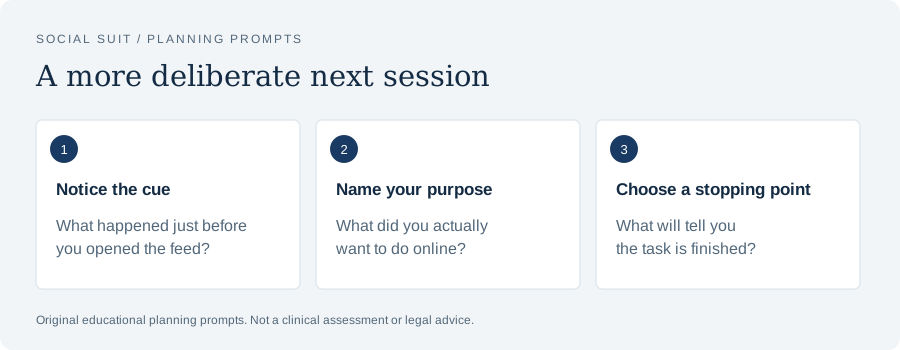
- Notice the cueWhat happened just before you opened the feed?
- Name your purposeWhat did you actually want to do online?
- Choose a stopping pointWhat will tell you the task is finished?
Read the device report with its limitations in view
Device reports can provide app totals, pickups, notifications, and time-of-day patterns, depending on the system and settings. The exact controls and definitions can change. Use the current report on your device and read any explanatory labels before relying on a number. Ask which devices are included, whether background activity is counted, and what period the report covers. If you are unsure, keep the figure as a rough indicator rather than describe it as a precise measurement of attention. A screen being active is not always the same as a person actively attending to the content.
Take a simple snapshot of the relevant period. You might note the top apps, the hours with the most activity, and the number of pickups if those measures help answer your question. Do not copy every category automatically. If bedtime browsing is the issue, a daily total alone may hide the late-night cluster that matters. If repeated openings interrupt work, a modest total with many pickups may still be relevant. If an app is required for work, its position at the top of the list may say little about optional browsing unless you add context.
Consider the report a prompt for questions. “Why was this app active after midnight?” is a question. “This number proves I am addicted” is a conclusion the report cannot establish. “Why did pickups rise on the day I was waiting for transport?” invites context. “My total fell, so the plan fixed everything” overlooks whether the activity simply moved elsewhere. The report is most useful when paired with a small number of observations about purpose and impact. You can then decide which setting is worth changing, rather than turn the device's categories into a verdict about your character or health.
Add purpose to a few relevant sessions
For each session that matters to your question, note what you intended to do. This can be a brief phrase: answer a friend, check a school group, find a recipe, read news, relax, or look for a distraction. If you had no clear intention, write that. Purpose helps distinguish a session that fulfilled a need from one that drifted into unrelated content. It also shows which useful functions a boundary should preserve. Removing an entire app without noticing its purpose can create a new problem while leaving the original pattern unexplained.
An example entry might read: “Opened at 8:10 to answer the project group. Answered by 8:15, then watched suggestions until about 8:45. Planned study start was 8:20.” The first part was purposeful and the later part displaced the intended activity. Another entry could read: “Opened the hobby group for fifteen minutes, got an answer, returned to cooking.” That session may be worth preserving. Include both kinds of examples. A record containing only unwanted sessions can make it seem as though every online interaction is a problem, even when the same app provides valuable contact or information.
Keep purpose separate from what happened. “Relax” is the intention; “felt more agitated after comments” is the result. “Get an update” is the intention; “kept refreshing after no new information appeared” is the result. The mismatch may suggest a different source, a clearer stopping point, or an alternative activity. You do not need to decide in advance which response is correct. The baseline's job is to show the relationship. For the opening moment itself, read Why you open an app without deciding to, which examines cues that can be lost when a report records only duration.
Record timing without demanding perfect recall
Approximate timing is often enough for an everyday baseline. Note when the relevant session began and ended, or write a rough duration if that is easier. If you do not remember precisely, say so. Avoid reconstructing an exact minute count simply because a neat table seems more credible. The useful question may be whether a session continued past the planned bedtime or delayed leaving home, not whether it lasted thirty-seven rather than forty minutes. Device reports can support recall, but they may not distinguish the particular session from another use in the same hour.
Record the intended stopping point when there was one. “Planned to stop after replying” differs from “planned twenty minutes of entertainment.” “Meant to close the app when the bus arrived” identifies an external signal. “No stopping point” is also useful. A session that has no chosen end presents a different planning problem from one that repeatedly passes a clear end. You can then test a boundary that fits the mechanism you observed: a return action after replying, a timer as a reminder, or a saved item with an obvious conclusion.
If a session is interrupted by necessary use, note the interruption rather than force it into an exact category. A caregiver may browse for ten minutes, answer an important call, then resume. A student may move between class material and messages. A worker may need a phone function during a protected interval. These are ordinary complications. The baseline should be accurate enough to respect them. At review, focus on repeated sequences you can explain confidently. If a question requires greater precision than your record provides, choose a targeted additional observation rather than pretend the existing numbers are a complete reconstruction of your attention.
Note what the session displaced
The effect on the day is often more informative than duration alone. Ask what you intended to do during the time the session occupied. A long planned conversation may fit your evening. A shorter unplanned feed check may cause you to miss a train. A few brief openings may repeatedly interrupt a difficult task. Write the displaced activity in concrete terms: started homework late, postponed shower, missed part of dinner conversation, delayed preparing lunch, or returned to work without finishing the planned section. Avoid broad labels such as unproductive when a specific description is available.
Include activities you chose for enjoyment or rest, not only obligations. If scrolling repeatedly replaces a hobby you genuinely wanted to do, that is relevant. If you intended to sit quietly but ended up reading upsetting comments, the mismatch matters even if no deadline was missed. Conversely, an intentional session of entertainment may be the rest you wanted. The baseline should not define every minute without an output as failure. Its purpose is to protect what matters to you, including leisure, connection, and recovery from demanding responsibilities.
At review, look for the activity that most consistently loses time. That may be the best first boundary. A plan to protect breakfast is more concrete than a plan to improve life generally. A plan to finish the first study interval before opening feeds can be evaluated. A plan to keep a conversation uninterrupted gives you a setting to practice. Read When social media use starts to feel out of control for a broader discussion of interference, and Setting limits you can realistically keep to turn the recurring mismatch into a practical boundary.
Include how you felt without claiming a cause
A brief note about how you felt before and after can reveal useful patterns. Use ordinary descriptions: tired, connected, irritated, calm, lonely, interested, or overwhelmed. You do not need a precise scale unless you find one helpful. The note is your report of the experience, not proof that the app caused the feeling. Several events may have occurred during the same period. A session may begin because you already felt distressed, and the content may or may not change that feeling. Keep the sequence visible without forcing a single explanation.
For example: “Worried before checking news; still worried after twenty minutes; no new information.” This entry may suggest that repeated updates were not answering the need for certainty. “Lonely before messaging a friend; felt connected afterward” identifies a use worth preserving. “Tired before recommendations; more frustrated afterward; stayed later than planned” describes a concern that might involve both content and timing. The baseline can show which sessions tend to help you meet a purpose and which leave the original need unmet. It cannot diagnose the reason for every change in mood.
The APA advisory on adolescent social media use emphasizes the importance of individual characteristics, context, and content, and describes limits in causal evidence. That supports careful interpretation rather than a blanket conclusion from a few observations. If symptoms are persistent or impair daily functioning, discuss them with a healthcare professional. Bring the record as one piece of information, not as proof of a diagnosis you expect them to confirm. A professional may consider several areas of life because the online pattern can exist alongside other concerns that also need attention.
Separate content categories when they matter
If your question involves the effect of the feed, add a short content description. You might note direct conversation, hobby information, news, appearance-related content, arguments, recommended entertainment, or work coordination. Use the broadest category that answers your question. You do not need to reproduce posts or save private messages. A description such as “comments on a contentious news clip” may be sufficient. Keeping the record proportionate protects privacy and reduces the chance that logging becomes another reason to keep viewing material you wanted to leave.
Compare the categories with purpose and result. Did a direct conversation provide connection while open recommendations left you unsettled? Did a search answer the question while browsing afterward delayed the next activity? Did a specific account repeatedly lead to content you did not want? These observations may suggest a content control rather than a blanket time limit. You could unfollow, mute, block, report, or change how you access information, depending on the current platform options and situation. Check the available controls rather than assume a particular feature exists in the same form on every app.
If the content involves threats, harassment, sexual exploitation, or immediate safety concerns, address those directly. A baseline is not the first priority in an emergency. A minor may need a trusted adult's support. Preserve only the information needed for an appropriate report and avoid distributing harmful material. For repeated distressing news consumption, read A practical way to reduce doomscrolling. For open-ended clips, see Recognizing the short-video rabbit hole. Timing, content, and access can all matter, but the baseline helps you choose which part of the pattern needs attention first.
Keep necessary use visible
Necessary use can make a total look high without explaining the unwanted pattern. Work, caregiving, school, disability access, and family coordination may require substantial time on a device. Mark these functions explicitly. If you cannot separate their minutes precisely, write a note about the overlap. A person whose phone is a communication tool should not interpret a comparison with someone else's entertainment total as a meaningful health assessment. A baseline should describe your own needs, not force your circumstances into a model designed around someone who uses the device differently.
An example day might include navigation during a long trip, several caregiver calls, and a brief feed session. Another day might include none of those necessities but a longer evening of recommendations. The total may be similar while the practical question differs. Label the necessary functions so that you do not accidentally target them when choosing a boundary. If the unwanted pattern occurs around a necessary use, focus on the transition. Answering an important message may be appropriate; drifting into the feed afterward may be the part you want to change.
Check whether an proposed adjustment preserves access. If you move the phone away during work, can an essential contact reach you? If you silence alerts, do you know which exceptions apply? If you replace an app with a browser route, does the needed group or tool work reliably? Test before relying on the change. See Making your notifications less demanding for an alert review and Using friction to interrupt a scrolling habit for access changes. The baseline should lead to a plan that respects necessary functions while reducing the optional pattern you actually identified.
Compare similar days and situations
A comparison is most useful when the situations have enough in common. Compare school days with school days, work shifts with similar shifts, or ordinary evenings with ordinary evenings. A weekend may offer more leisure time, different social needs, and fewer external stopping points. A day with a long commute may produce a different use pattern than a day at home. Record those differences before interpreting a rise or fall. You can learn from varied days, but you should not assume that the largest difference in total minutes reflects the success or failure of your self-control.
If you have only a short baseline, compare repeated settings within it. Did the same waiting period prompt an opening on several days? Did the study start move later each time a notification appeared? Did bedtime browsing follow unfinished work? These sequences can be more useful than comparing the entire daily totals. A boundary designed around one setting may work even when overall use remains similar because another intentional activity takes its place. Keep the outcome tied to the decision you wrote at the beginning: the protected study interval, the calmer evening, or the more deliberate opening.
Avoid comparisons with friends or online averages unless the context is truly relevant. Different jobs, disabilities, households, and devices produce different totals. A number offered in a discussion is not necessarily measured in the same way as your report. It may omit laptop use, count background activity differently, or include an unusually busy week. The baseline is not a contest to have the smallest screen-time figure. It is a record that helps you decide where your current pattern fits your intentions and where a change would protect something important. That question can be answered without ranking your life against someone else's report.
Make a one-page baseline template
A simple template can have seven fields: date and setting, approximate timing, intended purpose, cue before opening, main content or function, effect on the next activity, and a short feeling note. Add an uncertainty field if needed. You can write one line per session that matters to your question. Do not feel obliged to fill every field perfectly. If you forget the cue, say unknown. If the timing is approximate, label it. The template should make the review easier rather than become a requirement that delays returning to the activity you intended to do.
Here is a complete example in prose: “Thursday after dinner; about 7:30 to 8:10; intended to check the class group; cue was a message badge; answered two questions, then recommendation feed; homework started about twenty minutes later than planned; tired before and irritated afterward; timing approximate.” A useful session might read: “Friday lunch break; fifteen minutes; intended to message a friend; opened deliberately; direct conversation; returned to work on time; felt connected; no significant uncertainty.” Recording both examples helps identify the transition that needs attention while preserving the function you value.
At the bottom of the page, leave space for three review questions: What repeats? What do I want to preserve? What is the smallest change worth testing? Those questions turn a record into a decision. If the answers are vague, return to one concrete session. If the record shows several different patterns, choose the one with the clearest impact first. You can examine another later. A manageable baseline is more useful than a detailed archive that remains unread because it feels too large to interpret. The next action should be visible enough that you can explain why it follows from what you observed.
Do not let measurement become punishment
A baseline can lose its purpose if every entry becomes a reason for criticism. Avoid adding moral labels to the numbers. “Forty minutes of recommendations delayed lunch preparation” describes an event. “Forty wasted minutes because I am hopeless” adds a judgment without improving the information. If logging increases distress or conflict, reduce the scope or stop and reconsider whether a different approach is appropriate. The record is optional. You do not need to complete it before asking for professional help, discussing a boundary, or addressing an immediate safety concern.
Parents and partners should be especially careful about how a record is used. Agree on the purpose and what information will be shared. Do not publish another person's report, use it to humiliate them, or turn a private conversation into a comparison with others. A parent may have legitimate responsibilities for a child's safety, but that does not make every detail of every conversation necessary for a habit baseline. Focus on the setting and effect relevant to the shared question. If a young person reports serious online harm, respond to that concern rather than insist on a complete log first.
For adults, support can mean reviewing the pattern together and helping prepare a practical alternative. It does not need to mean that someone checks every app opening. Ask which reminders are welcome and which feel intrusive. A person may prefer a shared device place during dinner but not commentary on every daytime session. Keep the agreement specific. If the baseline becomes a recurring argument, the communication problem may deserve attention separately from the screen-use pattern. An informative record should increase clarity about the next step, not create a system in which every number can be used against the person collecting it.
Keep the record private and proportionate
An everyday baseline does not require sensitive screenshots, copies of private messages, or account credentials. Store the notes in a place appropriate for their sensitivity. A paper notebook may be sufficient. A private digital note may be convenient, but check who can access the device or shared account. Avoid public documents when the record includes personal feelings, family circumstances, or health concerns. If you use a tool that processes information externally, consider whether you need to enter identifying details at all. The simplest record often carries less privacy burden.
If you share the baseline with a professional, ask what format is useful. A short summary and a few examples may be more practical than a large export. Keep original records intact when relevant. Do not alter screenshots or fill missing details with guesses. If the concern involves another person, obtain appropriate permission and avoid accessing accounts without authority. A teenager's baseline, a partner's message history, and your own device report are not interchangeable sources. Collect only what is needed for the question you are actually trying to answer.
Do not send medical records, identity documents, or detailed private messages to ordinary website support email. Social Suit's support address is for website questions and corrections. If you are considering a legal review, use the appropriate intake route and read the recipient's privacy information before submitting sensitive material. The social media harm information page offers general context and an optional independent intake link; it does not determine eligibility. A baseline can support your personal understanding, but it is not a substitute for an individual legal assessment or a reason to collect more private information than a qualified professional actually requests.
Turn a repeated pattern into one experiment
At review, identify one repeated sequence and write it in a sentence. “After answering the class group, I enter recommendations and begin homework late.” “While waiting for a work file, I open a feed and do not return when the file is ready.” “After checking tomorrow's schedule, I keep browsing in bed.” Each sentence suggests a different point of change. Choose the smallest step that addresses that point. You might prepare an exit action, keep the needed screen visible, alter an alert category, or move optional browsing to a planned period.
State what the experiment should protect. If the baseline concerns homework, the outcome could be beginning the first interval at the planned time. If it concerns bed, the outcome could be ending optional browsing before the evening routine starts. If it concerns conversations, the outcome could be completing dinner without unrelated checks. A reduction in total minutes may occur, but it does not have to be the only measure. The protected activity is often the more meaningful result because it connects directly to the reason you gathered the baseline in the first place.
Keep the next observation simple. Record whether the boundary was practical, whether necessary access remained, and what changed in the relevant setting. Do not repeat the entire baseline indefinitely if a short follow-up answers the question. Read Designing a seven-day digital reset for a structured experiment and What to do after a scrolling setback for revising it. If the first idea does not help, use the result to choose a better one. A useful baseline is successful when it produces a clearer decision, not when it produces a particular number that makes the record look impressive.
Evaluate results without overclaiming
After a change, compare the setting you chose with the baseline. If homework began on time more often, say that. If the late-night session moved earlier, say that. If necessary messages were missed, note the cost. If the pattern did not change, keep that result visible. Avoid attributing every improvement or difficulty to the device adjustment when other circumstances also changed. A quieter week at work, a school holiday, illness, or a visit from family can alter routines. An honest review describes the change and its context rather than manufacture certainty.
You might find that the total stayed similar while the placement improved. A person could browse intentionally after lunch instead of during the first work interval. Another could keep a useful evening group conversation but stop entering unrelated recommendations afterward. These outcomes may fit the original goal. Conversely, a lower total may not address the problem if the remaining sessions still interrupt sleep or expose you to upsetting content. Return to the question at the top of the baseline. Did the experiment protect the activity or reduce the mismatch you wanted to understand?
Decide whether to keep, revise, or replace the change. Keep it if it is useful and practical. Revise it if a specific obstacle remains. Replace it if it addresses the wrong cue or creates a larger problem. If the pattern is persistent and affects daily functioning, a professional conversation may be more appropriate than another round of increasingly strict settings. The record can help you explain what you have observed and tried. It should not become a requirement to prove that you have exhausted every self-management option before you are allowed to ask for assistance or discuss concerns about your health.
When symptoms need a broader assessment
Screen-use notes can be one part of a health conversation, but they cannot explain every symptom. If you have persistent distress, difficulty completing ordinary responsibilities, significant sleep or appetite changes, or a loss of interest in activities, consider appropriate professional support. The NIMH guide on deciding when to seek help recommends considering severity, duration, and effect on daily life. You can bring a brief baseline without presenting it as proof of cause. A clinician may ask about several areas because the online pattern and other difficulties can coexist.
Prepare a concise summary: what changed, roughly when, what responsibilities were affected, which online patterns you noticed, and what you tried. Include uncertainty. “I noticed later browsing during the same month my sleep worsened” is more accurate than asserting a cause you cannot establish. “I turn to the feed when I feel isolated” describes a sequence worth discussing. The professional may help assess whether the plan needs broader support, a different explanation, or attention to several factors. A habit boundary can remain useful without becoming the entire response to a more serious concern.
If someone has thoughts of suicide or urges to harm themselves, seek immediate assistance. In the United States, call or text 988, and call 911 for a life-threatening emergency, as explained by NIMH. Do not wait to finish the baseline or analyze the device report. A resource article and website support email are not crisis services. Address safety first. The record can wait. That priority does not depend on proving that social media contributed to the situation, obtaining a diagnosis, or deciding whether any legal process might be relevant later.
What the baseline can contribute to legal questions
If you are considering legal options related to serious harm, a factual timeline may be useful for your own understanding and for a qualified professional's review. A screen-time baseline can describe recent habits, but it is not necessarily a record of earlier events and cannot establish a claim's viability by itself. Applicable law, deadlines, facts, and evidence require individual assessment. Do not assume that a high total, a symptom, or a particular platform name means a claim qualifies. Keep the practical habit decision separate from the legal question so that neither distorts the other.
If you document a history, distinguish contemporaneous records from later recollection. Keep original material where appropriate and identify approximate dates honestly. Avoid editing information to make it fit an expected account. Do not collect another person's private messages or access an account without authority. Ask the relevant professional what is needed before creating a large archive of sensitive material. More information is not automatically better if it adds privacy risks or obscures the events that matter. A truthful, organized summary with clearly marked gaps may be more useful than an exhaustive but unreliable collection.
Social Suit's social media harm information page provides general information and links to an independent intake destination. Following the link is optional; it does not establish a professional relationship with Social Suit or guarantee eligibility, compensation, or an outcome. Read the recipient's privacy practices before sharing sensitive information. Do not postpone healthcare or immediate safety measures while exploring a legal review. The baseline's value for everyday decisions does not depend on a claim proceeding. It can help you protect sleep, study, work, relationships, and chosen activities even when the legal question remains uncertain or no claim is pursued.
A final review before choosing the next step
Look at the record once more and answer the question you wrote at the beginning. If the answer is clear, choose the smallest useful experiment. If it is not, identify the particular missing detail rather than collect everything again. You may need to observe the transition after a message, note the first cue at bedtime, or separate necessary work from optional browsing. Targeted observation is more manageable than a second broad week of totals. The baseline should reduce uncertainty about a decision, not expand indefinitely because there is always another number available.
List what you want to preserve. This might include direct contact, a helpful community, accessibility functions, needed information, and entertainment you choose intentionally. Then list the mismatch you want to change. Keeping both lists visible supports a boundary that fits your circumstances. If the first experiment disrupts something useful, revise it. If the result is mixed, describe both the benefit and the inconvenience. If the concern goes beyond an ordinary habit, use the record to prepare a professional conversation rather than expect another device control to address every aspect of the problem.
Your most useful baseline is not necessarily the longest or most precise. It is the one you can understand, keep private, and translate into a practical decision. A few accurate examples can show where an automatic opening begins, where a session drifts, and what activity needs protection. The numbers can support that account, but they do not replace it. Start with the ordinary setting that matters to you, observe it honestly, and choose a change you can evaluate. From there, keep learning from the result while respecting necessary use, personal context, and the limits of what a screen-time report can tell you.
Sources and further reading
These primary resources provide context. Our practical examples and planning suggestions are original educational material, not validated treatment protocols. Linked organizations do not endorse Social Suit.