 Social Suit
Educational information, not individual medical or legal advice. Practical examples are hypothetical and do not describe clients or study participants. This article is not represented as reviewed by a clinician or attorney. How we prepare our guides.
Define the learning objective before the app boundary
A useful study boundary protects a learning objective. Begin by deciding what you want to understand or complete in the next session. You might explain a concept, solve a defined set of problems, compare evidence in two readings, or draft an outline for an assignment. 'Study for a while' leaves the task and its endpoint unclear. A specific objective gives you a reason to keep entertainment separate, while allowing online tools that actually help the work. The boundary serves learning rather than becoming the only accomplishment of the session.
Write the objective in terms you can check afterward. For a concept, plan to explain it without copying the source. For a calculation, plan to show the steps and review mistakes. For a reading, plan to identify the author's question and supporting evidence. For writing, plan to produce a usable outline or draft section. These examples are planning choices, not a claim that one method works for every learner. Match the objective to your course, instructions, access needs, and current understanding.
Gather the materials before starting. Open the assignment, locate the relevant source, and identify any tool required for the work. A missing document can send you through several apps and create an opening for unrelated content. Preparation should be proportionate: enough to begin the chosen action, not a long ritual that postpones studying. If you cannot find a required item, make that search the explicit first task and set an endpoint for it. Once the material is located, return to the learning objective.
Keep health claims separate from study planning. A difficult session does not diagnose an attention condition, and avoiding social media does not guarantee improved grades or well-being. The NIMH guidance on caring for your mental health discusses priorities, self-care, and support. This guide offers practical ways to organize a session. If persistent symptoms or distress are affecting learning and daily life, appropriate professional support may be needed alongside any change to your study environment.
Sort online tools by what they do for this objective
List the digital tools the objective actually requires. These may include a course portal, a document, a calculator, a research database, a communication tool, captions, translation, or an accessibility feature. Then list the apps or routes that usually send you elsewhere. The same app can appear in both lists if it provides useful collaboration and an unrelated feed. Do not assume a tool is either entirely useful or entirely distracting. Identify the function you need and the surrounding route that may expand beyond it.
For each required function, describe the smallest workable interaction. You might download one reading, ask one question, retrieve a citation, or submit one file. A defined interaction has an endpoint. 'Check the class group' can become reading every discussion, while 'ask whether the assignment uses the revised rubric' has a purpose. The boundary should preserve the function and make its completion visible. Once the function is complete, return to the objective rather than treating the app's remaining material as part of the assignment by default.
Use direct routes where practical. Open the course resource from the portal, visit the source you need, or enter the specific conversation. Features vary, so use current official instructions for shortcuts or focused views. If a platform cannot separate the necessary function from recommendations, write the purpose before opening it and leave when the purpose is finished. You may also discuss a different collaboration route with classmates if everyone agrees and it remains accessible. Do not create a new tool requirement without considering the people who must use it.
Review whether the tool list is realistic. Some assignments require extensive online research, and some learners depend on a phone as their main device. A blanket instruction to disconnect may make the work impossible. A better plan separates purposeful use from unrelated expansion. Keep the needed connection and design around its risks. The aim is not to prove that studying can happen without technology; it is to keep the chosen learning activity identifiable while using the technology that supports it.
Give collaboration an agreed route and timing
Classmates can provide useful clarification, accountability, and discussion. Decide what collaboration belongs in the current session and how you will access it. You may need a scheduled conversation, one question in a group chat, or a shared document. State your expected response window when appropriate. If you will check replies after working through the first exercise, say so. This reduces the need to monitor the conversation continuously and helps others understand that a delayed reply is part of the study plan.
Distinguish a question that blocks the current task from one that can wait. If the assignment instructions are ambiguous in a way that changes everything, clarification may be the first priority. If you are unsure about a later example, you may be able to continue with the current material and review the answer at the planned check. Write the question clearly so another person can respond usefully. A vague message such as 'I do not understand anything' may be honest but can require a longer conversation than the immediate need.
Avoid refreshing for an answer when no immediate response has been promised. Send the question, note when you will check, and work on the part that does not depend on it. If the entire task is blocked, choose an appropriate alternative or contact the relevant course support route. Repeatedly inspecting the chat does not make the reply arrive sooner. It can also open unrelated discussions that consume the session without resolving the original uncertainty. The plan should account for other people's schedules rather than depend on instant availability.
When collaboration becomes a social conversation, decide whether it belongs now. You can enjoy the exchange later, include a bounded social pause, or change the session's priority deliberately. What matters is recognizing the change. A useful class question does not make an unlimited conversation necessary for studying. End or defer kindly when the learning task needs attention. Shared expectations about timing are more effective than disappearing without explanation or expecting every classmate to obey your personal focus rules.
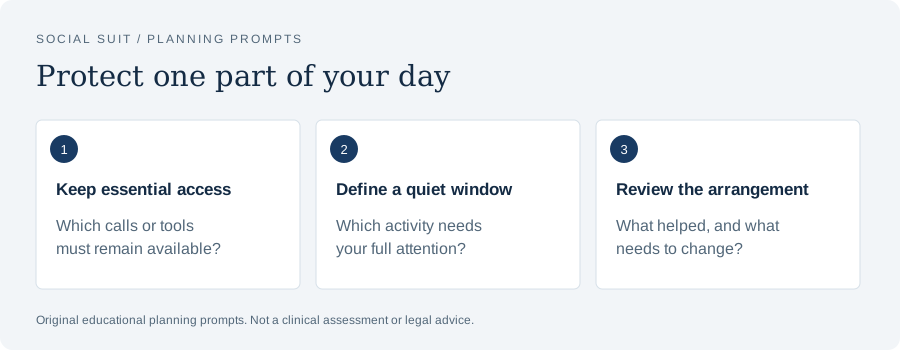
- Keep essential accessWhich calls or tools must remain available?
- Define a quiet windowWhich activity needs your full attention?
- Review the arrangementWhat helped, and what needs to change?
Build a question list instead of following every uncertainty
Studying naturally produces questions. Create a simple list with two categories: needed now and review later. A question is needed now if it prevents the next chosen action or could make the work substantially wrong. A later question is relevant but does not block progress. The distinction is practical and may change as you learn more. It gives uncertainty a place without requiring every new thought to become a search, message, or feed visit immediately.
Write enough context to recognize the question. Include the page, example, or step where it arose. 'Why does this sign change in line three?' is easier to revisit than 'confused.' You do not need a detailed diary. The note should preserve the question while allowing the current action to continue. If several questions accumulate around the same concept, that pattern may indicate a need to revisit the foundational material or ask for help. The list becomes a guide to support, not merely a collection of things to ignore.
At the planned review point, select the questions that matter most to the objective. Use the appropriate source or person. A course explanation, instructor, tutor, official reference, or primary research source may be suitable depending on the question. Do not treat a social platform answer as automatically reliable because it is easy to find. Record what resolved the uncertainty and what remains open. Then return the finding to the exercise, explanation, or draft so the research contributes to learning rather than remaining a separate browsing activity.
If the list becomes too large, narrow the objective. You may be trying to cover more than the session can reasonably hold. Choose one concept or section and identify the prerequisites it requires. A smaller objective can produce clearer understanding than moving superficially through a large amount of material. This adjustment is about task design. Stricter social media rules will not necessarily solve a session that asks you to learn too many unfamiliar things at once without enough instruction or support.
Use research sessions with explicit stopping conditions
Before searching, state the research question and the kind of evidence needed. A definition, a historical claim, a scientific result, and a current procedure call for different sources. Identify what would count as a sufficient answer for the assignment. You may need the original study, an official publication, or a required course reading. The stopping condition should match the claim you intend to make. Gathering many loosely related links is not the same as finding evidence that supports the particular point in your work.
When a search result appears on a social platform, distinguish explanation from evidence. A creator may summarize a paper, but the paper itself may use a narrower population or method than the summary suggests. Follow the primary source when the assignment requires that level of support. Note limitations rather than forcing the source to answer a question it did not investigate. The research task ends when you have the appropriate evidence or have established what remains uncertain, not when recommendations stop offering related content.
Save sources in a way that supports later use. Record the title, location, and the point it informs. Use the citation format required by your course, and follow its rules on academic integrity and assistance. Avoid saving dozens of links without notes about why they matter. At the end of the search interval, place the finding into the outline, answer, or evidence table. This closes the loop between browsing and studying. If a link does not contribute to the objective, park or discard it rather than keeping it open as another invitation.
If the question expands, choose whether the expansion is necessary. A new term may reveal a prerequisite you must understand. An interesting adjacent topic may belong after the assignment. State the distinction in the question list. Research can be valuable and still become a way to avoid producing the work. A bounded question, suitable sources, and a written next action help keep investigation connected to the learning result instead of letting the session become an unlimited tour of everything related.
Arrange the phone according to necessary access
If the phone is not required for the current work, choose a location that reduces casual checking while preserving any essential contact. It may be audible from a shelf or usable on a stand outside the immediate work area. If you depend on the phone for accessibility, communication, or a care-related function, keep that access. Physical distance is one optional tool, not a standard everyone must follow. The arrangement should make the chosen work easier without creating an access failure.
When the phone is the study device, prepare the required tool and reduce unrelated entrances where possible. Keep the document, exercise, or course resource ready. Adjust optional notifications using current device instructions, while preserving essential routes. If a focused mode is available, test what it actually allows and blocks. Do not rely on the mode's name as proof that it suits your needs. A configuration is successful when the learning tool remains usable and unrelated invitations do not repeatedly replace the task.
Use a visible task cue outside the feed. A short paper note or an accessible equivalent can state the objective and next action. After a necessary call or message, the cue tells you where to resume. It should not contain every assignment for the term. Keep the broader list elsewhere and bring only the current objective into the session. Too many visible demands can make the next step harder to identify, increasing the appeal of an easier activity that requires no planning.
For a shared device or changing workspace, build a portable version. Save the required files securely, keep a short objective note, and choose a workable device position at each location. Follow privacy and account rules when using shared equipment. You may not control every alert or app on the device, so focus on the route available to you. A study plan should acknowledge resource constraints rather than imply that purchasing a new device or finding a private room is necessary before useful learning can begin.
Select intervals that fit the content
Choose an interval based on the task and your circumstances, not on a universal timer formula. A difficult new concept may need a short period followed by a check of understanding. A familiar exercise set may fit a longer interval. A learner with care duties may need smaller blocks. Start with something plausible and review the result. The interval is a planning aid that helps you protect a piece of work; it is not a guarantee that attention will remain constant throughout it.
At the beginning, identify the output and the first step. At the endpoint, assess what you learned and what remains. If the work is progressing well and the next obligation allows it, you may deliberately continue to a clear stopping point. If you need a pause, write the next action before leaving. Avoid letting the timer become an automatic cue to open recommendations without considering what the break needs. The transition should be a choice connected to the session, not merely a change of app.
If you repeatedly cannot begin, reduce the first step. Open the reading and identify its question. Copy the problem accurately and name the method you might use. Draft one rough sentence in the outline. A small entry step can reveal what is actually difficult. If it still remains unclear, seek appropriate help with the content or instructions. Do not assume that resistance always means the phone boundary is too weak. An inaccessible or confusing task requires a different kind of correction.
If intervals repeatedly end without a learning result, review the method. Were you reading without checking understanding? Were you collecting sources without writing? Were you waiting for replies? Were recommendations interrupting the work? Each pattern suggests a different adjustment. A useful session review separates the learning process from the app boundary. You can improve both, but counting time away from social media alone will not tell you whether you understood the material or completed the assignment accurately.
Plan breaks that preserve a workable return
Before a break, write the next study action. Then choose a pause based on your need: food, a comfortable position change, quiet, a bathroom visit, or a brief direct conversation. The activity should fit the setting and your access needs. A screen break does not have to involve another information stream. If you choose entertainment, give it an endpoint and a format that fits the interval. The break should support the next step or meet an ordinary need, rather than rely on recommendations to decide its length.
A direct class message can fit a break when its purpose is clear. Check the reply to the question you sent, record the useful information, and return. Do not automatically process every discussion that occurred while you were working. If the conversation becomes important and needs more time, choose whether it should replace the next interval. Make that priority change explicit. A planned break can include collaboration without silently becoming an unlimited social session.
Review the return after a few sessions. Did you begin the next action when intended? Did the break leave an unfinished conversation or a compelling feed topic occupying your attention? Did it meet the need? If a format repeatedly expands, move it to a larger window and choose another pause between study intervals. The related guide on choosing breaks that do not become another feed offers a menu approach that can be adapted to your study environment.
Do not fill every break with more work. Rest and ordinary needs matter. A pause that becomes organizing every assignment, answering every message, and researching every parked question may be as demanding as the session it interrupts. Select what belongs now and defer the rest. If the schedule has no room for needs at all, review the workload and available support. A feed boundary should not become a reason to push through indefinitely without food, rest, or the help that the situation requires.
Work through a problem-solving session
Suppose the assignment contains several calculations and you want to understand the method rather than copy a solution. Select a small set, gather the formula reference, and decide where clarification questions will go. Write the objective: solve the selected problems, show the steps, and identify the source of any mistake. Keep a necessary contact route available while deferring optional feeds. The result is not just filled boxes; it is enough understanding to explain why each step belongs in the solution.
When you become uncertain, locate the exact step. Write what you know, what changes there, and what question would resolve it. If the reference answers the question, apply it and continue. If not, ask the course support person or classmate with enough context to help. While waiting, work on another problem that does not depend on that answer. Avoid opening the class chat repeatedly when no immediate reply is expected. The question has a route, and the session still has work that can proceed.
If a social video claims to show an easy shortcut, assess whether it fits the method and requirements of your course. A short demonstration may omit conditions or steps you need to understand. Use the required materials or appropriate source to verify the method. Do not let a shortcut search become viewing many unrelated demonstrations. The research task is to resolve the specific uncertainty and return to the problem, not to collect every entertaining explanation of the topic.
At the end, compare the work with the allowed feedback or solution process. Mark errors and explain their source in your own words. An arithmetic slip, an incorrect assumption, and a misunderstanding of the method require different corrections. The review may show that you need another learning session rather than a stricter phone rule. Preserve the collaboration route that helped and revise the detour that expanded. The session's usefulness is measured by the understanding gained and the next step identified, alongside the boundary's practical fit.
Work through a reading and evidence session
Suppose you need to compare two readings for an essay. Begin with the assignment question and create a simple note structure: each author's central claim, evidence, assumptions, and relevant differences. Open the texts and decide which contextual questions are necessary. The objective is a comparison you can use in the essay, not a complete account of everything ever written on the topic. Keeping the question visible helps you decide which online searches belong and which interesting side topics should wait.
Read a manageable section and summarize its point in your own words. If a term is unclear, mark it and decide whether understanding it is necessary now. Use an appropriate reference for required clarification. Avoid searching broad phrases that send you through commentary unrelated to the assigned text unless that commentary is actually part of the task. Return the definition or context to your notes, then continue the reading. A source search should contribute to the comparison rather than become a separate browsing excursion.
If classmates discuss the reading in a group, enter with one specific question or contribution. Read what answers that question, record any useful interpretation as an interpretation, and verify claims against the text. A classmate's confident summary is not a replacement for evidence in the reading. Keep attribution clear and follow course rules. Collaboration can reveal a useful angle, but your own comparison still needs to show what the authors actually argue and how the evidence supports the point you intend to make.
At the endpoint, explain the main comparison without reopening every tab. Which difference matters for the essay question? What evidence supports it? What remains uncertain? Those answers give you the next writing step. If the notes are only a collection of quotations, plan another interval to interpret them. The phone boundary may have protected time, but the review tells you whether the method produced usable understanding. Keep both measures visible so that avoiding a feed does not become a substitute for doing the intellectual work.
Work through a collaborative assignment
For a group assignment, agree on the shared objective and each person's immediate task. Define the communication channel, expected response window, and where final materials belong. A social platform may be convenient, but convenience alone does not clarify who is doing what. Write the division of work in a place everyone can access. The agreement should account for schedules, devices, accessibility, and course rules. Do not assume that every group member can remain continuously online or install the same additional app.
During the individual work interval, keep the route for task-related questions available according to the agreement. Park ordinary social conversation for a later check. If a question affects your part, answer it with the needed detail and return. If the group needs a longer decision, schedule or begin that discussion deliberately and pause the individual task. The boundary is between active collaboration and unrelated expansion, not between being a good group member and ignoring everyone.
Use clear handoffs. State what is complete, what remains, and what the next person needs. A file named meaningfully with a short note can reduce repeated clarification messages. Avoid sending many fragments that force others to monitor the chat continuously. If you discover a change that affects the whole assignment, communicate it through the agreed route and identify its consequence. This makes the message actionable and distinguishes it from ordinary commentary that can wait until the next check.
After the session, review both the work and the communication process. Did each person know the next action? Were questions answered within the agreed window? Did the chat repeatedly move into unrelated content? Revise the agreement based on concrete examples. A personal app limit cannot resolve every group coordination problem. Clear tasks and response expectations may reduce the need for constant checking more effectively, while still preserving the social connection that makes collaboration pleasant and sustainable.
Respect accessibility and support arrangements
Some learners use a phone for reading, dictation, captions, communication, translation, or assistive controls. Keep those functions available. An instruction to remove the device may exclude the learner from the task. Begin by identifying the required tool and test any proposed change with the interactions that matter. Can the person reach the control, see the information, hear the cue, or navigate the document? A boundary is useful only if the learning task remains accessible.
If you have an established accommodation or professional support plan, fit the session to it. Do not replace it with generic advice about discipline. Ask the relevant support person about a specific practical issue when needed: notification behavior, document access, breaks, or communication timing. Bring concrete observations about what interrupts the task and what helps you return. These details are more useful than a broad claim that you cannot study because of your phone or that you should be able to work like everyone else.
When another person helps configure the device, agree on their role. They can assist with settings or test a necessary route without gaining access to unrelated private conversations. Avoid handing over passwords or account control merely to create a study boundary. Keep ownership and privacy clear. The plan should be chosen with the learner and should preserve independence where possible. Support is different from surveillance, and a successful arrangement should not require someone to monitor every screen interaction.
Account for resource constraints. A shared device, limited data, crowded home, or irregular work schedule can affect the session. Download permitted materials when useful, choose a portable task cue, and keep the objective small enough to fit the available interval. Do not assume a quiet room or a second computer is available. The method should help within real conditions while making larger support needs visible. Practical adjustments can improve a session without pretending that every environmental barrier is under the learner's control.
Handle a feed detour without discarding the session
If you notice that a necessary check has become recommendations, close the feed at the next reasonable point and read the task cue. The remaining session can still be useful. Begin the next action or choose a smaller objective if time is limited. Avoid the idea that one detour means studying is ruined for the day. That belief can extend the detour because it removes any reason to return. A boundary should include an ordinary recovery step, not depend on perfect adherence from the start.
Review the detour after the work interval. Identify the entry point, the original purpose, and the moment that purpose ended. Did a class message lead to a home feed? Did a search introduce unrelated clips? Did a difficult problem make browsing the easier available action? Those explanations suggest different corrections. A direct conversation route, narrower search, or help with the problem may be more useful than a generalized promise to try harder. Record the change you will test next time.
Keep helpful collaboration and access while revising the detour. Do not block a classmate who answered an important question simply because the app also offered recommendations. Preserve the useful route and change the surrounding sequence. If the platform repeatedly makes that impossible, discuss another accessible channel or a planned check window. The practical review in what to do after a scrolling setback can help separate the event from judgments about your ability to learn.
If the session is too short to resume the original objective, choose a meaningful closure. Save the work, note the unresolved question, and write the first step for the next session. A clear closure prevents another delay caused by reconstructing what happened. Do not keep browsing while vaguely promising to restart at some unspecified moment. Decide when the work can resume or what support is needed. The session may have produced less than planned, but it can still leave a usable path forward.
Review understanding and protect rest
For an upcoming assessment, distinguish reviewing material from practicing the task the assessment requires. If you will need to explain an argument, include an interval in which you explain it without the reading open. If you will solve problems, include an appropriate practice set rather than spending the whole session watching demonstrations. Use the course's permitted materials and rules. The objective should make the gap between recognition and performance visible. A familiar-looking explanation may feel reassuring while leaving you unsure how to produce the answer yourself.
Prepare an assessment practice session with a defined scope. Select one topic, gather the permitted resources, and decide when feedback will be checked. Keep the class chat out of the practice interval unless collaboration is part of the task. Afterward, use the appropriate feedback to identify errors and questions. This separates the attempt from the review, making it easier to see what you can do independently. It also gives the online checking phase a precise purpose: resolve the mistakes from this attempt, rather than browse general study advice indefinitely.
If anxiety about the assessment sends you repeatedly into classmates' messages, clarify what information you actually need. A confirmed time or room is an administrative question with a direct source. Another person's prediction about the test may be uncertain and may not help your preparation. A comparison of how much everyone has studied can become an open-ended discussion without improving your understanding. Choose a bounded check for necessary logistics, then return to the practice objective. If distress is substantial or persistent, seek appropriate support rather than treating additional checking as the only way to feel ready.
Use errors to plan the next interval. Group them by the action they require: revisit a concept, practice a procedure, read instructions more carefully, or ask for clarification. Do not write 'study more' as the only response. A specific correction gives you a workable task and a reason to keep the feed separate. It may also reveal that some material is already sufficiently understood, allowing you to focus on the remaining gap. The plan should follow evidence from the attempt rather than the loudest concern expressed in a group chat.
Before ending, prepare a short logistics check for the assessment day. Record the time, location or access route, permitted materials, and any established accommodation arrangements. Verify uncertain details through the official course route. This can reduce repeated searches through old messages when the day arrives. Keep logistics separate from late-night content review so each has an endpoint. If a detail changes, update the note and the relevant people. The result is a clearer preparation sequence, with learning, feedback, and administration each occupying a deliberate place.
At the end, ask what you can now explain or do, what remains unclear, and what the next session should address. Include the app boundary in the review, but do not make it the only measure. You may have stayed away from social media and still used an ineffective study method. You may have answered necessary messages and learned the material. Accurate review distinguishes both. Keep the useful tool and communication route while changing the part that did not serve the objective.
Avoid extending study indefinitely to compensate for a detour. Consider the next obligation and the opportunity for rest. The NHLBI healthy sleep habits guidance treats adequate time for sleep and a quiet period before bed as important. A late study plan should account for those needs without claiming that one schedule fits everyone. If work, care, or course demands routinely leave too little rest opportunity, discuss support or adjustments where possible rather than relying on increasingly strict feed rules alone.
If concentration, distress, or other symptoms persist and affect daily functioning, seek appropriate professional support. A study log can provide observations, but it cannot diagnose the cause. If online experiences involve serious harm, respond with the help appropriate to that situation. Social Suit's legal process information offers preparation topics for questions about a possible claim without deciding eligibility or promising an outcome. Ask about secure sharing before sending sensitive records, and keep care or immediate safety separate from claim preparation.
Prepare the next session in a short note: the learning objective, required tools, collaboration check, and first action. Choose the optional feed window separately. The practical method in single-tasking when your phone is nearby can help connect that note to a manageable interval. The goal is a study session in which the technology has a clear role, uncertainty has a place, and progress is assessed by understanding rather than by a perfect record of never opening an app.
Sources and further reading
These primary resources provide context. Our practical examples and planning suggestions are original educational material, not validated treatment protocols. Linked organizations do not endorse Social Suit.