 Social Suit
Educational information, not individual medical or legal advice. Practical examples are hypothetical and do not describe clients or study participants. This article is not represented as reviewed by a clinician or attorney. How we prepare our guides.
Give the news session a purpose
Difficult news can deserve attention. A storm, an election, a conflict, a public health issue, or an event affecting your community may change what you need to know and do. The problem usually described as doomscrolling is not simply encountering bad news. It is continuing through updates, reactions, and recommendations after the session has stopped serving a useful purpose, often while feeling increasingly distressed or unable to leave. That description is practical rather than diagnostic. It invites you to examine what the session is doing for you and where your intended endpoint disappears.
Begin by naming the purpose before opening a feed. You might need to know whether transit is running, whether a local service is available, or what a reliable source has confirmed about an event. You might want a thoughtful account of an issue because understanding it matters to you. Those purposes imply different reading routes and different endpoints. A direct service page can answer an operational question. A longer reported article can provide context. An endless stream of reactions may do neither, even though it produces the feeling that you are staying connected to unfolding events.
Put the purpose into a sentence that you can revisit. For example, a hypothetical commuter might write, 'I need to check the official travel update before leaving.' A hypothetical student might choose, 'I want to understand the main facts and the remaining uncertainty in today's report.' The wording should describe a real information need. 'I need to know everything' cannot provide an endpoint, because a feed will always contain another angle. You are not abandoning interest in the world when you choose an achievable question. You are deciding what this particular visit should accomplish.
Notice when the purpose changes during the session. Perhaps you answered the travel question and then began reading frightening comments. Perhaps you read the report and then sought a more reassuring interpretation. Perhaps a recommendation opened a different topic entirely. A change of purpose can be reasonable, but it should be a decision you recognize. Pause and ask whether the new task belongs in this visit. If it does, define it. If it does not, save a relevant item for later or leave. Naming the transition restores a place where you can choose.
Recognize the search for certainty
Some ongoing events do not yet have an answer. A feed can deliver updates without reducing that uncertainty. In those circumstances, refreshing may feel productive because something new might appear, but novelty is not the same as a useful change in knowledge. Ask whether the next item is likely to alter a decision you need to make now. If it cannot, a scheduled return may be more useful than continuous monitoring. That distinction is especially relevant when comments repeatedly reinterpret the same unconfirmed information and create the impression that an answer is just beyond the next refresh.
Write down what remains unknown. This can be as simple as, 'The service has not announced when it will reopen,' or, 'The source has not independently confirmed the reported number.' Naming uncertainty helps you avoid treating it as a personal failure to search thoroughly enough. Some questions require investigation, time, or official action that your scrolling cannot accelerate. A useful news session can end with an unanswered question if you understand why it is unanswered and know where a meaningful update would be published. You do not have to manufacture certainty to justify leaving.
Separate information seeking from emotional reassurance. You may be looking for evidence that someone else sees the event as you do, for a comment that makes the outcome feel safer, or for confirmation that you are not missing an important development. Those needs are understandable, but a public feed may be an unreliable way to meet them. A direct conversation with a trusted person, a bounded review of confirmed information, or a practical action can sometimes help more. The point is to identify the need, not criticize yourself for having an emotional response to difficult events.
If you keep checking after recognizing the uncertainty, reduce the decision you have to make repeatedly. Choose the next checking point and the source you will use. Make a note of what would count as a meaningful update. For a local safety issue, that might be an official change in instructions. For a broader event, it might be a verified account that adds context. Your next visit then has a purpose beyond seeing whether the feed has changed. A clear return plan can make closing the present session easier to trust.
Separate safety information from open-ended commentary
Some news is directly relevant to immediate safety. In that situation, do not replace necessary monitoring with a general rule about avoiding screens. Identify the appropriate official source and the instructions that apply to your location or circumstances. If you are told to take a protective action, prioritize that action. Commentary from strangers may be interesting, but it is not a substitute for relevant emergency guidance. A practical doomscrolling plan should preserve access to essential information and reduce unnecessary exposure around it, especially when an event is active.
Use a direct route where possible. A hypothetical household monitoring a local disruption might bookmark the responsible agency's update page, maintain its required alert access, and check that source at sensible intervals. They could avoid keeping a recommendation feed open for hours simply because the topic is present there. The household would need to adjust to the actual situation, connectivity, and official instructions. This example illustrates the distinction between monitoring a defined information channel and consuming an unbounded stream. The former can have a clear function even during a stressful period.
Consider whether someone else can share the monitoring task. In a household, one person might check a relevant source while another prepares supplies or handles a practical responsibility, provided the arrangement fits the circumstances. Be clear about when updates will be shared and how urgent changes will reach everyone. Do not assume that a child or an already distressed person should monitor continuously. Dividing a task can reduce repeated exposure and prevent every person from independently checking the same material without gaining additional useful information. Reliability matters more than the volume of scrolling.
When the immediate need passes, review the temporary arrangement. An event that required frequent checking yesterday may require only an ordinary update today. Remove the extra alerts or return to your normal reading window when appropriate. Otherwise, an emergency pattern can continue after its purpose has ended. You may still want to understand what happened, but that can become a separate, deliberate reading task. The change in circumstances deserves a change in the information plan. Keeping a feed open is not the only way to remain informed or care about the people affected.
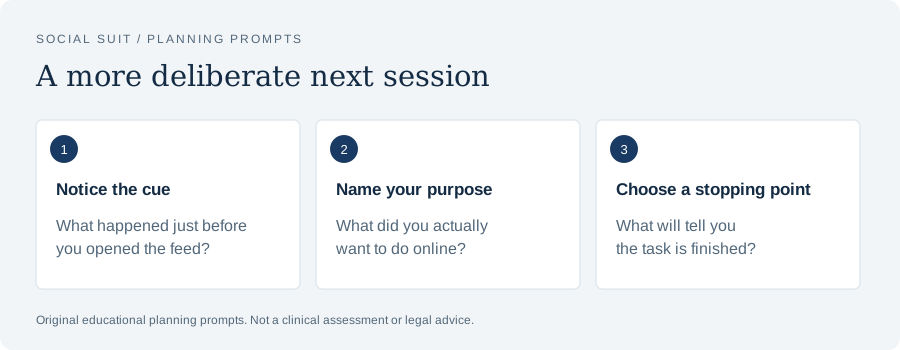
- Notice the cueWhat happened just before you opened the feed?
- Name your purposeWhat did you actually want to do online?
- Choose a stopping pointWhat will tell you the task is finished?
Choose sources by the question they can answer
A useful source matches the task. An official service page may be the right place for operating instructions. A primary document may clarify what a policy actually says. A carefully reported account may explain context and competing interpretations. A personal account may reveal one person's experience without establishing the full picture. Notice those differences before treating several sources as interchangeable. Adding more items from the same reaction stream may increase exposure without broadening understanding. The aim is a small set of sources that does meaningful work for the question you have chosen.
Ask what is confirmed, what is attributed, and what is interpretation. An article may describe a statement by an official without confirming the underlying claim. A video may show a real event without establishing where it happened or what preceded it. A comment may confidently summarize a document the writer has not read. These distinctions matter because uncertainty can otherwise be hidden inside confident language. You do not need to conduct a professional investigation of every post. You can choose to wait for a more careful source instead of making the feed your research workspace.
Beware of a route that repeatedly returns you to engagement cues. Searching for a specific report can become scanning trending topics, then watching clips, then reading arguments under those clips. If your goal is understanding, a direct article or source page may provide a more bounded experience. Save it outside the feed when practical, or use a reading view if your tools offer one. These are convenience measures rather than guarantees. Their purpose is to make it easier to finish the material you selected without continuously encountering unrelated invitations.
Keep your source list short enough to review. A list of dozens can become another impossible obligation. Select a few sources for different functions and revisit them when they stop serving those functions. If one repeatedly leaves you with dramatic claims and little clear evidence, reconsider its role. If a source provides a useful correction, notice that too. The review should be about the information it supplies, not whether it always confirms your expectations. Good understanding sometimes means revising a belief, and a calmer reading arrangement can make that revision easier to consider.
Use time boundaries as containers
A time boundary can help contain a news session, but the number is not the whole plan. Decide what you will read, what you will do when the boundary arrives, and where unfinished questions will go. Without those decisions, the reminder can become a recurring negotiation while the feed continues. The boundary should be long enough for the intended task and short enough to protect the next activity. Different tasks need different containers. Reading a substantial explanation deserves a different plan from checking whether a local service has posted an update.
Make the endpoint concrete. You might finish one selected article, check two relevant sources, or stop when you have the answer to the question you named. A timer can support that endpoint, especially if sessions often drift. When it signals, close the app and write a brief note if something needs follow-up. If the task genuinely requires more time, choose that extension explicitly and define its purpose. The point is not to obey an arbitrary sound without thought. It is to avoid silently sliding from necessary reading into unrelated, distressing consumption.
Plan the next ordinary activity before you begin. A transition is easier when it does not require inventing something while you are absorbed in the news. You could prepare lunch, walk to another room, complete a small household task, or return to a book already placed nearby. Choose something accessible and appropriate to your situation. These examples are not treatments for distress; they are practical transitions out of a browsing session. An ordinary action can mark that this information task is complete for now, even if the event itself remains unresolved.
Avoid using the boundary to grade your worth. If you overrun, note what pulled you onward and restore the next normal plan. Was the question too broad? Did a notification reopen the app? Did you seek reassurance from comments? Did an actual urgent development justify more time? Those explanations lead to different adjustments. A neutral review can make tomorrow's boundary more useful. A dramatic punishment may create a larger cycle of restriction and rebound without improving the original information task. The companion guide on setting limits you can realistically keep develops this approach.
Reduce the invitations that restart the session
A session may end successfully and then restart through an alert. Review notifications related to news, recommendations, trending discussions, and reaction activity. Keep alerts that serve an actual responsibility or safety need. Consider silencing those that merely announce another item you could browse. The distinction should follow the category and context, not the app's overall reputation. One service may deliver both useful local updates and optional suggestions. Read current controls carefully and test the arrangement, since interfaces and available categories can change over time.
Look at saved shortcuts and habitual routes. If every phone unlock lands beside a news feed icon, opening it can become the default response to a pause. Moving the shortcut or using a direct bookmark for the source you need can introduce a moment of choice. That moment is small, but it can remind you of the purpose you wrote down. Keep necessary access practical. A change that makes important information difficult to reach may lead you to abandon the plan entirely. Friction works best when it interrupts the unwanted route while preserving the useful one.
Check whether reaction notifications create a second task. Posting a comment or sharing a story can lead to repeated visits to see how others responded. If that happens, decide whether you want those updates immediately. You can participate in a discussion without monitoring every response as it arrives. Consider whether a thoughtful message to a person or a smaller group would serve your purpose better than a public exchange. The choice depends on what you want to communicate. Awareness of the follow-on demand helps you avoid starting a conversation whose delivery pattern you did not intend.
The guide to making your notifications less demanding offers a fuller review of alert purpose, timing, and delivery. For doomscrolling, the narrow question is whether the alert provides information you need now or simply returns you to an unfinished stream. Removing the latter can support your reading plan. It will not remove every reason to check, so observe what happens next. If you still reopen manually, examine uncertainty, boredom, or the next task rather than assuming that a quieter device has failed.
Distinguish engagement from useful action
After learning about a difficult issue, you may want to act. That can mean checking on someone, completing a civic task, helping through an appropriate organization, learning a relevant skill, or discussing the issue thoughtfully. The action should match your circumstances and reliable information. Scrolling can feel like participation because you remain emotionally involved, yet it may not produce the result you care about. Ask what, if anything, this session enables you to do. It is also acceptable for the answer to be that you wanted to understand, provided the reading actually served that purpose.
Choose an action small enough to complete. A hypothetical reader concerned about a local event might look up the announced community meeting, note its date, and decide whether to attend. Another might send a considerate check-in to a friend affected by the event. These examples are hypothetical and do not imply that any particular event requires those responses. The principle is to translate concern into a clear task when a task is appropriate. A concrete action has a completion point. Continuing through reactions afterward does not necessarily improve it.
Avoid confusing repeated exposure with moral commitment. You can care about people without viewing every distressing clip or reading every argument about their circumstances. Some roles require sustained professional attention, but ordinary readers do not need to make themselves a continuous audience to prove concern. Decide what information is necessary for understanding or action, and respect the privacy and dignity of the people depicted. You do not have to forward graphic material to show that you take an event seriously. A factual description or a carefully chosen source may communicate what matters with less unnecessary exposure.
Let the action end too. If you complete a practical task and then return to the feed for hours, the task may have become a brief interruption in the same pattern. Record what you did, identify the next legitimate step if there is one, and return to your ordinary responsibilities. You can revisit the issue later through a planned route. This is not a promise that concern will disappear. It is a way to preserve attention for both the issue and the rest of your life, including the people and tasks that depend on you directly.
Handle distressing images and videos deliberately
Images and videos can be informative, but they can also arrive without warning and repeat across several accounts. You may encounter the same distressing material while searching for updates that do not require viewing it again. Use current hide, report, autoplay, or recommendation controls where they address the problem. Leave the feed when necessary. You are not obliged to inspect every item to determine whether it deserves your attention. A text account from a reliable source may answer the practical question with less exposure to imagery you did not choose.
Before sharing material, ask what the recipient needs to know and whether the image is necessary. A warning does not automatically make sharing considerate, especially when the recipient did not ask for it. Consider describing the issue, linking a source that provides context, or asking whether they want the material. Avoid treating another person's suffering as a tool for winning an argument. Your reading plan can include a sharing rule, such as reviewing a source and purpose before forwarding. That small pause can prevent the feed's urgency from becoming an unexamined demand on others.
If distressing content lingers after you leave, talk to someone you trust or seek appropriate professional support when needed. You do not need to keep returning to the material to understand why it upset you. Describe the effect in practical terms: difficulty settling down, repeatedly replaying the content, or avoiding ordinary activities. A professional can consider the wider situation rather than treating one browsing pattern as a complete explanation. This article offers general habits for information use, not an assessment of trauma, anxiety, or any other condition.
When children or teenagers encounter upsetting material, respond with calm attention to what happened and how they are doing. Ask what they need and make trusted support available. A settings review can follow, but the emotional conversation matters too. Avoid requiring the child to show the material repeatedly to prove the experience. If documentation is needed for a particular safety issue, handle it carefully and involve appropriate support. Reducing repeated exposure is compatible with taking the concern seriously. The practical goal is safety and understanding, not a complete archive of every disturbing item.
Protect attention around sleep and study
News browsing can expand into periods you intended for sleep, study, or recovery. Identify the specific overlap rather than blaming every use of the phone. A student may need current information for an assignment but not a reaction feed during a problem set. An adult may want an evening update but not continuous checking after beginning a bedtime routine. Define which information task belongs in the period and which can wait. A direct source, an earlier reading window, and a clear endpoint can preserve the useful activity while reducing the drift.
The National Heart, Lung, and Blood Institute's healthy sleep guidance recommends supportive routines and avoiding bright artificial light near bedtime. That broad guidance is relevant to planning an evening, but it does not prove that doomscrolling causes every sleep difficulty or that a news boundary will resolve one. Keep the experiment specific: move nonessential news checks out of the period when you are trying to settle down. Observe the practical effect and seek healthcare advice for persistent sleep problems rather than relying on an article to identify their cause.
During study, write down the news question that interrupts you and decide when you will address it. If the question does not affect the immediate task, returning to it later can be reasonable. If it does affect the assignment, search directly for the needed source and keep a record of it without entering an unrelated feed. The guide on social media boundaries during study sessions discusses how to distinguish necessary tools from optional browsing. The distinction becomes easier when you name the work product you intend to complete.
Avoid checking news as every break by default. A break that leaves you more absorbed, distressed, or uncertain may be difficult to end. Choose an alternative that fits the length and purpose of the pause: water, a change of posture, a brief conversation, or another ordinary activity. Accessibility and circumstances matter, so adapt the examples. If you intentionally choose news during a longer break, give it the same purpose and endpoint you would use elsewhere. A break is still a container, not a reason to abandon the boundaries that support the next task.
Build a plan for waiting and boredom
Waiting often creates an opening for a feed. A page loads, a queue moves slowly, or a meeting has not begun, and the phone offers immediate activity. Difficult news can become the default content even when you did not intend to seek it. Notice one recurring waiting situation and decide what you will do there. The alternative can be modest: look around, review the task you are about to start, read a saved non-news item, or simply wait. You do not need to turn every pause into a productive exercise.
Use an alternative that is already available. A plan to take a long walk will not fit a two-minute queue. A paper note or an intentional saved article might. If you need the phone for the immediate situation, preserve that use and avoid opening the feed alongside it. For example, a hypothetical traveler could check a boarding detail and then return to the ticket view rather than tapping a trending alert. The action is small, but the distinction between the necessary check and the optional stream can become easier to recognize with practice.
Expect some pauses to feel unfinished. A feed can make empty time feel full, so leaving it closed may initially reveal boredom or discomfort that was already there. You can notice that experience without deciding that the plan is harmful or that you must eliminate the feeling. If the discomfort is persistent, intense, or tied to a broader concern, support may help. The practical habit is simply to allow a brief gap between the cue and the browsing decision. That gap creates an opportunity to ask whether news is what you actually want at this moment.
Record successful pauses when you review the experiment. A single moment in which you checked a necessary item and left can be informative even if another session later drifted. It shows that a route can work under some circumstances. Ask what made it workable: a clear task, a direct source, a visible next activity, or fewer alerts. Build from those conditions. Counting only overruns can hide the evidence that helps you improve the plan. A neutral account of both kinds of experience is more useful than a daily verdict about discipline.
Discuss news without recreating the feed
Conversation can help you understand an issue and process a response, but it can also become another stream of unbounded updates. Decide what the conversation is for. You might want to compare verified information, ask a question, share a feeling, or coordinate a practical action. Tell the other person which kind of discussion you need. A friend may respond more usefully to 'I am unsettled and want to talk briefly' than to a rapid sequence of forwarded posts with no explanation. Clear purpose respects both people's attention and reduces ambiguity.
Avoid assuming that everyone wants the same level of detail. Some people are directly affected, some are already overwhelmed, and some are handling other responsibilities. Ask whether it is a good time to discuss the topic. If the person prefers to wait, agree on another time or use a different appropriate support route. Their boundary does not establish that they do not care. Likewise, you can set your own boundary around repeated news discussion in a group. A conversation can be meaningful without becoming available at every hour.
Use a source or a short factual summary when clarity matters. Forwarding several emotional reactions can require the recipient to reconstruct the issue while absorbing your distress. A selected article and a specific question are often easier to consider. Distinguish what the source says from what you think it means. If you are unsure, say so. This supports a discussion in which people can learn rather than compete to sound certain. It also provides a natural endpoint: the question has been considered, a next step has been agreed, or the conversation can continue later.
If online arguments repeatedly restart your scrolling, choose how you will participate before entering them. You might make one considered contribution, follow a smaller discussion, or decline to engage with a thread whose format prevents useful exchange. No general rule will fit every situation. The relevant question is whether the interaction serves the purpose you identified. If it repeatedly leaves you checking for responses while neglecting something you value, adjust the delivery or the venue. You can remain interested in the issue while choosing a form of conversation that is easier to complete.
Review a setback without escalating the restriction
A long, distressing session can happen after a plan has been working. An unexpected event, a difficult day, an alert, or a conversation may change the circumstances. Describe the session neutrally. Note when it began, what you wanted, the point where it drifted, and what was affected. This is more useful than a global statement that you failed. A specific account can reveal a practical repair. Perhaps the news question was too broad, the source route led into recommendations, or the next activity was unclear.
Restore the next ordinary boundary. You do not need to compensate for one overrun with an extreme ban unless a deliberate broader change fits your circumstances. A punishment can distract from the information you just gathered about the plan. If the problem was an alert, revise that category. If it was uncertainty, define the next update point. If it was a difficult task, prepare the task's first step. If an important event genuinely required more reading, acknowledge that rather than treating every exception as evidence that the plan is impossible.
Consider whether the baseline expectation was realistic. A person following a major event that directly affects family may reasonably need more information than on an ordinary day. The useful question is whether the additional reading supplied that information or became a repetitive search for reassurance. This distinction avoids both dismissing a real need and giving unlimited permission to the feed. Write down what has changed and what remains the same. Temporary circumstances may justify a temporary plan with a review point. They do not have to erase every useful boundary you established before them.
The guide on what to do after a scrolling setback offers a broader framework for this review. For doomscrolling, the main repair is to reconnect browsing with an achievable information task. If the pattern persists and affects everyday functioning, bring examples to a qualified professional. Describe impact alongside any benefits you want to preserve. A professional conversation can consider mood, sleep, stress, relationships, and other circumstances that a timer or source list cannot assess. Seeking help does not require proving a particular diagnosis first.
A hypothetical week of bounded news use
Imagine a hypothetical reader who repeatedly opens a news feed after dinner and stays until the evening routine is delayed. They do not want to ignore current events. They want to understand a few topics while having time for the rest of the evening. On the first day, they write down what they usually seek and notice that several visits begin with no question at all. They choose one deliberate reading window and a short list of sources. They also preserve the relevant local alert route because a practical update may still matter outside that window.
On the second day, the reader opens a selected report and notes two confirmed points and one unresolved question. When they finish, they decide to check the question again the next afternoon if a meaningful update is available. They close the source and prepare tomorrow's essentials. The unresolved question remains uncomfortable, but the task has ended. On the third day, a reaction alert pulls them back into the app. They discover that the alert did not add information relevant to the question, so they change that category rather than abandoning the planned reading window.
On the fourth day, an actual local update requires attention. The reader uses the direct official route and adjusts a practical plan. They do not count the extra check as a failure because it serves a defined need. On the fifth day, they drift into comments while avoiding an unpleasant household task. Their note identifies that different trigger. They prepare a manageable first step for the task and keep the news boundary. The example shows why several overruns can look similar in a screen-time report yet require different responses in ordinary life.
At the end of the hypothetical week, the reader reviews useful information gained, important updates received, unnecessary visits, and the evening activities protected. They find the direct source route worth keeping and the exact reading time worth adjusting. This is a practical experiment, not a clinical outcome. It does not promise that distress disappears or that all readers should copy the schedule. It demonstrates how a small plan can generate information about what works. The review values both informed engagement and the parts of life the feed had been displacing.
Keep the measure connected to your life
Minutes can be one measure, but they need context. Ten minutes of intense, repetitive checking may be more disruptive than a longer, deliberate reading session that helps you understand an issue. A decrease in time can be useful if it protects sleep or responsibilities, but a number alone cannot show the quality of your information or the effect on your day. Record what the session accomplished and what it displaced. This gives the total a meaning. It also prevents comparisons with people whose work, caregiving, location, or interests require different information use.
Watch for a calmer pattern rather than a perfect record. Can you identify why you opened the source? Can you leave when the task is complete? Do you know where an urgent update will reach you? Are your chosen reading periods compatible with the activities you value? These questions describe ordinary functioning. They do not form a diagnostic checklist. A few clearer decisions can be worthwhile even when some sessions still drift. Continue adjusting based on specific observations rather than demanding that one technique remove every difficult feeling associated with the news.
The social media resource collection connects this topic with limits, attention, sleep, and interpreting research. Use those guides to address the part that fits your situation. A news boundary, a notification review, and a task transition solve different practical problems, although they may support one another. If a serious concern involves safety or health, use appropriate professional help rather than treating browsing adjustments as a complete response. The resource is a starting point for better questions and usable routines, not a substitute for individualized advice.
A practical approach to reducing doomscrolling leaves room for both concern and ordinary life. Choose the question, use a source capable of answering it, name what remains uncertain, and decide when to return. Preserve necessary updates, reduce invitations that do not serve the task, and prepare a clear transition. When the plan slips, inspect the point of drift and repair it. You can stay informed through visits that have a purpose. The feed does not have to become the place where every unresolved event waits beside every task you hoped to complete.
Sources and further reading
These primary resources provide context. Our practical examples and planning suggestions are original educational material, not validated treatment protocols. Linked organizations do not endorse Social Suit.