 Social Suit
Educational information, not individual medical or legal advice. Practical examples are hypothetical and do not describe clients or study participants. This article is not represented as reviewed by a clinician or attorney. How we prepare our guides.
Why a tired person can keep scrolling
Being tired and continuing to scroll is a familiar contradiction. You may have enough energy to swipe through another dozen posts while feeling unable to cook, answer a difficult message, or prepare for bed. That does not mean your tiredness is invented. Different activities ask different things of you. A feed offers an immediate next step without requiring much planning. Preparing a meal involves choosing food, locating ingredients, washing a pan, and dealing with the result. An activity that feels easy to start can win even when another activity would better address the problem.
This guide focuses on that mismatch. It does not diagnose addiction, identify a medical cause of fatigue, or prescribe a treatment. It helps you examine what is happening between noticing that you are depleted and opening an app. The useful question is not whether you are a disciplined person. It is whether the particular activity you chose is giving you the type of relief you needed. Sometimes an enjoyable online conversation does help. Sometimes a feed simply postpones food, sleep, movement, or a conversation until you feel worse.
Consider a common evening. You arrive home feeling heavy and unfocused. You sit down to check one notification and begin watching short videos. Half an hour later, you are still hungry, the room feels uncomfortable, and the unfinished evening seems more difficult. The videos may have entertained you. They have not necessarily solved the original problem. A fair assessment keeps both facts in view. You can appreciate an entertaining break while acknowledging that it became an unhelpful substitute for something more basic.
The distinction also matters when someone else comments on your habits. “If you have energy for your phone, you have energy for everything else” is not a useful way to understand effort. Nor is “scrolling always helps me relax” enough to explain an evening that repeatedly leaves you depleted. You need observations about the actual sequence: how you felt, what you did, what you postponed, and how you felt afterward. These observations can support a practical change without becoming an argument about character.
What the evidence can and cannot explain
The U.S. Surgeon General’s social-media advisory and the American Psychological Association’s adolescent advisory discuss sleep, developmental context, content, and the displacement of important activities. Their guidance supports looking beyond a single screen-time total. It does not establish that every tired adult who scrolls has the same problem, or that a particular minute limit will work for everyone. The discussion here applies that broader perspective to ordinary decisions about rest. The suggested exercises are practical reflection tools, not clinically validated assessments.
Fatigue has many possible contributors. An unusually demanding day, insufficient sleep, caregiving, illness, pain, a changing work schedule, stress, medication effects, and other circumstances can all matter. A website cannot distinguish those causes from a brief description. If tiredness is persistent, unexplained, severe, or interfering with daily life, discuss it with a qualified healthcare professional. If you are dangerously sleepy while driving or operating equipment, stop the hazardous activity and arrange a safe alternative. Changing an app setting is not an adequate response to that immediate risk.
It is also possible for a phone to provide essential support. Someone managing a disability may use it for accessibility tools, symptom tracking, communication, or assistance. A caregiver may need to remain reachable. A worker may receive shift updates digitally. These uses belong in the analysis rather than being treated as excuses. The goal is to distinguish necessary or supportive use from a feed that keeps running without a clear purpose. An intentional boundary should preserve functions that you genuinely need.
Avoid interpreting a single evening as proof of causation. If you felt tired before opening the app, the app did not necessarily cause that tiredness. If you felt worse afterward, other events may also have contributed. What you can test is narrower: does changing the order of your evening make it easier to meet a particular need? Eating before browsing, for example, may be worth trying because it changes an observable sequence. You do not have to establish a theory about your brain to make that small experiment.
Separate physical tiredness from task resistance
Physical tiredness and reluctance to begin an unpleasant task can coexist. You may genuinely need rest and also be avoiding a report that feels uncertain. Treating either explanation as the entire truth can lead to the wrong response. If you respond only with stricter productivity rules, you may ignore a need for recovery. If you respond only by resting, the unresolved task may continue creating pressure. The practical challenge is to identify which part needs attention now and which part can wait.
Start with the body rather than with a moral judgment. Have you eaten enough for your circumstances? Do you need water, a more comfortable position, a bathroom break, or relief from a noisy environment? Have you been sitting or standing for longer than feels manageable? These questions do not diagnose anything. They simply reveal needs that a stream of posts cannot directly meet. If one answer is obvious, address it before deciding whether you need more entertainment. A snack or a comfortable seat is not a failure of self-control.
Then examine the task. “Finish the entire application tonight” may feel overwhelming because you do not know what information it requires. “Find the deadline and list the documents” is a smaller action with an identifiable ending. If shrinking the task makes it approachable, part of the problem may have been uncertainty or scale. If even the small action feels difficult after adequate rest, that is useful information too. You may need more support, a different schedule, or a conversation about workload rather than another attempt to force yourself through it.
Imagine a student who opens a feed every time a homework question looks confusing. The immediate issue is not necessarily a desire for more entertainment. The student may need clarification, a worked example, or a short pause before trying again. An adult can say, “Show me the first place you got stuck,” instead of assuming that taking away the phone resolves the assignment. The same principle applies at work: a missing decision or instruction can make a task feel exhausting even when its practical next step is small.
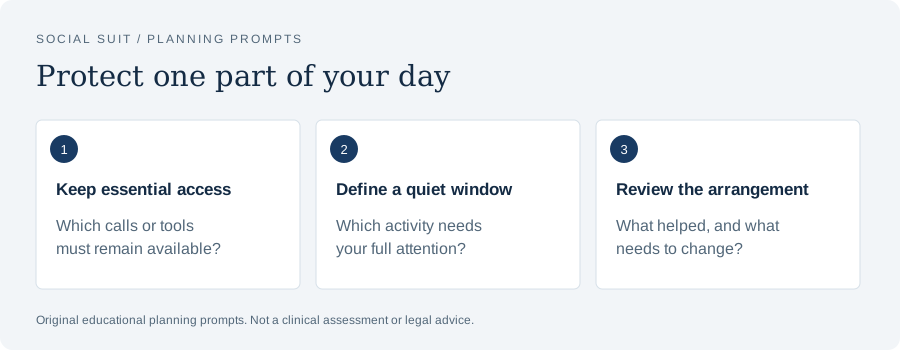
- Keep essential accessWhich calls or tools must remain available?
- Define a quiet windowWhich activity needs your full attention?
- Review the arrangementWhat helped, and what needs to change?
Identify the need hidden inside the browsing session
Before changing a habit, identify what the session is trying to do. You might be looking for quiet after a socially demanding day, stimulation after repetitive work, reassurance after an argument, or company during an isolated evening. These are different needs. A feed may satisfy one while worsening another. For instance, lively conversation may help someone who feels alone, whereas the same stream may add noise for someone who has spent all day responding to other people.
Try completing a plain sentence: “I opened this because I wanted ____.” Use everyday language. Possible answers include a laugh, a pause, an update from a friend, something interesting, or a way not to think about tomorrow. There is no preferred answer. If you cannot tell, describe the moment before opening the app. Were you moving between tasks, waiting for someone, lying in bed, or staring at a difficult email? The immediate context often gives more useful information than a broad statement that you use your phone too much.
Next complete a second sentence: “After this session, I still need ____.” That answer shows whether the activity met the need or only occupied the time. You may realize that you still need dinner, a direct conversation, a decision about tomorrow, or an earlier bedtime. The point is not to ban the session retroactively. It is to decide what comes next. You can say, “That was entertaining, and now I need to eat,” without turning the observation into a condemnation of the entire evening.
Be careful with needs that require another person. If you want reassurance from a friend, an open-ended feed may repeatedly expose you to people without actually reaching the person who matters. A direct message such as “Do you have ten minutes to talk this week?” makes the request explicit. The friend may not be available immediately. While you wait, choose an activity that does not make your well-being depend on repeatedly checking for a reply. The boundary protects the conversation from becoming another source of constant monitoring.
Rest does not have to be earned through productivity
Many people turn a break into a second performance. They decide that proper rest must include a walk, a perfectly prepared meal, journaling, tidying, and an early bedtime. Faced with that list, browsing may seem like the only available break that asks nothing more of them. A better plan begins with permission to rest in an ordinary way. Sitting quietly, listening to familiar music, looking out a window, or doing nothing for a while can be reasonable options. They do not have to produce a measurable benefit to count.
It helps to distinguish a restorative intention from a productivity demand. “I will sit somewhere comfortable for ten minutes” gives you a concrete opportunity to stop. “I will use this break to become a healthier person” creates another vague obligation. If you are exhausted, choose the smallest useful action. You might change out of uncomfortable clothes, lower the room’s noise, or put food within reach. The action should make the next few minutes easier, not turn them into a test of whether you deserve comfort.
People with limited money, space, transport, or mobility need options that fit those conditions. Advice to take a scenic walk or enjoy an elaborate hobby may be unusable after a late shift or while supervising a child. A quiet pause at the kitchen table, a brief stretch approved for your situation, or a phone call with a trusted person may be more accessible. There is no hierarchy in which expensive or picturesque activities are inherently better forms of rest. The relevant question is whether the activity fits your actual need and environment.
Nor must every online break disappear. You could watch one saved comedy clip, listen to an album, or read a specific article. These activities may be easier to contain because they have a recognizable endpoint. An endless feed has a different structure: the next item keeps appearing without requiring you to choose a new activity. If an online break is what you want, choosing a bounded item can make the decision clearer. The value comes from having a stopping point, not from declaring one kind of media universally healthy.
Build a transition between work and the evening
The minutes immediately after a demanding activity can determine the shape of the next hour. If the phone is already in your hand and the couch is the first comfortable place you reach, browsing has a strong practical advantage. Changing that moment does not require redesigning your entire life. Create a short arrival routine that meets one basic need before the feed opens. Put down your bag, wash your hands, prepare a simple drink, and decide what food is available. Keep the routine short enough to use on a difficult day.
A routine should also account for messages that genuinely matter. If you need to check a childcare update or a shift change, check that specific source. You can write a simple order: essential message first, food second, optional browsing third. This is more precise than saying that you will not touch the phone after work. It preserves necessary functions while reducing the chance that an essential check becomes an unplanned tour through several apps. If an urgent event changes the order, adapt the plan rather than treating the whole evening as ruined.
Consider the setting. A charger placed beside the sofa may make it convenient to continue watching indefinitely. Moving an optional charging location across the room can introduce a natural decision point when the battery needs attention. Do not move a device out of reach if you require it for safety, accessibility, or essential contact. Practical friction is only helpful when it supports your life. The arrangement should make an unwanted session slightly less automatic without making necessary communication burdensome.
Try the transition on two or three comparable evenings before drawing conclusions. A single night affected by a deadline, illness, or visitors may tell you little about the routine. Notice whether you ate sooner, felt less rushed, or reached bedtime with fewer unfinished necessities. You do not need a dramatic reduction in minutes to identify an improvement. If twenty minutes of chosen browsing follows dinner rather than delaying it, the evening may already work better even though the total screen time is similar.
Use an ending cue that does not depend on willpower alone
An intention to stop “when I feel ready” can be difficult to use because readiness has no clear sign. Choose a cue that you can recognize. The end of a saved video, a kitchen timer, the arrival of a family member, or the start of a planned activity can all provide a decision point. A cue does not force you to stop. It prompts you to reassess. If you choose to continue, make that a fresh choice with a new endpoint rather than allowing the original plan to disappear unnoticed.
Make the cue specific enough to survive a tired moment. “Browse for a bit” gives you little to work with. “Watch the two videos I saved, then make dinner” provides both an ending and a next step. Prepare the next step if possible. Put a pan on the stove before the break, set out comfortable clothes, or leave the book you want to read nearby. When the next activity is visible and simple, the transition asks less planning of you at the very moment when planning may feel difficult.
Avoid a cue that repeatedly interrupts essential conversation. If you are having a meaningful call, ending it abruptly because a timer rang may not meet your needs. Use the cue to check the situation: “I planned to begin getting ready for bed now; can we continue tomorrow?” The purpose is to protect rest while preserving connection, not to turn every relationship into a timed task. Different kinds of use may deserve different boundaries. A supportive exchange and passive browsing should not automatically receive the same rule.
When a cue fails, examine why. Was it easy to dismiss without thinking? Was the next task too large? Did you set an unrealistic boundary for the circumstances? Did the app reopen automatically through a notification? These questions lead to adjustments. You might choose a louder reminder, shorten the next task, or silence nonessential prompts during the break. The lesson is about the setup, not about proving that you lack discipline. A cue is a tool that can be changed when it does not work.
Make food and basic care easier before you are depleted
Many evenings go badly because every necessary activity requires a new decision. You are too tired to choose dinner, so you browse while hoping that an idea will appear. An hour passes and the decision is harder because you are hungrier. A small amount of preparation can change this loop. Keep a few realistic food options in mind, according to your preferences, budget, dietary needs, and access. They do not need to be impressive. The point is to reduce the number of decisions between noticing hunger and eating.
You can use a similar approach for other basic needs. Keep the items needed for an evening routine in a predictable place. Decide in advance where an essential device will charge. Make a recurring household task smaller by agreeing on which part must happen tonight and which part can wait. These choices are not rules for an ideal lifestyle. They are ways to reduce friction when energy is limited. A system that works only on your best days is unlikely to help with the moments that brought you to this guide.
If you live with other people, discuss the transition at a calm time. You might say, “After work I need twenty minutes before discussing chores, but I also need to eat before I get lost in my phone.” That request is easier to understand than a silent disappearance into a screen. The other person may have a competing need, such as childcare relief. Work out a sequence that acknowledges both. The phone can become a visible symbol of unfairness when the real issue is that the household has no agreed transition between responsibilities.
Avoid using this planning exercise to restrict food or to prescribe a particular diet. The aim is access to ordinary nourishment, not control over appearance or weight. If eating itself is difficult, distressing, or affected by a medical condition, seek appropriate professional guidance. Similarly, if a prescribed medication makes you drowsy, ask your clinician or pharmacist about the concern rather than changing the medicine on your own. A practical routine can support care, but it cannot replace individualized medical advice.
When scrolling becomes avoidance of an emotion
Sometimes the unmet need is emotional rather than practical. A feed can offer a break from grief, uncertainty, embarrassment, or conflict. A temporary distraction is not inherently wrong. The question is whether the distraction leaves enough room to address what matters later. If a difficult message waits for several days while you repeatedly browse to avoid thinking about it, the problem may be the missing plan for that message. You can reduce pressure by deciding when, where, and with whose support you will deal with it.
Try naming the emotion without requiring a full explanation. “I feel worried about tomorrow” is enough to start. Ask whether there is one action available now. You might confirm the meeting time, pack what you need, or write down the question you want to ask. If there is no useful action tonight, consider a boundary around the worry: put the note somewhere you can find it tomorrow and choose a break intentionally. The goal is not to eliminate the emotion, but to prevent a vague concern from controlling the entire evening.
For relationship conflict, browsing can postpone both a helpful conversation and an unhelpful argument. Taking a pause may be sensible if everyone is upset. Make the pause explicit: “I need some time to settle, and I want to return to this after dinner.” If the situation involves abuse, coercion, or danger, ordinary communication advice may not be appropriate; seek qualified safety support. In a safe relationship, specifying a return time can prevent the phone from being interpreted as a refusal to engage while still giving you room to recover.
If distress is persistent or your usual activities no longer feel manageable, a conversation with a qualified professional may be more useful than experimenting with more app limits. You do not need to wait until a problem becomes extreme to ask for support. This article cannot determine whether browsing is a symptom, a contributor, or an unrelated habit. Bring concrete observations to the conversation: changes in sleep, mood, appetite, concentration, and daily functioning. Avoid presenting a screen-time number as if it explains everything by itself.
A practical observation record for one week
An observation record should be brief enough that it does not become another burden. For each session you want to understand, note the time, what happened immediately before it, what you wanted, and what happened afterward. A record might read: “Tuesday, after a late shift; wanted quiet; watched clips; dinner delayed; still tired.” Another might say: “Thursday, after an argument; called a friend; felt supported; went to bed later than planned.” The two sessions had different functions and consequences, even if they lasted the same number of minutes.
Do not try to capture every tap. Choose one recurring situation, such as after work or before bed. Excessive monitoring can turn ordinary activity into a source of guilt and make the record hard to sustain. You can use paper or a simple note. If the record includes another person’s private information, keep it appropriately secure and leave out details that you do not need. The useful information is the pattern of your own decisions, not a complete archive of conversations or a list of everyone who contacted you.
At the end of the week, look for a specific sequence. Perhaps hunger often precedes browsing, or an unfinished task triggers repeated checks. Perhaps some sessions genuinely provide connection while others leave you comparing yourself with strangers. Choose one change related to the strongest pattern. Do not introduce six new rules at once. With several simultaneous changes, you may not know which helped, and the plan may demand more energy than you have. One adjustment is easier to assess and revise.
A useful outcome measure is closely connected to the need. If the issue is delayed dinner, measure whether dinner happened at a workable time. If the issue is losing the transition to sleep, notice whether you began your bedtime routine when intended. If the issue is isolation, consider whether you had a meaningful exchange rather than only viewing other people’s posts. Screen-time totals can provide context, but they should not replace the outcome you actually care about. A lower number alone does not tell you whether your evening improved.
Three realistic experiments to compare
The first experiment is “basic need first.” Choose one need that frequently goes unmet before browsing, such as eating or changing out of uncomfortable clothes. Meet it before opening the feed on selected evenings. Keep everything else as ordinary as possible. Then compare those evenings with your usual sequence. Did you still want to browse? Did the session last longer or shorter? More importantly, did you feel less rushed afterward? This experiment asks whether changing the order helps; it does not ask you to stop enjoying media.
The second experiment is “bounded entertainment.” Choose a specific item before beginning: a saved clip, a podcast episode, a chapter, or an exchange with a friend. Decide what happens when it ends. The chosen item may still lead you toward more content, so make the transition visible. You could close the app, stand up, or move to another room if that fits your circumstances. Notice whether having an endpoint changes the experience. If it does not, consider whether the selected item was too long or whether the next step remained unclear.
The third experiment is “direct support.” When the urge to browse seems related to loneliness or worry, try a direct action that addresses that need. Ask someone for a conversation, arrange a future activity, or write down the question you need help answering. Do not expect another person to respond immediately. Plan an interim activity that is manageable without constant checking. The purpose is to replace an indirect search for connection with a clear request, while keeping realistic expectations about other people’s availability.
Compare the experiments by fit, not by strictness. A more restrictive rule is not automatically more effective. You may discover that eating first helps far more than deleting an app, or that a direct call leaves you better supported even though it adds phone time. You may also find that a particular feed consistently makes rest harder and is worth limiting more firmly. Let the observation determine the next step. A practical plan can be modest, specific, and useful without becoming a permanent statement about your identity.
Advice for caregivers without turning fatigue into a fight
When a teenager says they are too tired for homework but continues using a phone, begin with curiosity. Ask what feels difficult about the assignment and what the phone is providing. There may be a missing instruction, worry about a friendship, a need for a break, or simple enjoyment. You can still set a boundary, but the explanation matters. “Let’s identify what you need before deciding the next step” offers a better starting point than telling the teenager that tiredness is impossible because their thumb can move.
Make a short agreement about the sequence. Perhaps the teenager eats, rests for a defined interval, and then works on one identifiable part of the assignment. If the task requires the device, distinguish the needed tools from unrelated browsing. Avoid demanding that the teenager prove exhaustion through visible misery. You can observe missed sleep or unfinished work without assigning a diagnosis. If difficulties persist across settings, involve appropriate school or healthcare support rather than escalating an argument about the device every evening.
Adults should also model a workable transition. Explain when you are using the phone for an essential task, complete that task, and return to the shared activity. If you lose track of time, acknowledge it plainly. A caregiver who admits, “I opened this to check work and stayed longer than I planned,” demonstrates that a lapse can lead to an adjustment rather than a lecture. That example may make it easier for a young person to discuss their own pattern honestly.
Do not remove access to every supportive relationship as the default response to fatigue. A young person may rely on online contact with friends, family, or an identity-affirming community. A boundary can protect sleep while preserving planned connection. Ask which contact needs to remain available and how urgent messages will be handled. If there is harassment, exploitation, or immediate danger, use an appropriate safety response; that situation requires more than routine time management. Ordinary fatigue and a serious online incident should not be treated as the same problem.
Common questions about being tired and scrolling
Does being able to scroll mean I am not actually tired? No. A low-effort activity can remain possible when planning, physical work, or an emotionally demanding task feels difficult. That observation does not identify the cause of fatigue, but it explains why the two experiences are not necessarily contradictory. If fatigue is persistent or disruptive, seek medical advice. For ordinary evening decisions, focus on whether the session meets your need and whether necessary care is being delayed, rather than arguing about whether your tiredness is legitimate.
Is it wrong to use social media as a break? A chosen break can be enjoyable and worthwhile. Problems arise when the activity repeatedly displaces what you need, exposes you to content that worsens distress, or continues after you wanted it to end. You can evaluate a specific session without condemning the entire category. A brief conversation with a friend and an hour of unwanted browsing are different experiences. Identify which one you are having before deciding what boundary would help.
Should I delete every app? You can remove an app if you want, but deletion is not the only option. You might preserve direct messaging, silence nonessential notifications, choose bounded content, or change the order of the evening. Consider what access you need for work, school, safety, or support. If a particular app repeatedly undermines a priority and smaller adjustments do not help, a longer break may be worth trying. Make a plan for necessary contacts before changing access, especially if other people rely on reaching you there.
What if the plan works for two days and then fails? Look at the conditions on the difficult day. You may have had less sleep, an unexpected responsibility, or a larger task than usual. Adjust the plan so it has a simpler version for those circumstances. For example, a full meal preparation routine may become a readily available meal, and a long walk may become a comfortable pause indoors. A plan should include difficult days rather than treating them as exceptions that invalidate all progress.
An evening reset you can use without making a new lifestyle
Begin by noticing the actual state of the moment. Put words to it: tired, hungry, overstimulated, lonely, worried, or bored. Choose one basic action that addresses the clearest need. Then decide whether browsing still belongs in the evening. If it does, identify the purpose and an ending cue. Finally, choose a small next step after the cue. This sequence is simple enough to remember because each decision follows from the one before it. You are not required to transform the whole night at once.
If the evening has already slipped away, start from the current time. Do not spend the remaining minutes punishing yourself for the previous hour. Identify what must happen for safety and basic care, what can wait, and what support you need. The next useful action may be preparing for bed rather than trying to complete every postponed task. Tomorrow’s observation can include what made tonight difficult. Recovery from an unplanned session is itself a practical skill; it does not require a perfect explanation of why the session happened.
For more specific situations, read our guides to a weekend routine with room for offline time and phone rules during homework without constant arguments. They address planning and family boundaries in more detail. If your concern involves serious documented social-media harm and you want general information about potential legal review, the separate Social Suit legal-options page explains the next step. Reading this fatigue guide does not establish a diagnosis, a legal claim, or eligibility for compensation.
The most useful result is a clearer answer to the question that brought you here: what did I need when I started scrolling? You may discover that the answer changes from day to day. That is normal. A thoughtful routine can leave room for entertainment, necessary communication, and recovery while giving each a clearer place. Treat the observations as information you can use, not a verdict about your worth. When the need is clear, the next decision usually becomes more concrete.
How to talk about the pattern without labeling yourself
Describe the behavior in terms that another person could recognize. Instead of saying that you are hopeless with your phone, say that you often start browsing before dinner and find it difficult to leave the feed. Instead of claiming that the phone destroys your evening, explain that the sequence leaves food, household tasks, and bedtime competing for the same final hour. Concrete language makes it easier to ask for a useful change. It also leaves room for evenings when the phone serves a different purpose, such as arranging transport or speaking with a friend.
If you want support from someone in your household, make the request specific. You could ask whether they would share a meal at a predictable time, help choose an easy dinner option, or remind you once when the planned break ends. Agree on how the reminder will sound and what happens if you choose not to stop. Uninvited monitoring can produce conflict, especially if the other person begins checking your usage repeatedly. A shared plan should support a choice you made, not create a new system of surveillance.
You can also tell friends about a changed routine without making a dramatic announcement. A message that you usually check nonurgent updates after dinner gives others a practical expectation. If your schedule varies, say so. You do not need to explain private health concerns or defend every delayed reply. Preserve a direct route for genuinely urgent contact where appropriate, then allow ordinary messages to wait. A boundary is easier to use when both you and the people contacting you understand its purpose.
Revisit the language after a week. Ask whether your description still fits the observed pattern or whether another need became clearer. Perhaps the problem was not the entire evening but the first ten minutes after work. Perhaps tiredness was less important than worry about an unfinished responsibility. Updating the explanation is a sign that you are learning from the situation. It keeps the plan connected to what actually happens rather than to a label that seemed convincing on one difficult night.
Sources and further reading
These primary resources provide context. Our practical examples and planning suggestions are original educational material, not validated treatment protocols. Linked organizations do not endorse Social Suit.