 Social Suit
Educational information, not individual medical or legal advice. Practical examples are hypothetical and do not describe clients or study participants. This article is not represented as reviewed by a clinician or attorney. How we prepare our guides.
Decide what the photograph is for
A family photograph can serve several purposes. You may want a private memory, an update for a relative, a celebration with friends, or a public post. Those purposes do not require the same audience or amount of information. Begin by choosing the purpose before selecting a platform. A picture saved in a personal library does not automatically need to become a public story. A relative who wants to see a birthday moment may not need the child’s school, routine location, or a detailed caption about their private life.
Thoughtful sharing is not a demand to stop taking photographs or to assume that every image causes harm. It is a process for deciding what a particular post reveals and whether that disclosure fits the people involved. The process can remain simple: purpose, people, details, audience, and timing. A short review before posting may identify an unnecessary location tag or a child who does not want the image shared. The aim is a usable habit, not a perfect guarantee that nobody can ever copy a picture.
The Federal Trade Commission’s guidance on children and cell phones discusses how sharing can affect the privacy of both the person posting and others. That principle applies to adults’ decisions too. This article offers original practical examples of reviewing family photographs. It does not provide individualized legal advice, assess the safety of a particular account, or promise that a privacy setting prevents every form of redistribution.
Adult choices also teach children what respectful sharing looks like. Our article on modeling phone habits explains how a visible decision can support a household boundary. Asking before posting, limiting an audience, or removing an unwanted image shows that privacy is not only a rule for the child’s account. Adults have responsibilities when another person’s life appears in their content.
Separate taking, keeping, and publishing
Consent to be photographed is not necessarily agreement to public sharing. A child may enjoy a picture at a family event while disliking the idea of classmates or strangers seeing it. An adult may be comfortable with a private album but not a public post. Ask about the actual use. “Can I take a picture?” and “Can I share this with these people?” are different questions. The distinction is easier to understand when the audience and caption are concrete.
Keeping a photograph can also involve choices. A personal device, a shared library, and an album accessible to relatives have different access arrangements. Review who can see or contribute to the collection using current official guidance for the service. Do not assume that a folder is private merely because it feels like a family space. The relevant question is which accounts or people have access and what the service’s current sharing arrangement allows.
Publishing adds another layer. A post may be visible to a selected audience, forwarded by a recipient, or shown in a context you did not intend. A public caption can connect the image to names, locations, or a story. Consider whether each detail is necessary for the purpose. You may choose to share the celebration without a full name, or describe the event without identifying a routine location. The decision should follow the actual information, not a blanket assumption that every detail is harmless or dangerous.
Explain the distinction to children in age-appropriate language. A young child can understand that the picture will be shown to a grandparent. An older child can discuss a public audience, a caption, and the possibility of copying. Do not expect a child to assess every technical risk. Adults retain responsibility for the decision. Participation means taking the child’s preference seriously while providing the protection and explanation they need.
Ask older children about the audience and caption
Ask an older child how they feel about the specific image, not only whether they look good in it. They may dislike a moment that feels private, a joke in the caption, or an audience that includes classmates. A request not to share can be meaningful even when the adult considers the picture flattering. Avoid arguing that the child should be grateful for a positive post. Their preference concerns use of their image and story, not merely the adult’s intention.
Make the request easy to refuse. If you ask in front of a crowd or after announcing that the post is important to you, the child may feel pressure to agree. A private question with a clear option not to share is more useful. Do not repeatedly ask until the answer changes. You can offer an alternative, such as a different picture or a smaller audience, but the discussion should remain respectful rather than becoming a negotiation in which the child must justify discomfort perfectly.
Review the caption together where appropriate. A photograph may seem ordinary while the text reveals a health concern, school difficulty, relationship issue, or embarrassing event. The child may agree to the image and object to the story. Treat those as separate choices. A short neutral caption may serve the celebration without explaining private circumstances. The audience does not need every detail for the family memory to be meaningful.
Revisit preferences as the child grows. A toddler’s comfort cannot be assessed in the same way as a teenager’s, and an older child may feel differently about past posts. Establish a process for asking and for requesting removal. Do not promise that every copy can disappear, but commit to reviewing the request and acting on the parts you control. A household preference can evolve without making earlier decisions beyond discussion.
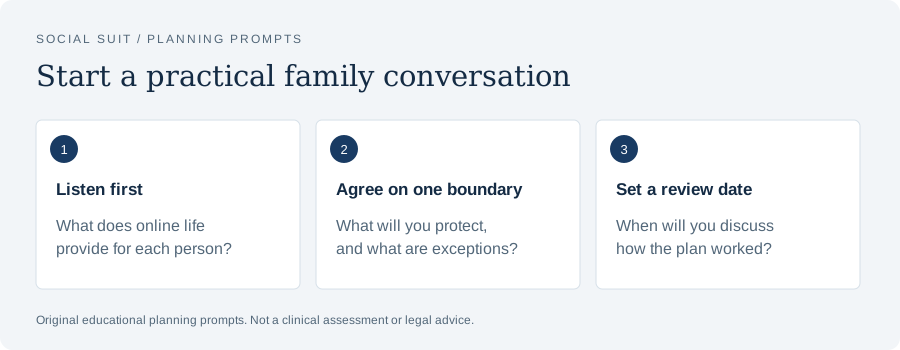
- Listen firstWhat does online life provide for each person?
- Agree on one boundaryWhat will you protect, and what are exceptions?
- Set a review dateWhen will you discuss how the plan worked?
Review the visible background
Look beyond the person in the center. A school sign, uniform, address, vehicle plate, appointment card, or screen in the background may reveal information you did not intend to share. The detail may be small in the original view and more visible when enlarged. Review the whole frame before posting. You do not need to search for an imagined threat in every object; identify the information that is unnecessary for the purpose and decide whether to remove or avoid it.
Cropping can reduce a visible detail, but it should not be treated as complete privacy protection. The remaining image or caption may still identify a location or person. A school logo may be removed while the location tag remains. A face may be hidden while a name appears on a certificate. Review the layers together. The practical question is what the finished post communicates, not whether one editing action was performed.
For a group image, notice other people’s details too. Another child may appear clearly, or a family’s private information may be visible in the setting. Ask the appropriate person before sharing where relevant. Do not assume that everyone who attended an event agreed to appear in your public account. A picture can include people who did not see the camera or had no opportunity to express a preference.
If the image contains a detail that is hard to remove safely, choose another picture or do not post it. The memory can remain in an appropriate private collection. You do not have to force every photograph into a shareable form. Selecting a different image may be simpler than applying several edits and still leaving an identifying clue. The purpose of the review is a better choice, not proving that every file can be made suitable for every audience.
Check location information as well as the scene
A photograph can include location information beyond what is visible. Apple’s current guide to photo location metadata explains that location coordinates can be embedded when the Camera app has location access, and that shared files may allow recipients to see that information. Use current official instructions for your device and sharing route. This article does not assume that every platform keeps or removes metadata in the same way.
Review both the file and the post. Removing embedded location information does not remove a visible address or a typed location tag. Conversely, omitting a public tag does not necessarily establish that the file contains no coordinates. The layers serve different functions. A practical review asks whether the purpose requires location at all and then checks the relevant controls. If the exact behavior of a sharing route is uncertain, consult its official documentation rather than relying on a general claim that all apps strip metadata.
Consider timing. A live location update can reveal where the family is now. A later post may still reveal a routine or identity, but it changes the immediate timing information. Do not represent delayed posting as a guarantee of safety. It is one possible way to reduce unnecessary real-time disclosure. The choice depends on the purpose and circumstances. A relative may be able to receive a private update without the same information appearing publicly.
Preserve useful device functions if you change a setting. Location information may help organize a personal library or support another legitimate use. You can choose what to share without necessarily removing every location feature from the device. Follow current official guidance and understand the effect before changing a control. The goal is an intentional disclosure decision, not an indiscriminate technical change that creates confusion about other functions.
Choose the smallest audience that serves the purpose
Ask who actually needs the update. If the purpose is showing a relative a school project, a direct message or selected album may fit better than a public post. If the purpose is a public celebration, consider whether the child agrees and which details are needed. There is no universal audience choice that fits every family. The useful habit is to choose deliberately rather than accept the platform’s default without checking it.
Review who is in a selected group. A family chat may include people you forgot, old contacts, or someone whose circumstances changed. An album may have contributors and viewers with different permissions. Use current official controls to understand the arrangement. Do not assume that a familiar name for the group accurately describes all current members. A smaller channel can reduce the audience while still requiring care about who has access.
Ask recipients not to repost when that matters. A clear statement can set an expectation, but it does not provide complete technical control. A recipient may copy or forward the image, intentionally or accidentally. Choose the content with that possibility in mind. If redistribution would create a serious concern, consider whether the image should be shared at all or whether another form of update can serve the purpose with less information.
Avoid ranking families morally by whether they use a public or private channel. Circumstances and preferences differ. The practical question is whether the people involved understand and accept the use, whether unnecessary details are reduced, and whether the audience choice fits the purpose. A thoughtful public post can still need limits, and a private message can still contain sensitive information. The label alone does not determine the whole privacy picture.
Do not use embarrassment as entertainment
A child’s mistake, distress, medical experience, or private struggle may be compelling content for an adult audience. That does not make it appropriate to publish. Ask whether the post serves the child’s needs or mainly invites reactions. A funny caption can feel humiliating to the person described. A positive intention does not erase that effect. Choose a way to celebrate or seek support that does not expose unnecessary private details.
If you need advice, use an appropriate channel and share only what is needed. A trusted professional or a small support conversation may be more suitable than a public post. Do not include images or identifying details merely to make the request more vivid. A question can often be asked without turning the child’s experience into a public narrative. For high-stakes health, safety, or legal concerns, seek qualified guidance rather than relying on an audience’s reactions.
Consider how the child may understand the post later. You cannot predict every future preference, but you can avoid obvious private or humiliating material now. A story that seems harmless to an adult may matter differently to a teenager. Build a process for reviewing past posts when requested. The adult’s memory of a moment is not the only relevant perspective; the person whose life appears in the post may have another.
Our guide to supporting a child after an upsetting online experience explains careful handling of disclosures. The same principle applies here: support should not require public exposure. If an incident needs evidence for reporting, handle it for that purpose rather than publishing it to generate attention. A family’s wish to help can coexist with a strong privacy boundary around the child’s experience.
Set expectations with relatives before an event
Tell relatives the sharing preference in advance where possible. A short message can explain that photographs may be taken for private family use but should not be posted publicly without checking. State the practical boundary rather than assuming everyone shares the same expectations. A relative may believe that attendance at a celebration implies permission. Clear wording reduces that misunderstanding and gives people time to plan how they will use pictures.
Offer a workable alternative if appropriate. You might share a selected image through a private channel, provide a photograph without identifying details, or suggest a picture of the event setup rather than the child. The alternative should serve the relative’s legitimate wish to connect while respecting the boundary. Do not offer an option that the child dislikes merely to avoid an adult’s disappointment. The choice should remain coherent with the purpose.
If a relative disagrees, repeat the boundary calmly and decide what action is within your control. You may need to limit access to images or ask for a post to be removed. Do not require the child to negotiate with adults or explain their discomfort repeatedly. Caregivers can communicate the household preference directly. If the situation involves coercion, danger, or a legal arrangement, seek appropriate guidance rather than treating it as an ordinary family etiquette problem.
Review the arrangement after the event. If the preference was respected, acknowledge the cooperation. If it was not, identify what happened and what needs to change. A reminder may be enough for a misunderstanding; a repeated disregard may require a different sharing route. The response should be practical, not a public campaign against the relative. The goal is a clearer future boundary and appropriate action on the existing post.
Think carefully about school and sports photographs
School events and sports activities can include many children. Ask about the organization’s current photography and sharing policy. A permission form for the organization may not answer every question about another family’s public account. Do not assume that because photographs are allowed at the event, every image can be posted with every detail. Review the policy and the people included in the particular picture.
If your child appears with teammates or classmates, consider whether to crop to your child, choose a nonidentifying image, or ask the relevant adults before sharing. The practical option depends on the event and the image. Avoid making a general legal claim about ownership or permission from the fact that you took the picture. Legal questions can depend on circumstances and applicable rules. This article focuses on thoughtful choices, not a universal rights determination.
Look for identifying details in uniforms, schedules, certificates, or location captions. A celebratory post may reveal a routine place and time. Ask whether that information is necessary. You can recognize the achievement without publishing the full schedule or a document containing personal data. The same review applies to screenshots of school portals or awards. A visible name, date, or account detail can be easy to overlook when attention is on the achievement.
If another family posts an image involving your child against your preference, contact the relevant person or organization through an appropriate route. State the request clearly and keep the tone practical. If the issue is serious or involves a safety concern, seek suitable advice. Do not promise the child that every copy will disappear immediately. Explain the actions you can take and keep them informed without turning the disagreement into public content.
Treat health and care information as a separate decision
A hospital visit, therapy milestone, or disability-related achievement may be important to the family. The child’s care information still deserves careful handling. Ask what needs to be shared, with whom, and for what purpose. A public photograph can reveal details through the setting, caption, documents, or equipment. You can celebrate support or progress without disclosing the full medical story. The appropriate choice depends on the person’s preferences and circumstances.
Do not assume that a positive story makes private information nonsensitive. A child may appreciate the support and still dislike public identification with a condition or treatment. Older children can participate in the decision, while adults retain responsibility for protection. If the post is intended to seek practical help, consider a focused private request. An audience does not need every detail to provide a meal, transport, or another specific form of support.
Avoid sharing documents, identity details, appointment information, or another person’s records in a casual post. A photograph taken for a private care purpose should not automatically become public material. If you need to transmit information to a professional, use the appropriate secure route and follow their instructions. This guide does not assess the security of a particular service or provide individualized privacy-law advice. The channel should match the sensitivity and purpose of the information.
If the child later asks to remove a care-related post, review the request seriously. You may control the original post but not every copy. Explain what you can change and ask others to remove material where appropriate. Do not use the original permission as a permanent reason to ignore a changed preference. A person’s comfort with disclosure can evolve, especially as they grow and understand the audience differently.
Keep a family album useful without making it uncontrolled
A shared album can help relatives stay connected, but its access should be reviewed. Know who can view, add, download, or invite others according to the current service’s controls. Features vary and change, so consult official documentation. A private-sounding title does not establish the permissions. The practical question is which people and accounts can use the collection and what the family expects them to do with the images.
Choose a small set of images rather than uploading everything automatically. The selection can reduce accidental inclusion of sensitive moments or unrelated people. Review captions and location details as well as pictures. If automatic sharing is active, understand what triggers it and whether it fits your preference. Do not assume that a feature’s convenience makes every added image suitable for the group. A manual check may be worth using for particular events or people.
Set a clear expectation about redistribution. Ask relatives not to repost without permission when that is the preference. Explain that the album is for the selected group, not a source of public content. This is a social boundary rather than a guarantee of technical prevention. Choose images with that limitation in mind. If one recipient repeatedly ignores the preference, consider a different arrangement instead of relying on the same request indefinitely.
Review access when family circumstances change. An account may be shared, lost, or no longer used by the expected person. A group may include old participants who no longer need updates. Use current official controls and avoid exposing passwords or sensitive details in ordinary messages. The album should remain a deliberate sharing arrangement, not a forgotten collection whose audience expands without anyone noticing.
Consider the story created by repeated posts
One image may reveal little, while a series can describe routines, locations, relationships, and personal history. Review the pattern as well as individual posts. You do not need to assume that every viewer assembles a detailed profile, but you can ask what information is repeatedly available. A school uniform, weekly activity, and caption about a routine time may together reveal more than any one detail alone.
Look at what the child’s identity becomes in the account. Are they primarily shown through achievements, mistakes, appearance, or a private struggle? The child may feel that the public story does not represent them fairly. Ask an older child about that impression. You can choose a more limited approach without requiring them to approve every adult memory. The goal is respectful representation, not a public archive of every stage of their life.
Avoid making posting a condition of participating in family activities. A child should be able to enjoy an event without repeatedly posing or accepting publication. You can take a few private pictures and then return to the experience. If the event becomes organized around content creation, notice whether the original purpose has changed. Our guide to a weekend routine with offline time discusses choosing activities for their function rather than their appearance online.
Schedule a limited review of older posts if the child requests it or if you want to change the sharing approach. Start with the most sensitive or unwanted material rather than attempting to inspect every file at once. Decide which posts to remove, edit, or restrict where the service allows. Do not promise that the review can erase all past distribution. It can still reduce the material you control and establish a clearer practice going forward.
Understand the limits of deletion
Removing your original post can be a useful action, but it may not remove copies, screenshots, or reposts. Do not make an absolute promise to the child that every version will disappear. Explain the part you control and the requests you can make elsewhere. If the material creates a serious safety or legal concern, use appropriate official guidance. A general privacy article cannot determine all available remedies for a particular image.
Keep the removal request specific. Identify the post, the action requested, and a suitable way to confirm it. Avoid adding unnecessary private information to the request. If the person refuses, consider the platform’s current reporting options or an appropriate professional route according to the facts. Do not escalate automatically through public accusations. The purpose is reducing unwanted exposure, and a public dispute may create a larger audience for the material.
For intimate or exploitative material, follow current official instructions rather than ordinary repost etiquette. The FTC’s image-based-abuse resource provides relevant guidance. Do not download or circulate sensitive content casually while seeking removal. The type of material and applicable process matter. If a child is at risk, seek suitable support promptly. A request to a relative or platform is not always the only necessary step.
After removing or restricting a post, discuss the future boundary. The child may want to be asked before new images are shared, or may prefer a particular audience. Write the expectation clearly if needed. A repair is more useful when it changes the next decision, not only the existing post. Adults can acknowledge that the original choice had an effect they did not intend and commit to a more careful process.
Avoid overclaiming what privacy law does
Privacy law and thoughtful family practice are different questions. A law may apply to a service’s collection of information without deciding every adult posting choice. The FTC’s COPPA frequently asked questions explains that COPPA covers information collected online from children and does not generally cover information collected from adults about children. That distinction should not be read as blanket approval of any adult post or as a complete account of other laws and obligations.
Do not infer a universal right to publish from owning the device or taking the photograph. Other people, organizations, agreements, and legal requirements may be relevant. If the question involves a dispute, commercial use, custody arrangement, or sensitive material, seek qualified legal advice. This article does not determine rights for a particular image. Its practical guidance can support a careful decision while leaving legal assessment to the appropriate professional.
Equally, avoid telling a child that every unwanted family post is necessarily illegal. That claim may be inaccurate and can create false expectations about removal or compensation. You can take the child’s preference seriously without making a legal conclusion. A respectful request, an access change, or a platform process may be useful regardless of whether a claim exists. Keep the action connected to the facts and the available route.
If serious documented social-media harm leads you to explore legal options, visit the separate Social Suit legal-options page for general information about review and independent intake. A family-photo concern alone does not establish eligibility, liability, or compensation. Immediate safety, healthcare, or removal needs should not wait for a legal inquiry. The resource library offers education, not individualized legal advice.
Build a simple family sharing agreement
Choose a few expectations people can remember. Ask before posting older children’s images where appropriate. Do not share private distress or sensitive care details publicly without careful consideration. Check identifying information and audience. Ask recipients not to repost when that is the preference. Provide a route for removal requests. The exact wording should fit the household and any relevant professional guidance. A short agreement is more useful than a long document nobody can explain.
Adults should follow the same principles they ask children to use. If children are told not to share a friend’s private message, adults should not publish the child’s private story for reactions. If the household values limited location disclosure, adult captions should reflect it. Legitimate differences can exist, but the purpose should remain coherent. Modeling a respectful choice makes the rule more understandable than an unexplained adult exemption.
Include a review point. Preferences can change as children grow, services add features, or the family’s circumstances shift. Ask whether the current arrangement still serves the purpose and whether any post needs attention. Do not make the review an audit of every mistake. Focus on current expectations and practical changes. Our family technology agreement guide explains how to write purposes, behaviors, exceptions, and review dates.
Keep private details out of the agreement itself. It can state that sensitive information requires care without listing a child’s medical history or a past incident. The document is a reference for future decisions, not an archive. If a specific safety arrangement is needed, handle its details appropriately. Clear rules can protect privacy without becoming another place where the family’s private information is exposed.
Four realistic posting decisions
A grandparent wants a picture from a birthday. The purpose is a private update, so the caregiver selects one image, checks other children in the frame, removes unnecessary identifying details, and uses an agreed channel. They ask that it not be reposted publicly. The arrangement preserves connection without assuming the update needs a broad audience. If the child dislikes that image, another picture or a different type of update may serve the same purpose.
An older child wins an award. The caregiver asks about the image and caption separately. The child agrees to a picture but does not want a full school name or personal story included. The post can celebrate the achievement with less detail, or remain private. The caregiver does not argue that positive publicity must be welcome. The choice respects the achievement and the person’s preference at the same time.
At a sports event, a photograph includes several teammates. The caregiver checks the organization’s current policy and considers other families’ preferences. They may choose a picture focused on their child or ask before sharing a group image. They review schedule and location details. The event’s public setting does not automatically settle every sharing question. A practical decision can avoid unnecessary exposure without turning the celebration into a legal debate.
An adult posted an embarrassing story and the child asks for removal. The adult reviews the request, removes or edits the part they control, and asks relevant recipients to remove copies where appropriate. They do not promise complete erasure. They acknowledge the effect and agree on a future check before similar posts. The repair teaches that an adult can revise a decision when another person’s experience becomes clearer.
Questions families often ask
Is a private account enough? A private audience can limit visibility, but it does not guarantee that recipients cannot copy or forward material. Review who has access and what the service’s current settings allow. Choose the content with that limitation in mind. A smaller audience is one part of the decision, alongside the image, caption, identifying details, and preferences of the people involved.
Should I blur every face? That is not a universal recommendation in this guide. Hiding a face may reduce one identifying feature while other details remain. The appropriate choice depends on the purpose, audience, preferences, and circumstances. Do not treat one edit as complete protection. Sometimes another image or no post is simpler. If you have a specific safety concern, seek appropriate guidance rather than relying only on an editing technique.
What if relatives say I am overreacting? State the practical preference and offer a suitable alternative if one exists. You do not need to persuade every person that they would choose the same rule. The household can set a boundary about its own images. If someone repeatedly ignores it, consider a different access arrangement. Keep the child out of the role of negotiating with adults or defending the family’s decision publicly.
Can a child change their mind about an older post? You can establish a process for reviewing that request. The child’s preference deserves consideration even if they once agreed. Explain what you can remove or restrict and what remains outside your control. Do not promise complete disappearance. A thoughtful repair can reduce current exposure and clarify future sharing without pretending that past distribution can always be reversed.
A quick review before the next post
Ask five questions: Why am I sharing this? Who appears or is described? What details does it reveal? Who will receive it? Are the people involved comfortable with that use? Add a timing question if the post reveals a current location. You do not need a lengthy checklist for every ordinary picture, but these questions can reveal a detail you otherwise overlook. The review should lead to a choice, not endless uncertainty.
If the answers are unclear, pause. Keep the photograph privately while deciding, ask the relevant person, or choose a smaller update. There is rarely a need to publish an ordinary family picture immediately. The memory does not lose its value because the post waits. A deliberate pause can make room for another person’s preference and a more accurate audience choice.
Thoughtful family sharing is a continuing practice. It recognizes that photographs can support connection while also revealing information about people who did not choose the audience. A useful routine keeps those purposes and responsibilities together. You can celebrate, remember, and stay in touch while asking before sharing, reducing unnecessary details, and repairing an unwanted post. The goal is respectful decisions that fit the people involved, with honest limits about what any setting or deletion can guarantee.
Sources and further reading
These primary resources provide context. Our practical examples and planning suggestions are original educational material, not validated treatment protocols. Linked organizations do not endorse Social Suit.