 Social Suit
Educational information, not individual medical or legal advice. Practical examples are hypothetical and do not describe clients or study participants. This article is not represented as reviewed by a clinician or attorney. How we prepare our guides.
Make intentional use visible
Children see phones in the middle of ordinary life. They see an adult check a message during a conversation, use a map while traveling, take a photo, answer a work call, or scroll while waiting. The device itself does not explain which of these actions is necessary, enjoyable, or distracting. Adult modeling makes that distinction visible. You can explain the task briefly, complete it, and return to the moment. The child learns that a device can serve a purpose without automatically taking over whatever was happening before it appeared.
Modeling does not require pretending that you never need technology. It requires honest, understandable behavior. A statement such as “I am checking the bus time, then I am putting this away” gives the use an endpoint. A statement such as “I have important things to do” can become an unlimited exemption if every notification receives the same explanation. Be specific enough that the child can recognize what happens next. You do not need to disclose private work information or provide a running commentary on every tap.
The purpose is not to perform perfection for a child. Adults can lose track of time, feel distracted, or choose an unhelpful habit. An ordinary repair can be part of the example: notice the interruption, acknowledge it, stop the unwanted activity, and return. That sequence shows a child what to do after a lapse. It is more useful than claiming that adults never make the mistakes for which children are corrected, or turning each adult lapse into a dramatic confession that places emotional responsibility on the child.
This guide offers original household examples and practical planning questions. It does not claim that one adult action determines a child’s future behavior. Children’s experiences are shaped by many people, circumstances, and developmental factors. Modeling is one part of a broader environment. If you have concerns about persistent distress, impairment, or safety, seek appropriate professional guidance. A change in adult phone habits can support a routine, but it cannot substitute for an assessment or guarantee that a child will avoid every online risk.
Choose one shared situation to begin
Start with a moment that recurs and matters to the household. A meal, a short conversation after school, a bedtime story, or a shared game may work. Choose a situation where you can realistically give attention and where the purpose is clear. Do not begin with a promise to put the phone away for every moment of family life. Such a promise may be impossible if you have work, care, safety, or accessibility responsibilities. A specific commitment is easier to keep and easier for a child to understand.
Explain the commitment in ordinary language. You might say that during the shared meal, optional browsing will wait so that people can hear one another. If an urgent call must remain available, name the exception without turning it into an invitation to check everything. The child should understand both the boundary and the necessary function. A coherent rule protects a particular kind of attention while preserving responsibilities that cannot simply disappear during the meal.
Arrange the environment to support the choice. Put the device in a place where optional checks require a deliberate decision, if that is compatible with your needs. Prepare any information you genuinely need beforehand. If you are expecting an essential message, identify how you will recognize it. Do not rely on repeatedly looking at the screen to see whether something important might have arrived. Where current device settings allow selective notifications, consult official instructions and test the arrangement before relying on it.
Try the shared situation for several ordinary occasions. Notice whether the interaction becomes easier and what interrupts it. If the rule fails because the timing always overlaps with a required work update, move the shared moment or clarify the exception. If it fails because optional browsing begins automatically, add a practical cue. A plan is useful when it fits the household’s actual conditions. Its purpose is to create a dependable experience of attention, not to reproduce an idealized image of family life.
Explain essential use without making it an endless exemption
Children can understand that adults have responsibilities they do not share. The explanation should connect the interruption to a specific task. “I need to confirm that Grandma’s ride arrived” is more informative than “Adults are allowed to use phones.” After the task, return to the conversation or activity. If the task takes longer than expected, explain the change. The child learns both that some interruptions are necessary and that necessary use has a practical boundary.
Keep the explanation brief. A young child does not need detailed workplace information, and an older child should not be expected to manage an adult’s employment stress. You can state that a message affects a shift or an appointment without showing private correspondence. The point is the sequence: task, completion, return. If you routinely continue into unrelated browsing, the visible sequence contradicts the explanation. Notice that pattern and choose a clearer separation between required use and entertainment.
Accessibility and health-related functions deserve the same respect. A person may use a device for communication, reminders, assistance, or other necessary tools. They should not have to reveal private information to satisfy a public family rule. Explain only what is needed for the routine. A child can learn that equal respect does not always mean identical behavior. Different people may need different arrangements while sharing the same purpose of avoiding unnecessary interruption.
If essential contact is frequent, choose a realistic promise. You might offer a short period when another adult handles notifications, or a shared activity during a less demanding part of the day. If no relief is available, say so honestly and identify the attention you can provide. Do not promise complete availability and then repeatedly break it. A modest reliable commitment can be more reassuring than an impressive rule that collapses under responsibilities the household already knows exist.
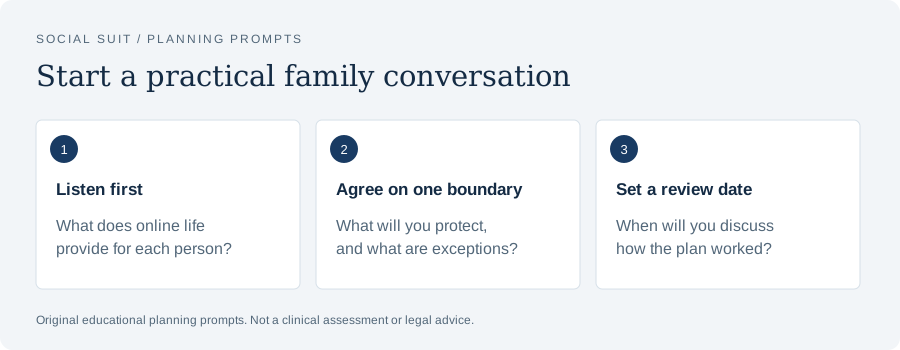
- Listen firstWhat does online life provide for each person?
- Agree on one boundaryWhat will you protect, and what are exceptions?
- Set a review dateWhen will you discuss how the plan worked?
Show the difference between checking and drifting
A check has a task and an endpoint. Drifting begins when the original task ends but the device keeps offering another item. An adult can make the distinction visible by saying, “The message is answered; I am closing the app.” This is especially useful when a child sees you reach for a phone for a legitimate reason and then remain there. The child does not need a lecture about technology design. They can understand the practical difference between completing a task and beginning a new activity.
You can also name entertainment honestly. “I want to watch a short video during my break” is clearer than disguising every session as work. A child learns that enjoyment can have a place and an ending. If the break continues longer than planned, describe that accurately. The goal is not to make entertainment shameful, but to show that a person can choose it rather than allowing it to appear under a false explanation. Honest categories make household rules easier to discuss.
Pay attention to transitions. After answering a message, stand up, put the device down, or return your attention to the person who was speaking. A visible action helps mark the endpoint. If you simply leave the app open in your hand, the next prompt may pull you back. The change does not need to be dramatic. It needs to be recognizable enough that the child sees the adult complete the task and rejoin the shared moment.
Avoid narrating every interaction so extensively that it becomes another interruption. The explanation should support attention, not replace conversation with a commentary about phone discipline. Choose the moments where the distinction matters. Over time, the routine itself can carry much of the message. A child who repeatedly sees a device used for a task and then put away gains a practical example without hearing the same speech at every meal.
Model attention during a child’s conversation
When a child begins speaking, notice whether you are available to listen. If you can stop the current activity, do so and give a clear sign of attention. If you cannot, explain when you can listen: “I need to finish this call, then I want to hear about it.” Follow through. A vague response while continuing to browse may leave the child unsure whether the message was heard. A clear delay with a return point is often more respectful than pretending to listen while missing the substance.
For a young child, the return point may need to be concrete and short. For a teenager, you can negotiate a time that fits both people. Do not use the delay repeatedly to postpone conversations you find uncomfortable. If the child asks about something upsetting or urgent, assess the need and respond appropriately. Ordinary scheduling advice does not apply when immediate safety support is required. The adult’s task is to distinguish a routine interruption from a disclosure that needs prompt attention.
If you missed part of the conversation, acknowledge it rather than guessing. Say that you were distracted and ask the child to repeat the important part once. Avoid making them retell a distressing experience repeatedly because you kept returning to the screen. When the topic is sensitive, put optional activity aside and ask focused questions. Respectful listening is part of modeling because it demonstrates what another person’s attention looks like in practice, not merely what rule they should follow with their own device.
Do not expect every child’s comment to become a long conversation. Sometimes they want to share a joke or a small observation. A brief engaged response may be enough. The key is that you respond to the actual communication. A household can contain quiet parallel activity as well as focused discussion. Modeling attention means being clear about availability and returning when promised, rather than requiring a continuous performance of interaction that nobody can sustain.
Make meals about connection rather than confiscation
If a shared meal matters to your household, explain what you want from it. You may want time to hear about the day, coordinate plans, or simply eat without optional interruptions. A device boundary should serve that purpose. Do not turn the meal into a daily inspection of who is obeying. If the conversation itself becomes only a lecture about phones, the rule may protect an empty space while removing the experience that made the boundary worthwhile.
Adults should participate in the same ordinary boundary. If you need an essential exception, explain it and return. Avoid browsing while asking a child why they cannot pay attention. Children can recognize this inconsistency even when they cannot explain it politely. You can address a disrespectful tone separately while still considering the observation. A child’s imperfect wording does not automatically make the practical point false.
Prepare the meal’s beginning if devices usually fill the waiting period. Let people know when food will be ready, give children an age-appropriate way to help, or provide a simple activity while waiting. An indefinite delay can lead everyone toward their screens. The solution is not always stricter enforcement; it may be clearer timing. A rule that starts when the meal actually begins may be easier to understand than one that applies from an uncertain preparation stage through cleanup without explanation.
If the household does not eat together regularly, choose another shared moment. Shift work, different schedules, health needs, or living arrangements may make a daily family dinner unrealistic. A short breakfast, a weekly meal, or a conversation during another routine can still matter. The principle is purposeful attention in a feasible setting. Do not treat one conventional family practice as the only valid form of connection or make children responsible for adult scheduling limitations.
Let children see a boundary with other adults
Modeling includes how you respond to messages from friends, relatives, and colleagues. If every nonurgent request receives an instant reply during a shared activity, a child may conclude that continuous availability is expected. You can show another option by replying later or telling someone when you are available. A short message such as “I will respond after dinner” demonstrates that a relationship can continue without occupying every moment. Use this example where the contact is genuinely nonurgent and the boundary is compatible with your obligations.
Do not ask a child to watch you set a boundary as a performance. The example can be ordinary and brief. You might mention that a friend knows you will call tomorrow, then return to the activity. The child sees that a delayed response does not necessarily mean rejection. This can be useful when they face group-chat pressure, but it does not guarantee their peers will respond similarly. Discuss the differences rather than assuming adult social arrangements solve a teenager’s situation.
Work boundaries may be constrained. If your job requires immediate contact, explain that specific responsibility without suggesting that all adult messages are equally urgent. Where you have discretion, use it intentionally. Where you do not, avoid promising a boundary you cannot keep. A child can learn from honest limits as well as from successful ones. You might choose a shared activity during a less demanding period or arrange support if another adult is available.
Be careful not to involve children in adult conflict. If a relative reacts badly to a delayed reply, the child does not need to manage the disagreement or decide whose behavior was right. You can explain the general principle that people may be unavailable while keeping private details private. Modeling should offer a usable example, not recruit the child as an audience or ally in an adult dispute. The household’s boundary is a practical arrangement, not a public judgment about everyone who contacts you.
Model privacy by how you share the child’s life
Your own posting decisions are part of the example. Before sharing a child’s image or story, consider the audience, identifying details, and whether the child is comfortable with the choice. Older children can express preferences about being included. A request not to share deserves serious consideration. Modeling privacy means showing that another person’s experience is not automatically available for publication merely because you were present or took the photograph.
Look beyond the face in the image. A background may reveal a school, routine location, address, or other detail. A caption may add information the image did not show. These are reasons to review the particular post, not to claim that every family photo inevitably causes harm. Choose what is necessary for the purpose and reduce details that do not need to be public. A private sharing arrangement may fit better, while still requiring thought about who can copy or forward material.
Do not post a child’s mistake or distress as a lesson for an audience. The child may experience that as humiliation, and it can contradict your advice about respectful sharing. If you want support from trusted people, share only what is needed through an appropriate channel. A public post is not the only way to seek help. When a serious incident occurs, preserve relevant information for the appropriate purpose rather than turning the event into content.
If you already shared something the child dislikes, discuss what can be changed. You may be able to remove a post or ask someone else to remove a copy, but do not promise that every copy will disappear. Acknowledge the request and explain the actions you can take. The repair models responsibility for information. It shows that privacy is not only a rule for children’s accounts; adults also need to consider the effect of their own choices on other people.
Show how to question a persuasive message
When appropriate, explain why you are checking a claim before acting on it. A product recommendation, a dramatic headline, or an influencer’s confident statement can invite an immediate response. You can model a pause: who is making the claim, what evidence is available, and whether the message has a commercial purpose. Keep the discussion connected to a real decision. A child learns more from seeing you compare relevant information than from hearing that everything online is untrustworthy.
Distinguish uncertainty from cynicism. Some claims are reliable, some are incomplete, and some are misleading. You do not need to reject all information to avoid accepting it automatically. If you cannot establish whether a claim is true, say so. “I do not know yet” models an appropriate response. A child can learn that confidence is not proof and that checking a source is a normal part of deciding, not a sign of weakness.
Avoid involving children in high-stakes adult decisions beyond what they can appropriately understand. You can explain that you will consult a qualified professional about a health or legal question without asking the child to evaluate the full matter. The example is that a general post does not replace individualized advice. Keep private records and sensitive information out of casual browsing or public comments. Modeling includes choosing the right channel for a question, not just evaluating the text of an answer.
If you discover that you shared something inaccurate, correct it in a proportionate way. Explain what changed and update the relevant message where possible. Do not insist on defending the original claim merely because you posted it. The child sees that an error can lead to a correction. This example may be particularly valuable in a household that wants children to ask questions openly. Adults who can revise a claim make it easier for children to admit uncertainty too.
Model chosen entertainment without shame
Entertainment can have a legitimate place in adult life. A child does not need to see every enjoyable use disguised as work or education. You can say that you are taking a break, choosing a program, or playing a game. Give the activity a place that fits your responsibilities and, where useful, an ending point. The example is not that adults must avoid enjoyment. It is that enjoyment can be intentional and can coexist with care, relationships, and necessary tasks.
Notice whether the activity has a natural endpoint. A chosen episode or game session may be easier to discuss than an endless feed. If you prefer the feed, choose a cue for reassessment. The cue does not have to become a strict rule every time. It helps you notice whether you are still doing what you intended. A child can learn that a new item is a new choice, rather than assuming the original break continues indefinitely because content keeps appearing.
Avoid describing a child’s entertainment as pointless while treating your own as inherently meaningful. Adults may also enjoy trivial or repetitive content. The important questions concern timing, content, effect, and responsibilities. You can set age-appropriate boundaries without pretending that only adults have worthwhile preferences. Ask what the child enjoys and explain the particular concern. Respect for an interest makes it easier to discuss a limit that protects another priority.
If you decide an activity is not working well for you, describe the change concretely. “I keep losing the bedtime transition in this feed, so I am leaving it closed after this point” is more informative than “Phones are ruining our lives.” The child sees an observation connected to an adjustment. The change does not need to become a universal rule for every person and platform. Modeling works best when the behavior follows a reason that can be understood and reconsidered.
Repair an interruption in a way a child can use
When you interrupt a conversation with optional browsing, acknowledge the actual behavior. “I looked away while you were speaking” is clear. Then return attention and ask for the important part if you missed it. Avoid a long explanation that makes the child reassure you. The repair should restore the interaction. A brief acknowledgment followed by changed behavior is often more useful than an elaborate apology followed by another check.
If the interruption was necessary, explain that too. You might say that an urgent call required attention and that you are now available. Do not apologize for every essential responsibility as if it were a moral failure. The child needs to understand the difference between a necessary interruption and an avoidable one. Both can be handled respectfully. The common element is clarity about what happened and a return to the promised interaction when possible.
If the same lapse repeats, change the setup. Put the device somewhere different, reduce nonessential prompts, or choose a shorter shared commitment that you can actually keep. A repair loses credibility when the adult uses the same words repeatedly without examining the pattern. Ask whether a responsibility genuinely conflicts with the chosen moment or whether the device remains too convenient for optional use. The answer determines whether to adjust the timing, the environment, or the expectation.
Invite a respectful reminder if you want one. Agree on the wording and how often it will be used. A child should not become responsible for policing adult behavior all day. The reminder is a limited support for a shared routine, not a new role that requires constant monitoring. If the child points out a lapse without the agreed wording, consider the observation before addressing tone. The adult’s responsibility remains their own.
Keep the example realistic during stressful periods
Stress can make an ordinary routine harder. A work deadline, illness, financial concern, or caregiving demand may require more device use or leave less attention available. Explain the temporary change in a way that fits the child’s age. You can say that this week has more necessary calls and identify the shared moment you can still offer. Do not promise the usual routine if you know it is unlikely to happen. A realistic plan reduces confusion and disappointment.
Preserve basic connection where possible. A short check-in, a familiar bedtime step, or a shared snack may be more feasible than a long activity. The child should not have to create an impressive conversation to receive attention. A small reliable moment can matter. If the household needs outside support, seek it through appropriate people or services. Modeling intentional phone use cannot solve a lack of resources or remove every demand on a caregiver’s time.
Do not use stress as an explanation for every optional session without examining the effect. Browsing may provide a break, but it may also postpone food, sleep, or a conversation you intended to have. Notice what the session does in the actual moment. You can keep chosen entertainment while changing a sequence that repeatedly leaves basic needs unmet. The child sees that stress is a circumstance to account for, not an unlimited excuse or a reason to demand impossible perfection.
If your own distress, fatigue, or concentration difficulties persist, consider professional support. This guide does not determine whether phone use is a cause, a symptom, or an unrelated habit. A clinician can help assess your circumstances. Keep the child out of the role of diagnosing or treating you. You can model seeking appropriate help without sharing details that place adult emotional responsibility on them. The example is that support can be sought when ordinary routine changes are not enough.
Include more than one caregiver where possible
If several adults share care, discuss the modeling goal together when safe and feasible. You may agree on one shared boundary and explain differences elsewhere. A child should not have to interpret contradictory adult behavior without guidance. For example, one caregiver may need a device for a shift update during a meal while another does not. The difference can be explained by the task rather than by claiming that one adult’s preferences are more important.
Do not use the child to deliver criticism between caregivers. If you disagree about a routine, address it through appropriate adult communication. The child needs clear expectations in the current setting, not a responsibility to decide which adult is right. Where households differ, explain the local rule and its purpose without turning the difference into a loyalty test. If there is coercion, danger, or a legal arrangement affecting communication, seek suitable guidance rather than applying generic cooperation advice.
Adults can share the practical work that makes attention possible. One person may handle an essential call while another begins the meal or listens to the child. Later, they can exchange responsibilities if circumstances allow. This arrangement acknowledges that attention has logistical requirements. It also avoids a pattern in which one adult always appears available because another adult silently manages every task. The child can see cooperation without needing access to private details.
If you are the only available caregiver, choose a plan that does not depend on an absent helper. A short reliable routine, clear explanations, and prepared transitions may be more realistic. You do not need to reproduce a two-adult example to model care. Acknowledge the limits and preserve what you can. The quality of the example comes from coherence and honesty, not from the number of adults in the household or the amount of uninterrupted time they can provide.
Ask children what they notice without making them judges
At a calm time, ask whether the shared routine is working. A child may notice that the device is still present, that a promised return did not happen, or that a particular moment feels easier. Listen for useful information. Do not ask the child to give you a score as a parent or reassure you that you are doing everything well. The question concerns a routine that can be adjusted, not a verdict on your worth.
For a younger child, use concrete choices. Ask whether the story was easier to hear when the phone was on the shelf, or whether they knew when you would finish the call. For a teenager, ask which adult exceptions are clear and which feel inconsistent. You can explain a legitimate responsibility while admitting that an optional check did not serve it. The discussion can remain practical even when the feedback is uncomfortable.
Avoid making the child responsible for maintaining the rule. Adults decide and manage their own behavior. A reminder may be welcome in a specific situation, but constant monitoring is not the child’s job. If the routine depends on the child catching every lapse, change the environment or expectation. The agreement should reduce conflict and uncertainty, not create a reversed caregiving role in which a young person manages the adult’s attention.
Notice feedback about the interaction itself. Perhaps the child wants a quieter conversation, a different time, or less questioning during the shared meal. A device-free moment is not automatically a good moment if the conversation feels uncomfortable or critical. Consider the content and tone alongside the boundary. Modeling attention means showing that another person’s experience matters, not merely removing a screen while continuing a routine that nobody enjoys.
Questions parents often ask about modeling phone habits
Do I have to follow exactly the same rules as my child? Not necessarily. Age, responsibilities, development, and accessibility can justify different arrangements. Shared purposes should remain coherent, and differences should have an understandable reason. A work call may be necessary for an adult; optional browsing during every meal may not be. A child’s required school tool may deserve an exception too. Fairness is not identical behavior in every circumstance. It is a clear relationship between the rule, the need, and the person’s situation.
What if I need my phone constantly for work? Identify which contact is truly required and which use is optional. Make a realistic commitment in a less demanding window if one exists. Explain temporary or ongoing constraints without placing work stress on the child. If current device settings can preserve required contact while reducing other prompts, use official guidance and test the setup. If the constraints cannot change, choose the attention you can reliably provide rather than promising a rule that you repeatedly break.
Should I tell my child I use my phone too much? Describe the actual pattern instead of a broad label. You might say that optional browsing has been interrupting a shared moment and that you are changing the setup. The child does not need to assess or fix you. A concrete observation and adjustment model responsibility without turning the conversation into an adult confession. If you need support with a persistent problem, seek it from appropriate adults or professionals.
Will better adult habits prevent social-media harm? No routine can guarantee that. Adult modeling can make expectations clearer and support conversations, but a child’s experiences also depend on platforms, peers, content, circumstances, and many other factors. Keep safety guidance and help pathways available. If a serious incident occurs, respond to the actual risk and seek appropriate support. Do not blame yourself or the child on the assumption that perfect modeling would have prevented every possible event.
A one-week practice that stays manageable
Choose one shared moment and one visible behavior. For example, during a short after-school conversation, optional browsing stays closed. Identify the essential exception and the return point if it occurs. Prepare the device’s location or settings if needed. Tell the child the plan briefly. Then use it without repeatedly narrating the effort. The routine should make the interaction easier, not draw all attention toward the adult’s discipline.
After a few occasions, record what happened in a simple way. Did you return when promised? Did essential contact remain available? Did optional checks interrupt the moment? What made the boundary difficult? These questions lead to practical changes. You may need a different time, a clearer task endpoint, or a less convenient place for the feed. Do not add many new rules because one small practice revealed a difficulty. Improve the chosen routine first.
Ask the child for one observation if appropriate, then decide the next version yourself or with other caregivers. Keep a behavior that worked. Clarify an exception that caused confusion. If the plan was unrealistic, make it smaller. A modest commitment kept regularly provides a clearer example than a sweeping declaration followed by repeated lapses. The practice is successful when it teaches a recognizable sequence of choice, attention, interruption when necessary, and return.
For related guidance, read our family technology agreement article, our guide to talking with a teenager about social media, and our article about sharing family photos thoughtfully. If you are exploring serious documented social-media harm and potential legal review, the separate Social Suit legal-options page explains that pathway. This modeling guide does not establish legal eligibility, diagnose a condition, or promise prevention. Its purpose is practical clarity about how adults can use devices while making care, respect, and intentional attention visible to children.
Keep the next step visible
Before the shared moment begins, decide what you will do if an optional notification appears. You might leave it until afterward or note the task without opening a feed. A simple prepared response reduces the decisions required in the moment and makes the boundary easier to explain.
Separate a photograph from a public post
A child may enjoy having a photograph taken without wanting it published. Make that distinction explicit. You can keep a picture for a private family memory while deciding separately whether to share it. Ask an older child about the audience and caption, not only whether the picture looks good. If they object, discuss what they are concerned about and respect appropriate limits. The conversation demonstrates that consent to one action does not automatically imply consent to every later use.
Consider the timing too. Taking a quick photograph at the beginning of an activity may be less disruptive than repeatedly stopping to capture every stage. If documenting the event becomes the main task, notice whether the shared experience is still serving its original purpose. You do not need a public record to prove that the family spent time together. A private memory can remain valuable without receiving reactions, and the child can learn that an event does not require an audience to matter.
When another adult wants to post the child’s image, communicate the household preference calmly and directly. Explain the practical boundary rather than asking the child to negotiate it alone. If a picture is shared against the preference, seek a correction through appropriate channels without promising that all copies can be removed. The example remains one of care, clarity, and proportionate action.
Sources and further reading
These primary resources provide context. Our practical examples and planning suggestions are original educational material, not validated treatment protocols. Linked organizations do not endorse Social Suit.