 Social Suit
Educational information, not individual medical or legal advice. Practical examples are hypothetical and do not describe clients or study participants. This article is not represented as reviewed by a clinician or attorney. How we prepare our guides.
What a first legal consultation can and cannot establish
A first conversation about a possible social media harm lawsuit should help you understand the questions that matter in your circumstances. It should not require you to decide, before anyone has reviewed the facts, that a platform caused every problem in your life. The useful starting point is narrower: what happened, when it happened, what information exists, and which qualified lawyer can explain whether those facts fit a potential legal theory. You can arrive with uncertainty. A careful consultation makes that uncertainty more specific rather than covering it with a promise.
This guide is for people preparing questions, including parents helping a young person, adults looking back at experiences during adolescence, and people trying to understand advertising about social media claims. It offers an organizational method, not an assessment of your eligibility. Social Suit does not present this article as legal advice, a law firm opinion, or a medical diagnosis. Individual requirements can depend on jurisdiction, the particular defendants and allegations, evidence, timing, and procedural developments. A qualified attorney must address those questions for the actual person involved.
You do not need a perfectly assembled evidence file to ask a lawyer about deadlines or whether a consultation would be appropriate. Waiting until every document is available can be a poor trade if a deadline is approaching. Instead, distinguish the information you already have from material you could obtain later. A short factual summary may be enough for an initial screening conversation, while a fuller review may require records and consent. Ask which stage you are in so you know whether the person is screening an inquiry, considering representation, or already acting as your lawyer.
A sound first meeting should end with understandable next steps. Those steps might be to gather a particular record, clarify a date, speak with a healthcare professional, consult someone licensed in another jurisdiction, or decide that the matter is outside the lawyer's practice. A decision not to take a case is not a diagnosis of your experience and does not necessarily mean no other legal route exists. Equally, an invitation to complete an intake form is not a guarantee of representation or compensation. Treat each step according to what it actually establishes.
Keep health and immediate safety separate from claim preparation
If someone is in immediate danger, obtaining help comes before organizing a claim. In the United States, call emergency services for an imminent emergency. For suicidal thoughts or emotional distress, the 988 Suicide & Crisis Lifeline can be reached by calling or texting 988. A website inquiry, evidence folder, or appointment with a lawyer is not an emergency response. Do not delay urgent care because you want to preserve the perfect account of what happened online. The person's safety matters more than a complete archive.
For concerns that are not immediate emergencies, a healthcare appointment and a legal consultation serve different purposes. A clinician can assess symptoms, functioning, risks, and treatment options. An attorney can explain legal rights and obligations. Neither conversation should be forced to replace the other. You do not have to establish a lawsuit before discussing sleep loss, anxiety, low mood, compulsive checking, eating concerns, or other difficulties with a provider. Likewise, a diagnosis does not by itself establish that a specific company is legally responsible for a particular injury.
When preparing for a clinical appointment, describe concrete changes in everyday life. A provider may understand a pattern more clearly when you explain that you repeatedly stayed awake despite intending to stop, missed school, stopped participating in activities, or felt distressed after particular interactions. Describe other circumstances too, including relevant stress, medications, prior health concerns, and changes in relationships. The NIMH preparation resource recommends discussing symptoms and questions with a healthcare provider. Do not edit your account to make a legal narrative look cleaner; accurate care requires the broader picture.
Avoid asking a young person to repeatedly retell painful events solely to improve an intake story. Agree on a way to share the necessary information once, with breaks and appropriate support. If a lawyer later needs more detail, discuss how that can be obtained with the least unnecessary distress. You can ask whether a written timeline or existing records would reduce repetition. Supporting the person and documenting events are compatible goals when the process respects their privacy and capacity. A legal inquiry should not become another demanding environment in which they feel evaluated or blamed.
Build a factual timeline before trying to prove a theory
Begin with a timeline that separates events from interpretations. An event is something like creating an account, changing a device, receiving a message, attending an appointment, or missing a particular activity. An interpretation is a conclusion about why that event happened or what it proves. Both may matter in a consultation, but mixing them can make an otherwise useful record hard to assess. Write the observation first. Put uncertainty in a separate sentence: you remember the change happened during a school term, but you do not yet know the exact month.
A practical timeline can have six fields: approximate date, age at the time, platform or account, observed event, source of the information, and confidence in the date. For example, a family might remember that late-night use became more frequent during a move, while a saved message gives an exact date for an argument. Label the first entry as recollection and the second as supported by a record. Neither should be presented as more precise than it is. A lawyer can then identify where additional evidence would matter and where an approximate account is sufficient initially.
Include the period before the harm you are concerned about. This can reveal the difference between an existing difficulty, a new problem, and a change in severity. It can also show beneficial uses that continued alongside a harmful pattern. A person may have used one platform for supportive conversations and another for distressing recommendations. Describing that difference helps avoid the unrealistic impression that all online experiences had one effect. A credible chronology does not need to erase helpful contact or inconvenient facts. It needs to make the sequence understandable.
Keep the first version short enough that someone else can follow it. If the account spans several years, begin with a one-page overview and maintain detailed notes separately. Mark the most important turning points rather than listing every session. You might group entries under first use, increasing difficulties, help sought, major incidents, and current circumstances. Ask the attorney whether those categories are useful for the review. There is no universal template that proves a claim. The purpose of the timeline is to support clear questions and reduce avoidable confusion.
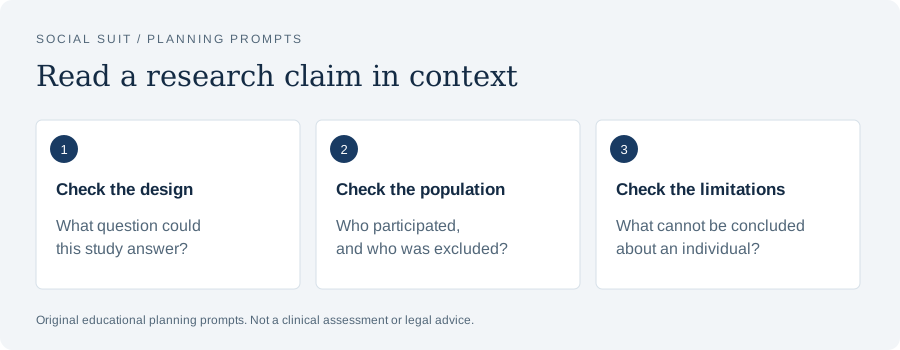
- Check the designWhat question could this study answer?
- Check the populationWho participated, and who was excluded?
- Check the limitationsWhat cannot be concluded about an individual?
Distinguish platform exposure from specific experiences
Saying that someone used social media is only the beginning of an account. Different activities within a platform can have very different contexts: messaging friends, watching recommended videos, following a creator, joining a group, posting images, receiving harassment, or participating in a challenge. For each concern, ask what the person actually encountered or did. If you cannot remember, say so. Do not replace missing details with assumptions about how recommendation systems usually behave. The attorney needs to distinguish your experience from general criticism of an industry.
Consider an illustrative example, not a case result. A teenager says a feed repeatedly showed distressing material. A useful preparation note would identify the period, whether the material appeared through recommendations or followed accounts, any saved examples, and the impact the teenager remembers. It would also record what they did next, such as reporting content, blocking accounts, changing settings, or seeking help. A less useful note would simply declare that an algorithm intentionally harmed them. The latter skips questions about the actual sequence and states a conclusion that may require evidence beyond the family's knowledge.
Another example involves social comparison. Someone might recall feeling worse after viewing carefully edited images, but not remember the accounts or dates. That experience is still worth discussing with a healthcare provider. For a legal review, ask what additional information would be relevant rather than inventing specifics. Existing photos, messages, appointment records, and recollections from the time may help describe the period. The absence of a screenshot does not justify creating a reconstruction and calling it original evidence. Keep recreated explanations clearly separate from contemporaneous material.
It may help to list accounts and devices without making changes to them. Record usernames you remember, old email addresses associated with accounts if known, approximate periods of use, and whether an account remains accessible. Do not send passwords to an intake service. Do not access another person's account without appropriate permission. If preservation could become important, ask the lawyer how to manage an account before deleting it, editing old posts, or making broad changes. Day-to-day safety measures and legal preservation questions sometimes interact, so seek individualized guidance when the situation is significant.
Make a record inventory, not a public evidence collection
An inventory tells you what exists without requiring you to upload everything. Possible categories include appointment records, school communications, saved messages, account exports, device usage reports, photographs, platform reports, and notes created at the time. List each category with where it is kept, who controls access, and whether obtaining a copy would require a request. This can be a simple private document. The first consultation may only require a description of these materials. Ask before sending sensitive records, particularly when you have not verified who will receive them.
Separate original files from working notes. If you annotate a screenshot to explain what it shows, keep the unedited original separately and clearly label the annotated copy. If you transcribe a message, retain the source where possible and identify the transcription as a transcription. Avoid cropping away context that changes the meaning. A lawyer may need the surrounding conversation, account identity, dates, or other details. Your task is not to select only the most persuasive fragments. It is to preserve an accurate account and let a qualified reviewer explain what matters.
Do not redistribute harmful material to prove that it was harmful. Some content may be dangerous, deeply private, unlawful to possess or share, or distressing for the person affected. Ask an appropriate professional how to document the existence of the material safely. Sometimes a link, report reference, descriptive note, or lawful record can be discussed without circulating the content itself. Never ask a minor to collect explicit material as evidence. If you encounter material involving exploitation or immediate threats, use appropriate reporting and emergency channels rather than treating it as a routine intake attachment.
Store the inventory in a place the affected person can reasonably control. A shared family cloud folder may expose records to relatives who do not need them. A school computer may be inappropriate for private healthcare information. Consider access permissions, account security, and the minimum number of copies needed. Before submitting anything through a website, read who operates the form and how information will be used. The Social Suit support email is for website inquiries; it is not an invitation to email medical files or a detailed evidence package.
Ask about deadlines early and avoid internet deadline arithmetic
One of the first questions for a lawyer should be whether any deadline could affect your circumstances. Do not assume that a deadline you see in a social media advertisement applies to every person or every claim. Legal time limits can depend on location, age, the type of claim, when relevant events occurred, when information was discovered, and other facts. The purpose of asking early is not to frighten yourself into signing a document. It is to obtain a specific explanation from someone qualified to evaluate the actual situation.
Provide the dates you know and explain where they are approximate. Tell the lawyer where the person lived during the relevant periods and where they live now. If the person was a minor, give their age at the key events. Ask whether any rules involving minors, discovery of harm, or other circumstances could matter, while recognizing that those concepts do not create a universal extension. An attorney should explain the applicable analysis rather than relying on a generic countdown. You should understand what action, if any, is needed and why.
Do not treat submitting an online inquiry as filing a lawsuit or preserving a deadline. Ask explicitly what the inquiry does. Does it simply request contact? Has anyone agreed to represent you? Has a complaint been filed? If a filing is necessary, who is responsible and when will you receive confirmation? Those questions matter even when an intake process looks polished. A confirmation email that says your information was received may mean only that a form arrived. It should not be interpreted as a court filing or an attorney-client engagement without clear evidence.
Keep notes about deadline advice you receive, including the attorney's name, date, and the facts on which the advice was based. If your circumstances change or you discover a significant date was wrong, inform the lawyer promptly. If you speak with more than one attorney and receive conflicting explanations, ask each to clarify the assumptions rather than trying to reconcile unfamiliar legal rules alone. A written explanation can be useful. The goal is an actionable understanding of your own situation, not a formula that appears to work for everyone reading an article.
Understand the difference between an allegation and a legal outcome
A lawsuit contains allegations: claims about facts, responsibility, and the legal consequences sought. The existence of a complaint does not establish that every allegation is true. A court may allow some issues to proceed without deciding that the defendants are liable. A procedural ruling can address which arguments may be litigated, what information must be exchanged, or how cases will be managed. When reading coverage, identify the stage of the proceeding before turning a headline into a conclusion about what a person will recover.
Federal multidistrict litigation involving social media adolescent addiction and personal injury has been organized as MDL 3047. A Northern District of California case management order provides a primary example of the procedural documents issued in that litigation. Such a document is useful evidence that a proceeding and management process exist; it is not proof that an individual visitor to this site has a valid claim. If a lawyer mentions that litigation, ask how your inquiry relates to it and which current court documents support the explanation. Do not rely on an old schedule as though it were a current outcome.
The terms class action, multidistrict litigation, individual lawsuit, and settlement program should not be used interchangeably in your own understanding. Ask the attorney what form of proceeding is relevant and what that means for your participation. Would your circumstances be evaluated individually? Would a separate complaint be filed? Are there forms, records, or discovery obligations? What role does the particular law firm have? A lawyer should be able to explain these concepts in language you can follow. You do not need to master civil procedure before requesting that explanation.
Be especially cautious with headlines announcing a large verdict or settlement elsewhere. An amount reported in one case may involve different facts, defendants, claims, proceedings, and allocation rules. It does not provide a reliable calculator for your situation. Ask whether the cited result is final, whether appeals or other proceedings matter, and whether it is meaningfully comparable. If a website cannot identify the underlying result, treat the number as unverified. A legal review should discuss the range of uncertainty, including the possibility of no recovery, rather than using another person's result as a promise.
Prepare questions about causation without forcing a single explanation
A person's history may contain several factors that affected health or functioning. Recognizing those factors does not mean dismissing a troubling online experience. It means keeping the account accurate. In a consultation, describe relevant earlier symptoms, family or school stress, offline harassment, changes in sleep, treatment, and other circumstances. An attorney can explain how causation would need to be addressed legally. A clinician can explain their assessment. You should not be asked to decide the entire causal question based on a marketing page or a short intake call.
Useful questions include: what would you need to establish about the relationship between platform use and the reported harm; what information would support or complicate that evaluation; and who would make any necessary professional assessments? Ask whether the review depends on medical records, testimony, expert analysis, or other materials. The answers may differ by claim and stage. Write down uncertainties openly. For example, you might know that difficulties worsened during a period of heavy use but not know whether one preceded the other. That distinction is important and honest.
Avoid drafting a statement that sounds more certain than the person actually is. An intake form may offer a checkbox asking whether social media caused a condition. If the answer is uncertain, ask how to describe the experience without making an unsupported assertion. Do not select a diagnosis from a list simply because you think it improves eligibility. Do not adopt an influencer's terminology as a clinical finding. Records should represent what was observed, what a professional actually concluded, and what remains unknown, each identified separately.
A useful example is a parent recalling several months of school absence and late-night scrolling. The timeline may show both patterns, but that alone does not tell the family exactly why the absences happened or who is legally responsible. Preparing for a consultation means gathering the school dates, clinical history if available, and the child's account without instructing them what to say. The attorney can then ask targeted questions. A stronger preparation process improves clarity; it does not manufacture certainty or require the family to become its own expert witness.
Ask who will represent you and what the intake service actually does
Online legal marketing can involve several organizations. A website may educate readers, collect inquiries, route them to an intake provider, or advertise on behalf of a firm. Before sharing sensitive details, ask who operates the form and who will contact you. If a lawyer is proposed, obtain the name of the firm and the attorney responsible for the matter. Ask where that person is licensed and how representation would work if the relevant jurisdiction is different. A brand name alone does not answer those questions.
Clarify the status of the relationship at each step. Completing a questionnaire may be an inquiry. A phone call may be screening. Receiving a proposed agreement may be an offer to establish representation subject to its terms. Ask when, if ever, an attorney-client relationship begins and what confirmation you will receive. Do not infer representation from friendly language, a case number assigned by an intake system, or a claim that your submission was accepted. An internal reference number may simply help a company find your form.
Ask who handles questions after the initial contact. Will you communicate with an attorney, case manager, outside call center, or another organization? What is the ordinary response time? How do you update records or contact information securely? What happens if the firm decides not to proceed after a fuller review? Will it explain that decision, return relevant materials, and identify any deadlines it has discussed? These are ordinary service questions. Asking them is not an accusation; it is a way to understand who is responsible for what.
Verify contact details independently when a request seems unusual. An unexpected message asking for payment, an account password, or a verification code deserves caution. Use an official firm website or a phone number you have independently confirmed rather than a link in the message. The FTC's phishing guidance explains the importance of avoiding deceptive requests and using trusted channels. Legal claim advertising does not make a direct message trustworthy. You can pause an inquiry to verify the recipient without giving up the right to seek advice elsewhere.
Read fees, costs, and authorizations before signing
Ask for a written explanation of fees and costs before signing a representation agreement. If a contingency arrangement is proposed, ask how the percentage is calculated, whether the calculation occurs before or after costs, and which costs you could be responsible for. Ask what happens if there is no recovery, if representation ends, or if another firm becomes involved. Do not assume the phrase no upfront fee resolves every financial question. The actual agreement and applicable rules matter. Request clarification on any language you cannot explain in your own words.
Look separately at authorizations to obtain records or share information. A healthcare release, a representation contract, a consent to receive marketing calls, and a platform account authorization may have different purposes and consequences. Ask why each document is needed, what information it covers, who may receive it, and how long it applies. Avoid treating a bundle of documents as one unavoidable checkbox. You can request copies and time to review them. If someone insists that careful reading will make you lose a guaranteed payout, that is a reason to scrutinize the process.
Discuss the affected person's role if they are a minor or if someone else is helping manage the inquiry. Who is authorized to sign? How will the young person's preferences and privacy be considered? What happens when they reach adulthood? Are there special steps for handling any potential settlement? A qualified attorney should explain the relevant requirements. A parent or caregiver should not assume that ordinary account access answers every legal consent question. Equally, an intake operator should not substitute a general script for an individualized explanation when legal authority is unclear.
Keep a complete copy of whatever you sign, including attachments and the version of terms incorporated into the agreement. Record the date and how the document was delivered. If a signature platform displays only a short summary, ask for the full document before completing it. Later disagreements are harder to resolve when no one can identify the actual terms. A well-organized file includes both the questions you asked and the answers provided. This is useful administrative preparation, not a substitute for independent legal advice about a contract.
Discuss privacy, public exposure, and the burden of participation
A possible claim can involve personal information, including health history, family circumstances, school records, and online activity. Ask what could remain private, what might need to be disclosed to other parties, and what could become part of a public court record. Do not assume that every conversation with every intake company has the same confidentiality protections as communication with your own attorney. The recipient, purpose, and legal relationship matter. A lawyer can explain the applicable protections and their limits for your circumstances.
Ask what participation might involve beyond submitting the first form. Could there be questionnaires, record requests, interviews, sworn testimony, or other obligations? How much time might be required, and who helps organize the response? What happens if the person finds the process distressing? How should safety concerns be addressed? Asking these questions does not mean you are unwilling to cooperate. It helps the affected person make an informed decision and lets the firm describe the actual demands rather than presenting litigation as a single effortless click.
Do not post an account of your prospective claim publicly to obtain feedback. A public story can reveal sensitive details, attract deceptive messages, and create statements that may later be examined out of context. Ask an attorney before discussing a matter publicly or responding to comments about it. This does not mean you must hide distress from trusted support people. It means choosing the right audience and level of detail. A private conversation with a provider or trusted person has a different purpose from a public post naming defendants and predicting a result.
Plan for everyday communication boundaries. If several family members are helping, choose one place for administrative updates while limiting access to sensitive records. Keep the affected person informed in an age-appropriate way and avoid making them answer every message immediately. Ask the legal team which requests are urgent and which can wait. An organized process can reduce the feeling that the possible claim has taken over family life. The legal inquiry is one part of the response to harm; it should not displace care, education, relationships, or recovery goals.
Use a focused question list for the first meeting
Start by asking the attorney what facts would determine whether they can assess the matter. Then give the short timeline and identify the records you have. Ask whether the firm handles this kind of claim, whether another jurisdiction or attorney may be needed, and whether any deadline requires prompt action. This sequence helps avoid spending the entire appointment discussing general news coverage. Your circumstances should lead the conversation. If the lawyer needs to explain a broader proceeding, ask how that explanation changes the next step in your own inquiry.
The next set of questions should address evidence and uncertainty. Which records would be helpful now? Which materials should be preserved without sending them yet? What should you avoid deleting or changing? How should you document an account you can no longer access? Does the lawyer need information about prior health concerns or other stressors? How will missing records be handled? Do not ask what story would produce the best result. Ask what truthful information is needed for a fair evaluation and how to provide it safely.
Finally, ask about representation, costs, communication, and outcomes. Who would be responsible for the case? What agreement would establish the relationship? How are fees and expenses calculated? What could participation require? What are the major uncertainties? What happens if the firm does not proceed? When should you expect an answer, and how will you receive it? A useful answer may be conditional because the review is incomplete. The important distinction is between a clear explanation of uncertainty and a vague promise that avoids the actual question.
After the meeting, write a short summary while it is fresh. Separate what the lawyer said from what you inferred. List tasks, responsible people, and dates. If a point remains unclear, send a focused follow-up through the agreed channel: for example, whether the inquiry itself protects a deadline or whether a particular release is required before records can be reviewed. Avoid repeatedly sending the entire history in different formats. A concise clarification is easier to answer and less likely to expose more private information than necessary.
Evaluate compensation language without turning it into a personal estimate
Advertising sometimes emphasizes that a person in a similar type of case might pursue substantial compensation. That language should not be treated as a forecast for you. A possible claim can end without recovery, and any outcome depends on facts, legal requirements, evidence, negotiations, court decisions, and other circumstances. Ask what a displayed amount refers to. Is it a reported result in an identified proceeding, an estimate, an upper possibility, or a marketing statement? If no reliable basis is supplied, do not use it to make financial plans.
Be wary of calculators that turn minutes of use, a diagnosis checkbox, or a person's age into a precise payout. Those inputs may be relevant to some questions, but they do not mechanically establish liability or damages. Ask a lawyer how potential damages would be evaluated and which uncertainties prevent a meaningful estimate at the current stage. A responsible explanation may be less satisfying than a large number. It is also more useful. Certainty created by a polished interface is still unsupported if the legal analysis has not happened.
Do not make borrowing, treatment, or other financial decisions on the expectation of a future settlement. If someone offers funding related to a possible case, obtain independent advice about the agreement, fees, risks, and consequences. Ask whether your lawyer has any relationship with the provider and whether you are required to use it. A prospective claim can take time and may not produce the expected outcome. Planning around money that has not been obtained can add pressure to an already difficult situation. The consultation should reduce confusion rather than create a financial commitment.
You can hold two ideas at once: serious harm deserves careful attention, and a recovery is uncertain. A lawyer who explains uncertainty is not necessarily dismissing your experience. A website that repeats an impressive figure is not necessarily evaluating it. The decision to seek a consultation should rest on the need to understand your legal options, not on a belief that you have already been assigned a dollar value. Keep the focus on truthful facts, informed consent, and a clear account of what the review can establish.
A preparation example: turning a difficult story into clear questions
Imagine a caregiver who is concerned about a young adult's experience beginning during adolescence. The caregiver remembers increased late-night use, distress after particular online interactions, missed activities, and several appointments. They also remember a family move and problems at school. The first draft of their note says that social media caused everything and that the family should qualify for compensation. A better preparation document replaces that conclusion with a chronological account. It preserves the concern while giving the attorney something concrete to evaluate.
The revised overview identifies approximate ages and dates, the platforms remembered, major changes in functioning, care sought, and records available. It notes that the family move occurred during the same period and that some dates remain uncertain. It distinguishes the young adult's own recollection from what the caregiver observed. It does not include account passwords or a public folder of private messages. The caregiver asks the young adult what they are comfortable sharing and arranges a way to participate without making them repeatedly perform their distress for different intake operators.
The questions then become more specific. Does the firm assess circumstances of this kind? Are any deadlines relevant to the person's location and age? What information is needed to evaluate the relationship between platform experiences and reported harm? Which records should be obtained, and through what secure process? Who would represent the person if the review proceeds? What are the fees and obligations? How will the legal team consider the broader health history? These questions are practical because they arise from an actual uncertainty rather than a promise in an advertisement.
The result of this preparation is not a stronger manufactured story. It is a more accurate and manageable conversation. The attorney may still decide not to take the matter, ask for further information, or suggest another resource. The young adult may decide that participation is not right for them. Those possibilities should remain available. A careful intake process supports an informed choice; it does not pressure a person to fit a predetermined narrative. This example is illustrative and does not represent a client, a legal outcome, or a prediction.
Where to go next without sending unnecessary sensitive information
If you want to explore potential legal options, begin with the general eligibility and process information on the Social Suit /seo page. Its external intake link is a separate destination. Review the intake provider's identity and privacy practices before submitting information, and remember that a form does not itself guarantee a lawyer, a filed claim, or compensation. Use the least sensitive information needed for the initial stage. Keep full medical records and detailed evidence for an appropriately verified, secure process requested by a qualified professional.
If your immediate goal is to describe what happened online, the companion guide on keeping a record of online harm safely can help organize observations without turning documentation into repeated exposure. If your main concern is the effect on daily life, the guide on talking to a professional about problematic social media use focuses on preparing a healthcare conversation. If you are trying to interpret headlines and studies, the research-reading guide explains why an association in a study is not an individualized causation finding. These are different routes because the questions are different.
Set a stopping point for preparation. Once you have a short timeline, a record inventory, the key dates you know, and your first questions, you may be ready to request a consultation. Continuing to search indefinitely can make the task feel larger without resolving the issues that require professional advice. Keep a note of missing information and ask which gaps matter most. A qualified reviewer can often prioritize the next step more efficiently than a person trying to anticipate every legal requirement from online articles.
Return to your everyday support plan after the administrative work. A potential claim does not replace healthcare, school support, safe relationships, account protection, or practical changes in online use. You can pursue information while keeping those needs central. The most useful outcome of preparation is a clear, truthful, bounded conversation with someone qualified to explain your options. It is not a conclusion that every troubling experience must become a lawsuit, nor a promise that a lawsuit will resolve every part of the harm.
Sources and further reading
These primary resources provide context. Our practical examples and planning suggestions are original educational material, not validated treatment protocols. Linked organizations do not endorse Social Suit.