 Social Suit
Educational information, not individual medical or legal advice. Practical examples are hypothetical and do not describe clients or study participants. This article is not represented as reviewed by a clinician or attorney. How we prepare our guides.
Describe the useful part and the difficult part separately
An online experience can offer something valuable while also creating a cost. A community may provide friendship and expose you to conflict. A creative feed may teach techniques and prompt comparison. A group may supply practical information while repeatedly interrupting your day. Recognizing both sides does not require choosing one overall label for the service. Start by naming the specific benefit and the specific concern. This gives you something to preserve and something to change. A broad conclusion that social media is good or bad can hide the practical decision you need to make.
Be concrete about the benefit. Connection is clearer when you describe a weekly conversation with a distant friend. Information is clearer when you identify a reliable local alert. Creativity is clearer when you describe feedback on a project. Do the same for the cost. Instead of saying the feed is toxic, describe the hostile comments, unwanted recommendations, or delayed sleep. Specific descriptions make alternatives easier to consider. You can ask whether a different route would keep the conversation or information while reducing the surrounding exposure. The answer depends on the service and your circumstances, but the question is useful.
Imagine belonging to a gardening group that helps you learn and recognize familiar members. The group's main discussions are enjoyable, while the home feed often inserts material you find upsetting. Leaving the entire platform might remove both. A direct route to the group, changed subscriptions, or another channel may preserve the benefit. If those options do not work, you can consider a larger change. The first task is to understand the parts of the experience. This avoids treating a useful community as proof that every feature is acceptable or a difficult feed as proof that every connection lacks value.
Use balance as a method of inquiry rather than an obligation to tolerate harm
A balanced review does not mean that every serious harm must be offset by an equal benefit. Threats, harassment, coercion, exposure of private information, or other dangerous conduct deserve an appropriate response. The existence of useful information in the same space does not require continued participation. Balance means describing actual benefits and actual costs accurately. It does not mean minimizing one because the other exists. If the concern is urgent, prioritize safety and suitable assistance. Routine adjustments can follow, but they should not delay a response to immediate danger.
The 2023 Surgeon General's advisory on social media and youth mental health discusses both potential benefits and concerns in youth experiences, along with evidence gaps and responsibilities across groups. That general framework supports careful inquiry. It does not assess your individual situation or settle what you should do in a specific incident. A public advisory and a personal decision have different functions. Use the broader context to ask better questions, then examine the conduct, access needs, and impact in your own circumstances. Serious harm should remain visible within that examination.
Suppose a support group helps you feel understood but repeatedly allows members to target someone who disagrees. The support you experienced can be real, and the conduct can still be unacceptable. You can seek another group, use reporting routes, or leave. There is no requirement to defend the whole community because it once helped you. Similarly, you do not need to deny the helpful experience to justify a boundary. Both observations can stand. A clear decision can acknowledge what you valued while choosing an arrangement that better fits your current needs and safety.
Identify the function before comparing alternatives
An alternative is useful only if it serves the function you need. If social media connects you with distant family, a local event is not automatically a substitute. If a group offers accessibility information, a general hobby class may not provide it. If your need is companionship, a news subscription may preserve information but not conversation. Name the function and then investigate realistic options. This keeps the review grounded in your life. A suggestion that sounds healthy in the abstract may be unusable because of distance, cost, disability, scheduling, or the absence of a suitable local community.
You can divide functions within one service. Direct messages may preserve relationships. A group may support a shared activity. Recommendations may introduce new material. Notifications may prompt practical responses or create interruptions. Each part can be evaluated separately. The goal is not necessarily to keep every function in one place. You might use direct contact for family, a chosen source for information, and a moderated group for a hobby. Different routes can meet different needs. A varied arrangement may reduce pressure on one platform to provide every kind of connection and content.
When comparing alternatives, check practical details. Is the group active at times you can attend? Does the format work with your access needs? Is the cost manageable? Are rules and moderation clear? Can you participate without excessive disclosure? Does the route actually provide the information or relationship you hoped to preserve? A public description may promise more than the experience delivers. Try a manageable level of participation and review what happens. The alternative should be evaluated through its real conduct and usability, just as the original service is.
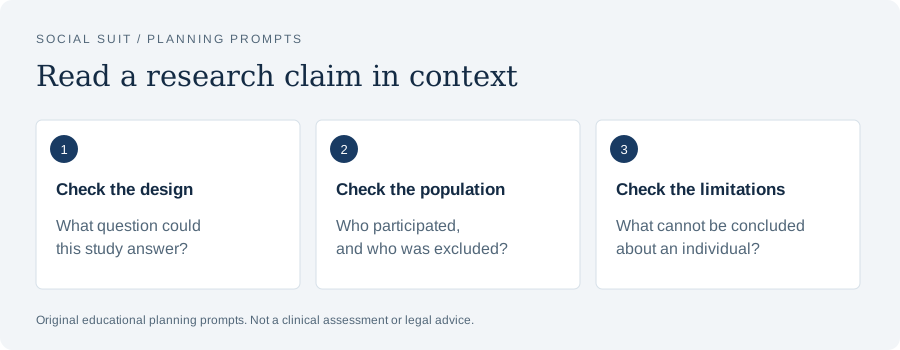
- Check the designWhat question could this study answer?
- Check the populationWho participated, and who was excluded?
- Check the limitationsWhat cannot be concluded about an individual?
Distinguish the relationship from the feed around it
A meaningful relationship may be housed inside an experience that includes unrelated recommendations, ads, or public arguments. The value of the relationship does not automatically extend to those surroundings. Ask whether you can reach the person directly or use another channel both of you understand. A change of route can preserve the relationship while reducing unwanted exposure. The platform should serve the contact, rather than make every conversation depend on navigating an entire feed. Current service controls and the other person's preferences will shape what is possible.
If you propose another channel, explain the practical reason without making a broad judgment about the other person's use. You might say that direct messages are easier to keep track of or that you are reducing recommendation browsing. The person may have different needs or constraints. Look for a format that works for both, such as a call, email, voice message, or another appropriate route. A good alternative should not simply transfer the burden from you to them. The relationship can guide the choice, with the platform as one available tool.
Sometimes a relationship remains tied to a group activity. You may enjoy playing a game together or discussing a book without wanting private contact. That limited form can still be valuable. The decision might be to use the group at a chosen time, avoid unrelated threads, and preserve boundaries around disclosure. You do not need to turn every useful acquaintance into a close friendship. Different connections can meet different needs. By recognizing their scope, you can preserve what works without asking the relationship to solve concerns it was never meant to address.
Review timing and displacement alongside enjoyment
An activity can be enjoyable and still conflict with another need. A lively conversation may continue beyond your intended bedtime. An interesting tutorial may delay a task. A friendly group may create so many notifications that concentration becomes difficult. The enjoyment is not false, and the cost is not erased by it. Describe both. A practical change might concern timing, notification arrangements, or a clearer ending rather than the activity itself. The question is how to fit the benefit into the day with less interference in responsibilities or valued routines.
Avoid assuming that every online minute displaces something better. A session may replace waiting or another leisure activity. The relevant comparison is the actual alternative available to you. If a conversation replaces an empty period and provides companionship, that differs from a session that repeatedly delays sleep. If an online activity is the accessible option, a comparison with an inaccessible event does not help. The review should use realistic circumstances. This makes the tradeoff more accurate and prevents a general ideal from replacing the choices you can actually make.
When a cost appears repeatedly, choose an outcome to protect. You might want to begin a bedtime routine on time, finish a work block without optional alerts, or remain attentive during dinner. Connect the boundary to that outcome. A time cue may help, but the number should serve the purpose. If a meaningful exception occurs, evaluate it deliberately rather than treating all variation as failure. A flexible plan can still be clear. The distinction is between choosing an exception for a reason and repeatedly losing the activity you intended to protect.
Look at content and conduct independently
Content concerns what you encounter. Conduct concerns how people behave toward you or others. A group may share useful material while tolerating insults. A creator may offer interesting tutorials while pressuring viewers to buy. A friend may post valuable updates while disclosing another person's private information. These features should be evaluated separately. A good topic does not excuse harmful conduct, and polite conduct does not establish the accuracy of a health or legal claim. The review becomes more useful when it asks both what is being offered and how the interaction is handled.
For claims that matter, use reliable information suited to the question. A health story may be relatable without providing an individual assessment. A legal allegation is different from an established finding. A study's association is different from proof of causation. You can appreciate a post's emotional value while checking its factual conclusions. The source should support the actual statement, and uncertainty should remain visible. A friendly presentation does not remove the need for evidence. Similarly, disagreeing with one claim does not require rejecting every useful contribution from the person.
For conduct, examine the pattern of boundaries. Can people decline advice? Do moderators address targeting? Is private information handled carefully? Can you leave without threats or unreasonable pressure? These observations say more about the environment than its stated mission alone. A community that calls itself supportive may still behave in ways that do not serve your needs. You can choose another space based on the actual experience. The decision need not become a public accusation about every member. It can be a practical judgment about fit, trust, and the cost of participation.
Treat privacy as a cost that may not be immediately visible
An interaction can feel rewarding while requiring more disclosure than you intended. A public story may receive support but expose health details, a child's circumstances, or a precise location. A private message may feel intimate but can be copied. Before sharing, ask what information the audience needs and what you would prefer to keep controlled. You can preserve the conversation with a more limited account. Privacy is part of the tradeoff, even when no obvious problem has occurred yet. The absence of an immediate reaction does not establish that the disclosure was necessary or risk free.
Consider other people's information too. A post about your experience may identify a friend, coworker, or family member. Ask whether they agreed to the specific use and audience. A supportive intention does not automatically authorize publication of their story. If you need advice about a sensitive issue, choose a suitable professional or private route and limit details appropriately. A public group may offer general perspectives, but it is not the same as a confidential individual service. The benefit of recognition should be weighed against the information required to obtain it.
Review technical controls and content choices together. Current audience, message, tag, and location settings may reduce exposure, but they cannot guarantee that recipients will keep information private. A secure account can still publish too much, and a limited post can still be copied. Choose details according to purpose. If something was exposed accidentally, respond to the specific information and use relevant services or support. The next step may be removal, account recovery, a conversation with an affected person, or another appropriate route. A vague instruction to use the platform less may miss the actual consequence.
Preserve creative opportunities without making popularity the whole goal
Online creative communities can provide tutorials, feedback, collaboration, and a place to share work. These are distinct benefits. Public metrics can also encourage comparison or shift attention toward approval. Ask what you want from the activity. Learning a technique is different from building an audience. Sharing a project with friends is different from professional promotion. A clear purpose helps you evaluate whether the current route supports the work or repeatedly distracts from it. You may choose a smaller feedback group, direct collaboration, or a planned period for public updates.
Feedback quality matters more than reaction count for many goals. A specific comment about a drawing may help you improve more than a large number of likes. A familiar group may provide a manageable space to ask beginner questions. A competitive feed may display impressive work without helping you learn. These observations do not tell you to avoid ambition or public sharing. They help distinguish the function each environment serves. You can use one route for inspiration, another for practice, and another for promotion, with boundaries appropriate to each.
If comparison repeatedly leaves you discouraged, review the content and timing. Are you comparing a practice session with selected portfolios built over years? Are you seeing resources or circumstances different from your own? Does the feed offer actionable learning or an impossible standard? These questions can clarify interpretation, but you may still choose to reduce exposure. A practical boundary does not require proving that the comparison is irrational. You can preserve useful tutorials and collaboration while limiting a stream that does not support the activity you want to continue.
Keep peer support distinct from professional care
An online support group can help people feel understood and exchange everyday experiences. That benefit is real when the interaction is respectful and useful. It does not make the group a clinical authority. Personal stories cannot assess every member's situation, and a creator's confidence does not establish a treatment plan. If you need individual care, seek an appropriate qualified provider. You can keep peer companionship alongside professional support. The roles can complement one another when their limits are clear and the group does not discourage outside help.
Be cautious when belonging is made conditional on accepting a diagnosis, buying a product, or rejecting professionals and trusted relationships. A source of support should tolerate reasonable questions and respect boundaries. If it pressures you to share sensitive information publicly, consider whether another route is more suitable. You can value the recognition you found while declining the demand. Gratitude does not create an obligation to accept every explanation or sale. A helpful account can be one piece of support without becoming the sole interpreter of your health and life.
The National Institute of Mental Health offers general information about mental health, care, and finding help. If distress persists, worsens, or interferes with daily life, seek qualified support rather than waiting for a perfect feed. Describe concrete examples and wider circumstances. Include online benefits you want to preserve and changes you tried. An assessment can consider the fuller picture. This article provides a framework for reviewing experiences, not an individual diagnosis or treatment recommendation. Appropriate care should be discussed through a service with relevant qualifications and processes.
Use a focused experiment to examine a tradeoff
Choose one change tied to the concern. If comments are the difficult part, view useful content without opening the thread. If recommendations interfere with a group, try a direct route. If alerts interrupt work, review optional notifications. If late sessions delay sleep, connect a stopping cue to the evening routine. State what you want to preserve and what you want to reduce. This makes the experiment easier to evaluate. A broad overhaul can obscure which part helped and may remove benefits unnecessarily. A focused change gives you a clearer account of the result.
Compare reasonably similar circumstances when possible. A relaxed holiday and an exhausted work night differ in many ways. You do not need a controlled study, but note major changes in context so the platform adjustment does not receive all the credit or blame. Keep the record light: purpose, action, practical result, and a relevant circumstance. Include mixed outcomes. A boundary may reduce detours but make discovery harder. A mute may protect attention but hide a useful update. These observations are information for adjustment, not proof that the whole plan failed.
At the review point, choose a next step. Keep the change if it helps. Modify it if a useful function became difficult. Try another route if the concern remains. Seek broader support when the issue extends beyond the platform. The review should lead to a decision rather than endless tracking. You can stop an experiment that creates unnecessary pressure. A personal observation is not a clinical assessment or a research finding, and it does not need to be. Its purpose is to help you choose a practical arrangement in your own circumstances.
Do not let benefits conceal a pattern of coercion
Coercion changes the nature of an interaction. Someone may use friendship, community status, or helpful advice to pressure you for money, intimate material, credentials, or secrecy. The earlier benefit does not authorize the later demand. Evaluate the request separately. You can decline without proving that every past interaction was false. If pressure continues, end contact and seek appropriate support or reporting. A meaningful relationship should allow boundaries. The need for connection should not require surrendering control over information, finances, or personal choices.
If threats or blackmail are involved, prioritize safety and suitable assistance. Preserve relevant information carefully when appropriate, avoid unnecessary public distribution, and involve trusted support. If a child or teenager is affected, include an appropriate adult. Immediate danger requires emergency help. A public argument with the sender may not resolve the problem and can create further exposure. The response should address the conduct and consequences. A time limit or feed preference is not a substitute for safety steps when the issue is coercive behavior.
Be cautious about offers to recover money or account access through private messages after an incident. Verify through official routes and do not share codes or credentials. A new promise may exploit the distress created by the original event. The useful plan is specific: identify what was shared, contact the relevant service or institution, and ask about available steps. Outcomes vary, so keep expectations realistic. Support should help you regain clear choices, not create another urgent demand. Benefits, harms, and recovery claims all deserve independent evaluation.
Discuss tradeoffs with people who understand your circumstances
A trusted person may help you see an alternative or clarify the cost of an experience. Explain the useful part and the concern together. You might say that a group provides important companionship, but the surrounding feed has become distressing. Or that a service is necessary for work, but optional notifications interrupt rest. A concrete account invites practical ideas. A broad statement that the internet is bad may lead the other person to recommend withdrawal without understanding what would be lost. The conversation should include the realities that shape your choices.
If someone offers an inaccessible alternative, explain the constraint. A local event may be too expensive, unavailable, or physically difficult to attend. A call may not fit a time zone. A different app may not be usable for the people involved. These details are not excuses; they are part of planning. Look for an option that serves the function and fits the constraint. Sometimes no equal alternative exists, and a narrower boundary within the current service may be the most practical step. The review should acknowledge that rather than demand an ideal arrangement you cannot use.
You can also ask for limited help. A friend might join you in trying a new group, help locate current platform guidance, or make a regular contact plan. They do not need to assess your health or manage your whole online life. If the concern needs professional support, use that route. Different people can provide different functions. A clear request reduces pressure on the relationship and helps you understand what the person can offer. Support becomes more sustainable when its scope is stated rather than assumed.
Support young people with a fuller account of their online life
For a child or teenager, ask what the activity provides as well as what concerns them. A group may offer friendship, identity exploration, creative work, or information not easily available locally. Those benefits should be heard. Also ask about unwanted content, pressure, privacy, sleep, responsibilities, and conduct. The purpose is to understand the experience, not to demand a defense of every minute. A fuller conversation can identify a specific adjustment or support need. It can also reveal serious issues that a simple total would miss.
Review controls together through current official guidance when appropriate. Explain their intended effects and limits. Discuss practical choices about images, tags, location, and private messages. Adults should consider their own posting about the young person too. A child's careful account settings cannot control an adult's public disclosure of a school, routine, or personal story. A family plan can include both sides. Respect dignity and make mistakes discussable. If disclosure reliably leads to humiliation, a young person may delay asking for help when an interaction becomes unsafe.
When serious conduct occurs, respond to it directly. Threats, harassment, coercion, or exposure of private information should not be treated only as evidence that the child needs a stricter timer. Use appropriate reporting and support, handle records carefully, and seek urgent help for immediate danger. If distress continues, consider qualified care. The useful online activity may be preserved through another route, but safety comes first. A balanced review allows both truths: the activity can matter to the young person, and the harmful conduct can require a strong response.
Read broader claims without forcing your experience into them
Public discussions often present social media as uniformly beneficial or uniformly harmful. Research is more specific. Studies differ in populations, definitions, methods, and outcomes. A finding about one kind of use should not become a rule for every activity. An association may not establish causation. A personal story may reveal an important experience without estimating how common it is. When a claim matters, consult the primary source and examine its limits. Your own experience can be considered alongside research without pretending that either settles every individual question.
The 2023 HHS advisory provides a broad youth focused discussion of potential benefits, concerns, and unanswered questions. It is useful context, not a substitute for current evidence or individual assessment. Avoid pulling a single phrase into a universal verdict. A careful explanation should distinguish the source's finding from a commentator's recommendation. If a numerical threshold is presented as a complete rule, ask what was measured and how the advice was derived. Precision in a number does not necessarily mean precision in its application to every reader.
Your personal review can remain modest. You do not need to decide the global value of social media before changing one feed. You can say that a direct conversation is useful and that a recommendation stream is not serving you now. You can preserve a hobby and leave a hostile group. You can seek support for distress without proving its sole cause. These choices are about your circumstances and purposes. Keeping their scope clear makes them easier to explain, review, and revise without turning each one into a statement about everyone else's online life.
A worked example: a community with valuable information and difficult conduct
Imagine a hypothetical person named Mina who joins a local parenting group. The group provides useful information about services and events, but several discussions become hostile and expose private family details. Mina separates the benefits from the conduct. They save links to official local sources and identify a smaller moderated space for ordinary questions. They stop participating in the hostile threads and use reporting where appropriate. The decision acknowledges that the group helped with information while choosing a different route for ongoing participation. Mina does not need to deny the benefit to justify leaving the difficult part.
Mina also reviews past posts for unnecessary information about a child. They remove or limit content through available controls and communicate privately with relevant people if a disclosure needs correction. The privacy issue is distinct from the tone of the discussion, though both affect the experience. A complete response considers each. Mina's new arrangement preserves practical updates through official pages and provides conversation through a smaller group. It may require more than one channel, but that is a reasonable tradeoff if the functions remain accessible and the cost is reduced.
At a later review, Mina notices that the smaller group is friendly but slow to answer urgent practical questions. They use the official service contact for those questions instead of expecting the group to provide every function. This adjustment illustrates why alternatives should be evaluated through actual use. A community can be good for companionship and unsuitable for urgent information. Different routes can coexist. The useful outcome is an understandable network of sources and relationships, each with a role, rather than dependence on one busy group for everything.
A worked example: preserving a creative practice
Consider a hypothetical person named Theo who follows artists for inspiration. Tutorials are helpful, but a stream of polished portfolios repeatedly leaves Theo discouraged about beginner work. Theo identifies the benefit as learning specific techniques and the cost as comparison during late browsing. They save a few tutorials, join a beginner practice group, and reduce the portfolio stream. The experiment does not require declaring all inspiration harmful. It changes the route so the content more closely serves the actual goal of practicing. Theo reviews whether the arrangement supports time spent making art rather than only looking at it.
The beginner group provides specific feedback, while one public thread becomes competitive. Theo leaves that thread and keeps the useful exchange. They also choose a time for practice that fits their day. The total amount of online activity may not fall dramatically because collaboration continues, but the function changes. A simple time report would not fully show the improvement. Theo can describe it through outcomes: more practice, clearer feedback, less unplanned comparison. These observations guide the next decision without becoming a medical claim or a rule for every artist.
If discouragement persists across other areas of life, Theo seeks appropriate support rather than assuming the feed is the sole cause. They can bring the examples and explain both the helpful changes and what remains. The online arrangement addressed a specific exposure. Broader concerns may need another kind of help. This hypothetical example shows how a benefit and a risk can coexist and how a focused change can preserve one while reducing the other. It does not promise that the same group or content choices will work identically for every person.
A worked example: friendship and constant availability
Imagine a hypothetical person named Sasha who has a meaningful online friendship. The friend listens and shares an interest, but recently expects immediate replies at all hours. Sasha values the relationship and also needs uninterrupted work and sleep. They state a clear availability boundary and suggest a scheduled conversation. The earlier benefit does not require accepting constant access. The friend's response helps Sasha understand whether the relationship can respect ordinary limits. Mutual support should leave room for each person's responsibilities and capacity rather than making every delayed reply a test of loyalty.
If the friend is disappointed but accepts the boundary, they can adjust together. If the friend uses threats or pressure, Sasha seeks appropriate support and reassesses contact. The response should fit the conduct. A friendship can be meaningful and still need a change, and a pattern of coercion may require ending the exchange. Sasha does not have to make a global judgment about online friendship to decide. They can describe what happened, what they need, and what limit is necessary. The relationship's value is one part of the account, not a reason to ignore the cost.
Sasha also avoids becoming the friend's only source of help for serious distress. They encourage appropriate support and do not promise a level of availability they cannot maintain. In an immediate danger, they use relevant urgent assistance rather than treating private messages as an emergency system. The friendship may continue within clearer roles, or it may not. The useful principle is that support should be honest about capacity. A benefit becomes more sustainable when the people involved can say what they can offer and what requires another route.
A worked example: necessary work contact and optional interruptions
Consider a hypothetical person named Devon who uses social media for a small business. Customer messages and project updates are useful, while unrelated notifications interrupt personal time. Devon initially considers deleting the app, then identifies the functions separately. They review current notification and contact controls, define times for ordinary work replies, and keep an appropriate route for business inquiries. They also review the public profile to remove unrelated private details. The arrangement supports the business while reducing exposure that does not serve it. The decision is based on function and consequence rather than one total.
Devon tells relevant collaborators how the new process works and clarifies who handles urgent issues. This prevents the boundary from creating confusion. They use supported account roles where available rather than casually sharing credentials. At the review point, Devon checks whether customer contact remains usable and whether personal interruptions declined. If a useful inquiry is missed, they adjust narrowly. A good plan can be revised. It does not need to choose between constant availability and complete absence. The practical aim is a clear route for work that leaves room for the rest of life.
If an unexpected message claims an urgent account penalty, Devon verifies through the official service rather than responding automatically. The account's value makes verification important, not optional. A useful business tool can also be the route for a suspicious request. Recognizing the benefit does not make the message trustworthy. Devon evaluates the request independently and protects credentials. This example shows how several dimensions can coexist in one account: work value, interruption costs, privacy choices, and security concerns. Each deserves a response suited to its actual function.
Keep the final decision specific and reviewable
A useful decision names what you will keep, what you will change, and what result you will review. You might keep a direct friendship, leave a hostile thread, use an official source for information, or seek professional support. State the reason in plain language. This summary can guide the next week more effectively than a broad verdict about the platform. It also makes revision easier. If the change does not preserve the needed function, identify that problem and adjust. If the cost remains serious, consider a stronger boundary or another route.
Do not require complete certainty before making an ordinary practical choice. You can reduce exposure that repeatedly feels unhelpful without proving a clinical cause. You can preserve a meaningful relationship without claiming that every feature is safe. You can ask for support without choosing a diagnosis. The scope of the decision should remain honest. Personal observations guide personal arrangements, while research and qualified professionals address broader or individual assessment questions. A clear boundary can coexist with uncertainty about the full explanation. That is often enough to move forward responsibly.
Benefits and risks can exist in the same experience because online life contains many functions, relationships, and forms of content. A careful review makes those parts visible. Preserve what serves your purposes, address serious conduct, limit unnecessary disclosure, and seek suitable support when concerns extend beyond a routine change. The aim is an arrangement you can use and understand in your real circumstances. A platform does not need one permanent label for you to make a clear next choice about it.
Sources and further reading
These primary resources provide context. Our practical examples and planning suggestions are original educational material, not validated treatment protocols. Linked organizations do not endorse Social Suit.