 Social Suit
Educational information, not individual medical or legal advice. Practical examples are hypothetical and do not describe clients or study participants. This article is not represented as reviewed by a clinician or attorney. How we prepare our guides.
Begin with the actual research question
Social media mental health research does not ask one single question. A study might examine time spent on a platform, repeated checking, exposure to harassment, supportive communication, sleep disruption, body image, or a particular intervention. It might measure life satisfaction, symptoms, mood during a session, or a clinical outcome. A headline can compress all of that into social media is harmful or social media is harmless. Before accepting either conclusion, identify the question the researchers actually asked. The answer should be interpreted at the same level of specificity.
This guide offers a practical reading method for people who want to understand research without becoming statisticians. It does not provide a complete systematic review or claim to settle every debate in the field. Its purpose is to help you compare a public claim with the underlying study and notice where the claim becomes broader than the evidence. You can use the method for news articles, social posts, creator videos, policy discussions, and health websites. The first useful habit is asking what was measured before arguing about what the result means.
Write the research question in a sentence that includes the people, exposure, outcome, and period. An illustrative question might be whether self-reported hours of use are associated with later symptom scores among a particular group of adolescents over one year. Another might ask what happens when consenting adults deactivate one platform for several weeks. Those are different questions even if both appear under the same topic label. The distinction matters when someone uses a result to recommend a rule for children, predict an individual's health, or make a legal claim.
Keep your own question visible too. You may want to know whether a late-night habit is affecting sleep, whether a child's particular feed is concerning, or how to evaluate a widely shared statistic. A study may inform that question without directly answering it. That is not a failure of research; it is a limitation of fit. Reading well means recognizing both what a study contributes and what remains outside its design. You do not have to turn every relevant finding into a universal verdict about every platform and every person.
Identify who was studied and who was not
Look for the participants' age, location, recruitment method, and relevant characteristics. A study of university students is not automatically a study of young adolescents. A sample recruited through volunteers may differ from a broad population sample. A study conducted in one country may reflect cultural, educational, or platform conditions that differ elsewhere. These details are not reasons to dismiss the result. They tell you where the evidence begins and where additional judgment is required. Ask whether the people in the study resemble the people discussed in the public claim.
Consider an illustrative headline stating that social media breaks improve teenagers' well-being. If the underlying participants were consenting adults, the headline has changed the population. If the participants were already willing to stop using a platform, the result may not describe people who rely on it for essential contact. If the study excluded people with certain clinical conditions, its implications for those people may be uncertain. The appropriate response is to restore the missing context, not declare that the research is worthless because it did not study everyone.
Notice whether the paper reports subgroup information and how it handles limited representation. A broad average can conceal differences by age, circumstances, or experience. However, a small subgroup result can also be unstable or exploratory. Ask whether the authors planned the comparison, how many people it included, and whether the conclusion has support beyond that one analysis. Do not turn a subgroup finding into a fixed rule about every member of a demographic category. People are not interchangeable simply because they share an age range or gender label.
For your own decision, state the fit in cautious language. You might say that a study is relevant because it includes people near your age and measures a similar outcome, while its platform and setting differ from yours. Or you might say it offers background but not a direct answer for your child. That kind of statement is more useful than saying that science proves a universal rule. It also allows the evidence to inform a conversation with a qualified professional without replacing the person's actual circumstances with the average participant's profile.
Ask what social media use means in the study
The term social media use can describe several different measurements. A survey may ask people to estimate daily time. A device measure may record foreground activity on particular apps. A questionnaire may assess difficulty stopping, interference with responsibilities, or other patterns. A study may focus on messaging, passive browsing, posting, content exposure, or a platform break. These measures do not capture the same thing. If the public claim refers to addiction but the study only measured hours, the interpretation has shifted from one construct to another.
Imagine two people who each report an hour of use. One spends the hour arranging a family visit and participating in a supportive group. The other scrolls through distressing recommendations late at night while avoiding sleep. A time measure treats their duration as similar even though the context differs. This hypothetical does not prove that one activity has a particular health effect. It demonstrates why you should ask what the measure can distinguish. A result about duration may be useful while still leaving content, purpose, timing, and emotional context unresolved.
Read the actual questions or measurement description if available. Was the participant asked about a typical day, yesterday, the past week, or the last month? Did the measure include all platforms or only named services? Did it include work and school activity? Were multiple devices captured? What happens when an app runs in the background? You may not find every answer, but the questions reveal how much precision the public claim can reasonably assume. A vague exposure measure should not be presented as a detailed account of every online experience.
The companion screen-time guide explores this issue in everyday observation. For research reading, write down the exact exposure variable in plain language. For example, estimated daily hours on selected services is more informative than online addiction when the latter was not assessed. Preserve that wording in your own notes and discussions. It helps prevent a chain of paraphrases from gradually exaggerating the result. The measurement is the bridge between the research question and the conclusion; if the bridge changes, the conclusion may no longer refer to the original study.
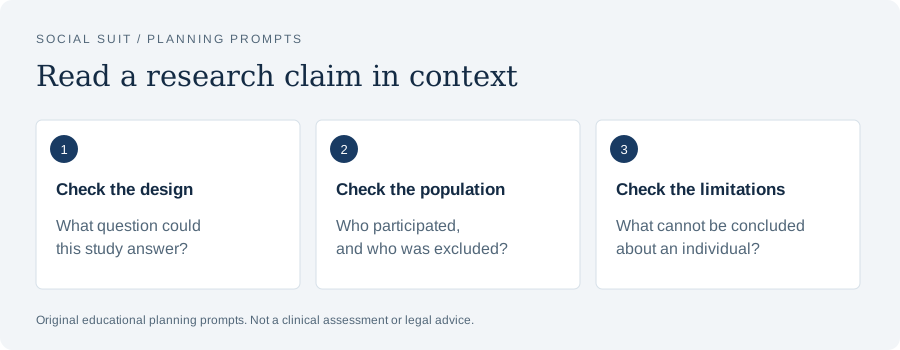
- Check the designWhat question could this study answer?
- Check the populationWho participated, and who was excluded?
- Check the limitationsWhat cannot be concluded about an individual?
Ask what mental health or well-being means in the study
Life satisfaction, momentary mood, symptom scores, psychological distress, sleep, and diagnosed disorders are related topics but different outcomes. A questionnaire score is not automatically a clinical diagnosis. A change in how someone rates a day's mood is not the same as a lasting change in a disorder. A study may be valuable because it measures one of these outcomes carefully, but a headline should not substitute a more dramatic outcome that was never assessed. Identify the actual measure and the period it covers before interpreting the result.
Consider an illustrative report that says a platform break cures depression. If the study measured a modest change in a symptom questionnaire over a short interval, the word cures adds a clinical and lasting claim beyond the measure. The better description would name the measured outcome, comparison, and period. Similarly, a finding about life satisfaction should not automatically be described as an effect on every aspect of mental health. Precision in language is not pedantry when people may use the claim to make treatment, parenting, or financial decisions.
Ask who supplied the outcome information. A participant's report, a caregiver's report, a clinician's assessment, and an administrative record may each provide useful information with different limits. If exposure and outcome were measured through the same survey, consider how recall and response style could affect both. If a study uses a validated scale, that is helpful, but it does not mean every interpretation of the scale is correct. Read what the authors say the measure represents rather than relying only on the familiar label in a news story.
For personal use, translate the outcome back into a practical question. Does the study help you think about sleep, distress, social connection, or another concern you actually have? It may suggest something to discuss with a provider, but it cannot diagnose you from a population average. If difficulties persist or interfere with daily life, seek qualified help without waiting for a perfect study that matches every circumstance. Research can inform care and observation while the individual assessment addresses what is happening for you.
Distinguish a snapshot from a sequence over time
A study that measures exposure and outcome at one point can identify patterns in that sample, but the timing may remain unclear. If people reporting more use also report more distress, several explanations are possible: use could contribute to distress, distress could affect use, both could respond to another factor, or the relationship could involve several pathways. A snapshot alone does not settle which direction dominates. The NIH and NLM study-design resources explain why design matters when evaluating causal claims. Use that distinction as a question, not as a slogan for dismissing every association.
Following people over time can add information about sequence. A study might examine whether earlier use predicts later outcomes while accounting for an earlier outcome measure. That is more informative about timing than a single snapshot, but it still depends on measurements, assumptions, and other factors. The duration between observations also matters. Annual surveys may not capture changes within a week, and a short study may not address longer-term patterns. Ask what kind of change the design can observe and which changes could happen between measurement points.
An illustrative example can clarify the issue. Suppose a survey finds that people who report more late-night use also report less sleep. The practical concern is understandable, but the survey may not establish whether the person used the phone because they could not sleep or slept less because they continued using it. A longer observation could help with sequence, while a carefully designed intervention could address another part of the question. No single sentence about correlation resolves all those possibilities. The useful step is identifying what the study actually adds.
When writing a note about a result, use language matched to the design. Associated with, predicted later scores, and changed after a randomized intervention carry different meanings. Do not upgrade predicted to caused simply because the result was measured over time. Equally, do not downgrade a carefully designed intervention to an ordinary correlation if the design supports a stronger inference within its limits. A balanced reading respects the strength of the method while keeping the conclusion bounded to the people, intervention, and outcomes studied.
Understand what a randomized intervention tests
Random assignment can make groups more comparable on average and help estimate the effect of an intervention under the study's conditions. The NIH clinical-studies resource describes well-designed randomized trials as particularly important for evaluating interventions. In social media research, an intervention might involve deactivation, reduced access, a change in posting behavior, or another defined action. The result concerns that action and comparison, not necessarily the effect of every type of use. Ask what participants were assigned to do and how well that assignment was implemented.
The Welfare Effects of Social Media study provides a primary example of a randomized Facebook deactivation experiment around the 2018 U.S. midterm election. The researchers reported changes across several outcomes, including subjective well-being and news knowledge. The example is useful because it shows that an intervention can have more than one consequence. It does not create a universal prescription for every child, every platform, or every period. A reader should retain the study's setting and intervention rather than converting it into a claim that leaving all social media always improves every outcome.
Ask what the comparison group did. Was it usual use, a shorter break, a different activity, or another intervention? Did participants know their assignment, and could expectations influence self-reports? Were some participants unable or unwilling to comply? Did the study report the assigned intervention effect or only outcomes among people who followed the instruction? These are ordinary interpretation questions, not automatic disqualifications. Even a strong design has practical limits. Understanding them helps you avoid exaggerating or dismissing a result based on a single feature.
Think about what a personal experiment would and would not reproduce. You could try a manageable change in notifications or timing and observe your experience, but that is not a randomized clinical study and does not prove a general causal claim. Other life events may change at the same time. The useful personal goal is learning what supports your needs, while a research trial asks a more formal question across participants. Keep those purposes separate. If you need treatment or urgent support, do not substitute a self-designed platform experiment for professional care.
Notice averages and individual variation
A reported average summarizes a group. It does not mean every participant experienced the same effect or that you will experience the average. Some people may benefit, some may be harmed, and some may show little change. The distribution and context matter. Ask whether the paper describes variability, subgroup patterns, or reasons effects could differ. A small group average can coexist with meaningful concerns for particular people, but an extreme individual story also does not establish the typical effect across a population. Both kinds of information need careful interpretation.
The PNAS study on adolescent life satisfaction separated between-person and within-person relationships and emphasized a nuanced picture rather than a simple population-wide effect. The research on developmental sensitivity likewise examined how relationships may vary across age-related contexts. These papers illustrate why the analytic question matters. Comparing different people is not the same as examining how changes within one person relate over time. Do not turn these examples into fixed thresholds or a personalized risk score. They support asking more precise questions about variation.
Imagine that an article says heavy users are less satisfied than light users. That comparison may reflect differences between groups, including circumstances that influence both use and satisfaction. It does not automatically show that one particular person will become less satisfied whenever they add an hour. Conversely, if a within-person pattern is reported, it still may not explain every individual change. Ask which comparison was analyzed. Writing between people or within people beside the result in your notes can prevent a common and consequential misunderstanding.
For family decisions, combine the research context with observation and qualified guidance. A child who is distressed by a specific interaction needs attention even if a population average is small. A child who uses a service for valuable support should not have that benefit erased by a broad headline. The question is what is happening in that person's life and which safe changes or supports are appropriate. Research helps frame the possibilities. It should not be used to tell a person their experience cannot matter because it differs from an average.
Read effect size and uncertainty before celebrating a number
A statistically detectable result is not automatically large or practically important. Look for the size of the estimated difference or association and the uncertainty around it. Ask what the unit means: points on a scale, a standardized value, a percentage difference, or a change in odds. A number can sound dramatic when removed from its baseline and measurement. If you cannot interpret the unit, do not turn it into a confident personal prediction. Seek the authors' explanation or a reliable methods resource before repeating the claim.
An illustrative example is a statement that risk doubled. If the underlying outcome was uncommon, the absolute change may still be small; if it was common, the practical implications could be different. This example is not a finding about a specific platform. It shows why a relative comparison needs a baseline. Similarly, odds and probabilities are not interchangeable in every context. A reader should ask what the reported measure actually represents rather than swapping it for a familiar word. If the paper reports an adjusted association, retain that qualification.
Uncertainty is not a defect to hide. A range around an estimate can show that several effect sizes remain compatible with the data under the analysis. A result near zero with wide uncertainty may mean the study cannot rule out effects that matter, rather than proving nothing happens. A precise small estimate may convey something different. You do not need to calculate the interval yourself to ask whether the public description reflects it. Headlines that present a single point estimate as exact can make a study seem more conclusive than it is.
For your own notes, write what you can safely say and what you cannot. You might note that the study found a group-level association on a particular symptom measure, while the practical magnitude and relevance to an individual remain uncertain. That sentence can be useful in a conversation without producing a false sense of precision. Avoid using a reported percentage as a personal diagnosis or a compensation estimate. The statistic belongs to the study's design, sample, and assumptions; it does not become a universal calculator when copied onto another website.
Look for adjustment, missing data, and analytic choices
Researchers often account for other measured factors when estimating a relationship. Read which factors were included and why. Prior symptoms, demographics, family circumstances, or other variables may matter, but adjustment does not automatically remove every alternative explanation. Some relevant factors may not have been measured well or at all. The exact analysis can also affect the result. Ask whether the authors explain their choices and discuss limitations. A statement that the result remained after adjustment is informative, but it should not be translated into all other causes were ruled out.
Missing data deserve attention because the people who complete every survey may differ from those who leave a study. Ask how much information was missing, whether dropout was related to important characteristics, and what method was used to address it. You may not understand every technical detail, but the paper should explain the issue. A larger initial sample does not guarantee that the final analysis represents everyone equally. Do not reject a study simply for having missing data; evaluate whether the limitation is acknowledged and handled transparently.
Analytic flexibility can make results depend on choices about variables, models, exclusions, and outcomes. Pre-registration, sensitivity analyses, shared code, and replication can help readers understand those choices, although none is a magic stamp of certainty. If a result appears only under one of many possible analyses, a broad public claim may be too strong. If the authors examine several reasonable approaches and explain what is consistent, that can improve interpretation. The adolescent life-satisfaction paper is one example of research explicitly considering how analytic decisions relate to conclusions.
When discussing these issues, avoid assuming motive from method alone. A paper with limitations is not necessarily deceptive, and a sophisticated model is not necessarily decisive. Ask what the limitations do to the specific claim. If the concern is unmeasured context, say that. If the public story ignores sensitivity analyses, restore them. This keeps criticism useful rather than turning research reading into a contest to find any flaw. The aim is a proportionate conclusion: neither more certainty nor more dismissal than the design supports.
Separate a single study from a broader evidence picture
A single study can add useful information without settling an entire topic. Ask whether similar questions have been studied with other samples, methods, and outcomes. A broader evidence picture can reveal consistency, disagreement, and gaps. However, a review or meta-analysis is only as informative as the studies and definitions it brings together. Combining research does not erase differences in exposure, population, measurement, or quality. Read the review's question and limitations just as you would read an individual paper. A large combined number is not enough by itself.
Suppose one study finds an association between estimated use and later symptoms, while another finds a small or uncertain relationship with life satisfaction. Those results may not directly contradict each other because the outcomes and designs differ. Ask whether they measured the same exposure, studied similar people, and used comparable time periods. The Riehm study and the Orben papers offer examples of distinct research questions within the same broad field. Do not use one to declare every other result false without examining what each was actually designed to answer.
Avoid assembling only studies that support the conclusion you wanted before reading. If you are concerned about harm, evidence of benefits still matters. If you value online connection, evidence of risks still matters. A reliable reading process includes findings that complicate the story. Make a note of the strongest uncertainty or alternative interpretation alongside the main result. This is particularly useful when discussing research with family members who have different views. You can agree that the evidence is complex without dismissing either the person's concern or the platform's useful role.
Do not confuse a public health advisory with an individual diagnosis or a court determination. The HHS social media youth mental health advisory discusses evidence, concerns, and actions at a broader level. Its purpose differs from a clinical assessment of one person or a legal finding about responsibility. Advisories can help frame precautions and policy questions while individualized decisions still require context. A website should identify which kind of source it is using rather than letting the authority of one source imply conclusions that belong to a different process.
Check the publication, funding, and limits without inventing credentials
Find the original paper where possible and identify its publication status. Is it a peer-reviewed journal article, a preprint, a conference report, a commentary, or a press release? These forms have different purposes and review processes. A press release can help locate the study, but it should not be the only basis for a precise claim if the research is accessible. Read the abstract, methods overview, limitations, and relevant results. You do not have to understand every equation to identify whether a news story changed the population or outcome.
Look for funding and conflict disclosures. Industry support, advocacy interests, and other relationships can be relevant, but a disclosure does not automatically invalidate the result. Ask how the research was designed, whether the investigators had independence, what data were available, and how limitations were handled. Conversely, the absence of an obvious commercial connection does not guarantee quality. Evaluate the actual methods and transparency. A useful critique connects a potential conflict to a specific question rather than assuming that a source is trustworthy or untrustworthy solely because of its affiliation.
Be cautious of websites that turn citations into an implied expert review. Listing papers does not mean the page was written or reviewed by a clinician, statistician, or attorney. Look for truthful authorship, editorial methods, correction practices, and a clear distinction between general education and individualized advice. Social Suit publishes this guide as educational content under its brand and does not claim a medical or legal review that did not occur. Readers should be able to assess the material's sources and limits without being asked to trust invented credentials.
Check dates without assuming that newest always means best. An older paper can remain useful for understanding a method, while its platform setting may no longer match current features. A new paper may address a current question but still have limited follow-up or uncertain replication. Ask what changed and why it matters to the claim. Do not add a fresh publication date to old information merely to make a page appear current. A meaningful update should explain what was checked or revised, especially when discussing changing platform practices or legal proceedings.
Turn a headline into a bounded statement
Use a simple rewriting exercise. Begin with a headline such as social media makes young people depressed. Then replace broad terms with the study's actual elements: which young people, which measurement of use, which outcome, what period, and which design. The rewritten sentence may say that a particular sample showed an association between estimated daily use and later symptom scores. That is less dramatic, but it is closer to what can be evaluated. If the study used a randomized intervention, the statement should identify the intervention and comparison instead.
Next add the most important limitation. It might concern self-report, a narrow sample, missing context, a short follow-up, or uncertainty about individual variation. Do not bury the limitation beneath an unqualified opening claim. The sentence should communicate the level of certainty at the point where the reader learns the result. If you cannot state the result without adding several qualifications, that may be a sign that the headline was too broad. The solution is a more specific claim, not a long disclaimer attached to an exaggerated one.
Try the same exercise with a reassuring headline such as science proves social media is safe. Ask safe for whom, in what circumstances, against which outcome, and over what period. A study that finds little association with one outcome does not evaluate every potential risk, including harassment, privacy exposure, or harmful recommendations. Similarly, a positive finding about supportive communication does not establish that every use pattern is beneficial. Precision should apply equally to claims of harm and claims of safety. Selective skepticism produces another oversimplification rather than a better understanding.
When sharing the result, include a link to the original source and avoid adding a personal diagnosis. You can say that the study raises a question relevant to your family's experience and that you want to discuss it with a provider. You should not tell someone that the paper proves what caused their condition or what treatment they need. A bounded statement invites an informed conversation. An exaggerated headline can pressure people into decisions that the study was never designed to justify.
Apply research to a practical decision without overpromising
Begin with the problem you want to address in daily life. If late-night browsing is reducing time available for sleep, a practical plan might focus on timing, notifications, and preserving necessary contact. If a feed produces repeated distress, the plan might focus on specific content and support. Research can suggest questions and options, but it does not replace observation of the actual pattern. Choose a manageable change with a clear purpose rather than applying a sweeping rule simply because a headline sounded decisive.
Define what you will observe without turning it into a diagnosis. You might note bedtime, how often you reopen an app after intending to stop, whether a session feels connecting or isolating, and which responsibilities are affected. Keep the observation brief and avoid constant monitoring. If a change appears helpful, it can be worth continuing even though it does not prove a general causal theory. If the problem persists, seek qualified help. A personal experiment should support your well-being, not postpone assessment or become a demand to solve everything alone.
Preserve benefits when possible. Research on authentic self-expression offers one example of a question about how people use social media rather than just whether they use it. That does not prescribe a posting style for every reader, but it illustrates why the quality and purpose of use deserve attention. A family may need to reduce harmful exposure while keeping a supportive community accessible. A rule that removes both without considering context can miss the actual goal. Ask what the person wants to preserve and what they want to change.
Review the decision in light of experience and appropriate guidance. Did the change reduce the specific problem? Did it create a new difficulty, such as losing useful contact? Are symptoms or safety concerns still present? What does a qualified professional recommend for the person's circumstances? These questions keep the plan responsive. Research-informed action does not require pretending that the evidence is complete. It means using credible information proportionately, observing honestly, and being willing to revise the approach when the person's needs become clearer.
A worked example of reading beyond the headline
Imagine a parent reads a post claiming that one hour of social media use guarantees a mental health problem. The post links to a study, but the parent initially sees only the headline and an alarming chart. Instead of repeating the claim to their child, the parent identifies the original research question. They note the sample, how use was measured, the outcome scale, and whether the design was observational or experimental. This is an illustrative reading exercise, not a description of a specific study or a threshold established by research.
The parent discovers that the study compared groups rather than predicting a guaranteed outcome for each child. They also notice that the measured outcome was a questionnaire score, not a new diagnosis confirmed in every participant. The study remains relevant, but the public claim has added certainty. The parent rewrites the result in bounded language and lists what it does not answer, including the child's particular content, supportive relationships, and other stressors. They do not dismiss the study; they restore the context needed to use it sensibly.
The family then discusses the actual concern: the child is staying awake later than intended and feels distressed after a particular type of feed. They choose a manageable change in evening use and plan a healthcare conversation if difficulties continue. They preserve contact with supportive friends and avoid telling the child that the headline has diagnosed them. If the parent later encounters a study emphasizing benefits, they apply the same reading method rather than treating it as proof that the earlier concern was imaginary. The standard remains consistent across both kinds of claims.
The useful outcome is a clearer decision process. The family understands that research can inform concerns without forecasting an individual destiny. They can explain why they chose a particular change, what they want to observe, and when professional help is needed. They are less vulnerable to creators who promise a universal cure or websites that use a scientific citation to support unrelated legal or financial predictions. Reading beyond the headline does not remove uncertainty. It makes the uncertainty specific enough to guide a more thoughtful conversation.
Questions to keep beside the next article you read
Before sharing a claim, ask whether you can identify the original source, actual research question, population, exposure, outcome, and design. Ask what the result's size and uncertainty mean, whether the public language matches the method, and which limitations matter most. Look for the difference between an average and an individual prediction. Check whether the article acknowledges findings that complicate its conclusion. If these answers are missing, pause before treating the claim as a rule. You can be interested in a result without being ready to repeat it confidently.
If your next question concerns your own well-being, choose a more focused companion guide. The feed-and-mood article supports observation of specific experiences. The screen-time guide explains why duration alone is incomplete. The benefits-and-risks guide helps preserve useful connection while identifying harm. The addiction-language guide distinguishes popular labels from individualized assessment. If you are concerned about serious documented harm and want to understand potential legal options, the /seo page is a separate information and external intake route. A research finding alone does not establish claim eligibility or compensation.
Do not make complete certainty a requirement for sensible support. A person can take a distressing experience seriously, improve boundaries, and seek professional help while the broader research remains complex. Equally, uncertainty should not be used to justify a claim stronger than the evidence. The most useful position is specific: this is what the study examined, this is what it found, this is what remains unclear, and this is how it may inform the question at hand. That approach respects both the research and the person.
Keep a short reading note rather than an endless archive. Record the source, bounded conclusion, key limitation, and practical question it raises. Revisit it when new evidence meaningfully changes the picture. You do not need to win every online debate about social media to make a thoughtful decision. Clear measurement, proportionate claims, honest uncertainty, and attention to individual circumstances are more durable than a dramatic slogan. They help turn research into useful information while avoiding the promise that one paper can explain every online experience.
Sources and further reading
These primary resources provide context. Our practical examples and planning suggestions are original educational material, not validated treatment protocols. Linked organizations do not endorse Social Suit.
- NIH: Understanding Clinical Studies
- NCCIH: How to Make Sense of a Scientific Journal Article
- NLM: Finding and Using Health Statistics
- Orben and colleagues: Social media’s enduring effect on adolescent life satisfaction
- Allcott and colleagues: The Welfare Effects of Social Media
- Riehm and colleagues: Associations Between Time Spent Using Social Media and Mental Health Problems
- Orben and colleagues: Windows of developmental sensitivity to social media
- Bailey and colleagues: Authentic self-expression and subjective well-being
- NCCIH: Checklist for Understanding Health News Stories
- HHS: Social Media and Youth Mental Health