 Social Suit
Educational information, not individual medical or legal advice. Practical examples are hypothetical and do not describe clients or study participants. This article is not represented as reviewed by a clinician or attorney. How we prepare our guides.
A useful record is accurate, bounded, and safe
Keeping a record of online harm can help you explain an incident to a platform, school, healthcare professional, lawyer, or other appropriate support person. The goal is not to gather every upsetting item you can find. It is to preserve enough accurate information to make the situation understandable while protecting the affected person's privacy and well-being. Start with the question the record needs to answer. What happened? Who needs to understand it? What can that recipient actually do? Those questions shape a safer and more manageable approach than collecting material indefinitely.
Documentation should not become a requirement someone must satisfy before receiving support. A person can be distressed even when a message disappeared, an account was deleted, or the date is uncertain. Write down what they remember and identify it as recollection. If immediate safety is at risk, obtain appropriate help before organizing files. In the United States, emergency services are the route for imminent danger; people experiencing suicidal thoughts or emotional distress can call or text 988. A folder of screenshots and an ordinary website inquiry are not emergency responses.
This guide offers practical organization suggestions, not a legal evidence standard, forensic procedure, or clinical assessment. If the matter may involve litigation, exploitation, stalking, threats, or another serious safety issue, qualified professionals should explain the preservation and reporting requirements for the actual situation. Do not assume that a general checklist makes material legally admissible or guarantees a particular outcome. A well-organized account can improve communication, but the recipient may still need additional information, a different format, or specialist assistance.
Begin small. A short incident summary, a timeline, and an inventory of existing records are often more useful than a massive unstructured upload. Separate original material from notes you create to explain it. Label uncertainty rather than filling gaps with assumptions. Share only what is needed for the current purpose, through a verified channel. Stop when you have enough to ask for help or clarify the next step. The process should reduce confusion, not make the person repeatedly relive the harm or expose sensitive information to a wider audience.
Choose the purpose before collecting more material
Different recipients need different kinds of information. A platform moderator may need the relevant account, content link, and behavior that appears to violate a rule. A school may need dates, student connections, the effect on participation, and the support requested. A clinician may need symptoms, changes in functioning, and the wider context. An attorney may need a chronology, jurisdictional facts, records, and an explanation of uncertainty. A record prepared for one purpose should not automatically be sent in full to every other recipient. Decide what question you are trying to help them answer.
For example, if a public post reveals a student's timetable, a school contact may need to know that the information is visible and what immediate safety concern it creates. They may not need the student's full private message history. If a healthcare appointment concerns sleep and distress, a clinician may benefit from a brief account of the exposure and its timing rather than dozens of images of abusive comments. Ask the recipient what is necessary. Reducing unnecessary detail can make the central concern clearer and protect unrelated private information.
Make a recipient list that includes purpose and verified contact method. You might write school safeguarding contact, platform report form, healthcare appointment, or attorney consultation. Add what you plan to share and what you will hold back pending a request. This helps prevent the common mistake of turning one folder into a universal packet. If multiple supporters are involved, agree on who sends which information. Overlapping submissions can create inconsistent accounts, unnecessary copies, and confusion about what has already been reported.
If you do not yet know the purpose, make an inventory rather than collecting more. List existing messages, links, reports, appointments, and notes without uploading them anywhere. Keep the list private. Then ask an appropriate professional which items matter. A person may feel that more material will make them more believable, but volume is not the same as clarity. A focused record can be both truthful and limited. You can preserve the possibility of a fuller review while avoiding a premature disclosure of every sensitive detail.
Write an incident summary in plain language
A concise incident summary should explain the concern without assuming that the reader knows the platform or the people involved. Describe the behavior, approximate period, relevant account or group, and practical effect. Use ordinary verbs: someone sent repeated insults, created a profile using another person's image, posted an address, or threatened to share private material. Avoid a conclusion such as the algorithm destroyed my life when the immediate task is to describe a particular series of events. Conclusions may require professional evaluation; the observed sequence can be described now.
Include the distinction between direct observation and secondhand information. If you saw the message yourself, say so. If a friend told you that a private group was circulating an image, identify that as a report from the friend. If an account appears to belong to a classmate but you are not certain, explain the basis and the uncertainty. Those qualifications do not make the incident unimportant. They help the recipient ask the right questions and avoid acting on a false assumption. Accuracy includes being clear about what you do not know.
Keep the summary separate from the full story. A one-page overview might identify the first known incident, most recent incident, whether contact is ongoing, any immediate risk, and the help requested. A fuller timeline can sit behind it. The overview should not omit important context merely to make the situation look more dramatic, but it also does not need every comment. Ask yourself whether someone unfamiliar with the incident could understand why you are contacting them and what action you want them to consider.
Review the summary with the affected person where appropriate. They may correct a date, explain an account's role, or identify a detail they do not want shared unnecessarily. If a child or young person is involved, keep the conversation manageable and age-appropriate. Do not pressure them to endorse a statement that feels inaccurate. A supporter can help organize the language without replacing the person's account with a stronger-sounding narrative. The summary should remain a truthful description, not a performance designed to persuade at any cost.
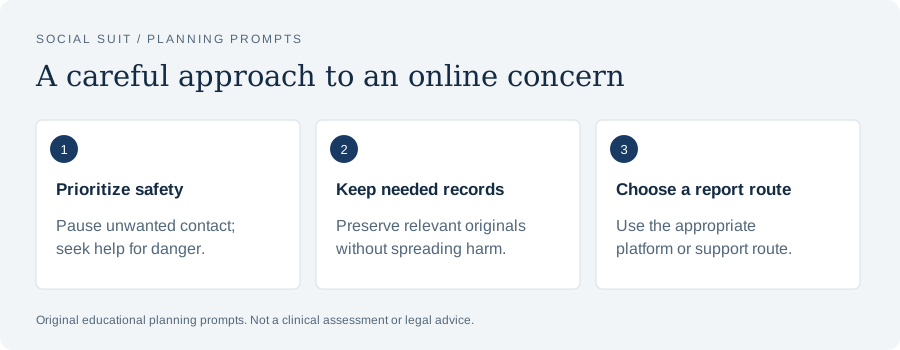
- Prioritize safetyPause unwanted contact; seek help for danger.
- Keep needed recordsPreserve relevant originals without spreading harm.
- Choose a report routeUse the appropriate platform or support route.
Build a timeline that makes uncertainty visible
A timeline is useful because online harm often unfolds across separate messages, accounts, and offline events. Use simple fields: date or date range, event, source, and notes about uncertainty. Add the affected person's age when relevant to the purpose. If an event is tied to a school term or a move rather than an exact date, say that. Do not assign a precise day just because a spreadsheet requires one. A recipient can work with honest approximation more effectively than false precision that later conflicts with an existing record.
Separate contemporaneous records from later recollections. A message saved at the time, an appointment date, or a school email provides a different kind of support from a memory written months later. Both can be worth noting. Label them so that someone reviewing the timeline can understand the basis for each entry. If two people remember events differently, record the disagreement instead of forcing a single version prematurely. A qualified reviewer may identify other information that clarifies the sequence. Your job is to organize what exists, not decide every disputed point yourself.
Include relevant events before and after the incident. An account creation date, a change in privacy settings, a report, an attempt to seek help, or a later return to school may explain the context. Do not include every ordinary life event simply because it happened during the same year. Choose details that help answer the recipient's question. For a healthcare conversation, changes in symptoms and functioning may matter. For a platform report, the sequence of contact and responses may be more useful. The same underlying timeline can produce different limited summaries.
Maintain one working version with a clear update date. If you discover a date was wrong, correct it transparently rather than quietly rewriting the history and forgetting the reason. A simple note can say that the approximate month was changed after finding a dated email. This is an organizational practice, not a forensic guarantee. It helps you remember how the account developed and reduces confusion when several supporters are involved. Avoid creating numerous conflicting copies that cannot be distinguished from each other when a professional asks for the current version.
Preserve context around screenshots and messages
A screenshot can show a piece of content, but it may not explain the whole exchange. Consider whether the recipient needs the account name, date, surrounding messages, post URL, or information about where it appeared. A cropped insult may look different when the preceding conversation is visible. Preserve enough context to avoid misrepresentation. If you make a cropped copy for a specific purpose, retain the original where it is safe and lawful to do so, and identify the copy as edited for readability. Do not let presentation changes obscure the source.
Do not add commentary directly to the only available original. Use a separate note or duplicate if you need to explain a detail. Label added arrows, highlights, captions, or translations. If you translate a message yourself, say who prepared the translation and whether a professional translation may be needed. If a phrase has a particular meaning in a group, explain that as context rather than assuming every reader will recognize it. The goal is to make the information understandable without blending original content and later interpretation.
Record links where available, but do not assume that a link will remain active. Content can be edited, removed, or restricted. Conversely, do not assume that a screenshot proves the account's owner or all surrounding facts. It may be one useful record among others. If authenticity could become a serious issue, ask qualified professionals about appropriate preservation. Avoid claiming that your ordinary capture process is a certified investigation. Practical documentation is valuable precisely because it states its limits and leaves specialist questions to the people equipped to handle them.
If the platform provides a report reference or a confirmation message, save that separately from the harmful content. The reference can help with follow-up and show which incident was reported. Note the date and category selected. If the report was made by a supporter, identify that person in your private log. This can avoid repeated searches for the same information later. A structured report history may be more useful than collecting additional screenshots that do not add anything new to the account of what happened.
Know when not to download or forward material
Some harmful content should not be collected through ordinary downloading or forwarding. Explicit material involving minors, exploitative images, threats, and deeply private content require particular care. Do not ask a child to save or send explicit images as proof. Do not circulate such content among parents, classmates, or friends to raise awareness. Obtain guidance from appropriate reporting or safety professionals about how to describe and report the incident without creating unnecessary or unlawful copies. The fact that material is relevant to harm does not make every method of possession or distribution appropriate.
When uncertain, describe the existence and location of the material without sending it. A report may identify the platform, account, date, and link where available, while a professional explains the safe next step. The affected person should not be required to repeatedly open the content to prove it is upsetting. If immediate danger or exploitation is involved, use the relevant urgent or specialist channels. A general website support inbox is not the right place for explicit material or a sensitive evidence package. Choose a recipient who can actually address the risk.
Avoid recording additional harmful behavior through unsafe participation. Do not encourage a person to remain in a dangerous group, engage with a threatening sender, or provoke a new message solely to obtain better evidence. Do not create a fake profile to investigate someone if you do not understand the safety and legal implications. A qualified professional may have a different, safer approach. Documentation should support protection and understanding, not require the affected person to expose themselves to more harm in order to produce an ideal record.
If a supporter has already received material that should not be circulated, stop forwarding it and ask appropriate professionals how to proceed. Do not make broad deletion decisions when an active investigation or legal preservation question may be involved without guidance. At the same time, do not continue creating copies because you are unsure. Explain exactly what you have and how it arrived. The safe response may depend on the content and circumstances. A general article cannot resolve every preservation duty, but it can emphasize the need to pause rather than multiply the risk.
Create a record inventory without oversharing the contents
An inventory lists what you have, where it is stored, and who controls it. It does not need to contain the full material. Useful categories might include platform messages, public posts, reports, account exports, appointment records, school communications, contemporaneous notes, and device usage information. Add whether a copy is available, whether access is uncertain, and whether a request would be needed. A professional can review the inventory and identify the next priority without receiving every file during the first conversation.
Use neutral names for categories and files. A title such as message thread March 2025 is easier to manage than proof of criminal platform misconduct when the legal conclusions have not been evaluated. Descriptive naming helps you locate an item without turning the folder into an argument. Keep identity documents, passwords, payment details, and unrelated personal material out of routine collections. If a professional asks for a specific document, verify the purpose and secure channel. The need to organize records does not justify putting all sensitive information in one broadly accessible location.
Distinguish material you possess from material held by someone else. A school may have attendance records, a provider may hold clinical records, and another person may have a message you have not seen. List the possible source and ask whether obtaining it is necessary and authorized. Do not access someone else's account or records without appropriate permission. Do not ask friends to secretly gather private conversations. A record inventory can identify gaps honestly while preserving boundaries around other people's information.
Set priorities based on the purpose. If a platform report needs a content link and account name, those may come first. If a legal consultation needs dates and an overview, do not spend days organizing every image before asking about deadlines. If a clinical appointment is approaching, a short summary of symptoms and functioning may be more useful than a technical archive. The inventory should help you decide what to do next. It should not become a perfectionistic project that delays care or makes the person feel that support depends on assembling an exhaustive case.
Store records with realistic privacy protections
Think about who can see the storage location before adding material. A family-shared cloud drive, school device, workplace account, or public link can have a wider audience than you expect. Choose a location appropriate for the sensitivity of the records and limit access to people who need it. Review sharing permissions and avoid links that allow anyone with the address to view the contents. A convenient folder is not necessarily a private folder. If you are unsure how access works, do not upload sensitive material until the question is resolved.
Keep administrative information separate from especially sensitive records where practical. A timeline and report log may be shared with a supporter who does not need healthcare details or private images. A contact list may be useful without exposing the underlying evidence. Limiting access by purpose can preserve the affected person's control while allowing practical help. Ask them who they want involved, within appropriate safety and legal limits. Supporting someone does not automatically entitle every relative or friend to read all of their private communications.
Protect the accounts used to store or send records using the services' current security guidance. Be alert to unexpected requests for passwords, one-time codes, or remote access. A person claiming to be an investigator or recovery specialist may be deceptive. The FTC's phishing guidance recommends using trusted channels rather than responding to suspicious links and requests. Verify a professional's contact information independently when a message seems unusual. The existence of a real incident can make people more vulnerable to someone promising to fix it quickly.
Keep the number of copies manageable. Multiple downloads on shared devices, attachments in group emails, and duplicate folders can make it difficult to know who has access. Before sharing, ask whether a secure upload, limited summary, or appointment discussion would meet the need. If a recipient requests a full file, confirm the destination and retain a record of what was sent. A simple sharing log can list recipient, purpose, date, and items. This is not a guarantee against disclosure, but it makes the process more intentional and easier to review.
Keep a reporting log that supports follow-up
A reporting log records actions taken, not just harmful content. Include the date, recipient or service, method, report category where relevant, reference number, and response. Note any follow-up promised and who is responsible for it. If a platform says it reviewed the content, save the notice. If a school meeting results in a support plan, record the agreed steps. This log can prevent everyone involved from repeatedly asking whether a report was made or why a particular issue remains unresolved.
Separate the service's response from your interpretation. A platform notice might say that the content did not violate a specific rule. That does not necessarily mean the platform determined that no harm occurred. A school may state that it cannot disclose another student's discipline while still agreeing to support the affected student. Record the words or a faithful summary, then add your questions separately. This makes a follow-up more focused and reduces the risk of turning an ambiguous administrative message into a broader conclusion than it supports.
When preparing a follow-up, identify what is new or still unanswered. You might have a new account contacting the person, a threat that was not in the earlier report, or a support step that has not been implemented. Send the relevant addition instead of the entire archive again unless requested. Repeatedly forwarding all material can create unnecessary exposure and make it harder for the recipient to identify the change. A concise update should connect the new fact to the action you are requesting or the question you need answered.
Agree on a review point so the log does not become constant checking. A person may feel compelled to refresh a report page or revisit an abusive thread throughout the day. A supporter can sometimes handle routine administrative checks with permission. If urgent risk develops, do not wait for the scheduled review. Otherwise, predictable follow-up can reduce the sense that the incident demands uninterrupted attention. The log exists to support a practical response, not to keep the affected person permanently focused on what happened.
Prepare a healthcare summary without diagnosing yourself from a feed
For a healthcare conversation, focus on how the experience relates to daily functioning and distress. Describe sleep changes, concentration, appetite, mood, anxiety, avoidance, school or work participation, and other concerns that are relevant to you. Give examples and an approximate timeline. Include other circumstances, prior difficulties, medications, or stressors that may matter. Do not reduce the account to the number of hours spent on an app or a diagnosis suggested by an influencer. A clinician needs a wider picture to assess the person rather than simply confirm a label.
The NIMH preparation resource encourages people to raise mental health concerns, prepare questions, and describe symptoms to a healthcare provider. A short note can help you remember what to discuss. You might write that you repeatedly opened messages after intending to stop, slept less, and felt anxious before school. State what you observed and what you are unsure about. You do not need to prove that the platform caused a condition before asking for care. Conversely, seeking care does not automatically establish a legal claim about the platform.
Ask whether the provider wants to see specific material before bringing an extensive collection. A few examples or a description may be enough to explain the context initially. Some content could be distressing or inappropriate to circulate. Use the provider's secure process for any records they request. Do not email sensitive information to an address you found in an unrelated advertisement. Clarify what will be documented and how privacy works for the actual setting. These questions are particularly important when a minor is involved and family members are helping arrange the appointment.
Keep healthcare goals distinct from evidence goals. The appointment should help address the person's needs, not pressure them to obtain a particular diagnosis for eligibility. Do not ask a provider to rewrite a history to make it fit a claim. If a lawyer later requests records, discuss that through the appropriate authorized process. An accurate clinical record may contain complexity, uncertainty, and other contributing factors. That is normal. The person's care depends on truthful information, and a legal reviewer should evaluate the actual history rather than a version shaped around marketing expectations.
Prepare a legal summary without treating organization as proof
If you are considering legal advice, a timeline and inventory can help an attorney understand the situation. Ask about deadlines early; do not wait until every record has been collected. Identify where the person lived, their age at important events, the relevant accounts or platforms, observed harm, and available records. Mark uncertain dates. A well-organized summary does not establish that a claim is valid, that a particular company is liable, or that compensation will follow. Those questions require individualized legal analysis.
Ask the attorney how to preserve existing material before deleting accounts, editing posts, or making broad changes when a legal matter may be involved. Do not assume that ordinary safety advice resolves preservation obligations. If there is an immediate safety concern, explain it so the professional can help address both needs. Ask which records should remain untouched, which copies are useful, and whether specialist assistance is needed. The right approach can depend on jurisdiction, proceedings, and facts. A general blog guide should not pretend to provide a universal legal protocol.
Clarify who receives your information and whether representation has begun. An intake form, screening call, or internal reference number may not mean an attorney is representing you. Obtain the firm and responsible attorney's identity, ask how the relationship is established, and read any agreement before signing. Share sensitive records through a verified process requested for a clear purpose. Do not provide passwords or verification codes. A person who has experienced online harm may be especially receptive to promises of quick compensation, so pause when a request seems inconsistent with a legitimate review.
The companion guide on preparing questions about a possible legal claim covers timelines, fees, privacy, participation, and uncertainty in more detail. The Social Suit /seo page provides general information and an external intake link, with no guarantee of eligibility or outcome. Documentation is one possible step toward an informed conversation. It is not a reason to postpone support, exaggerate a causal claim, or repeatedly expose someone to distressing material. Keep the record truthful and let qualified people explain what it can and cannot establish.
Support someone else without taking control of their entire account
If you are helping another person, define the task and permission before starting. They may want help saving a particular message, drafting a report, or organizing dates without sharing unrelated conversations. Agree on what you may view, where records will be stored, and what you will share. A supporter should not use the incident as justification for unrestricted access to every account. Appropriate adult involvement for a minor and urgent safety responsibilities may affect the arrangement, but the process should still be explained rather than carried out secretly.
Do not coach the person into a stronger account. Ask open, manageable questions about what happened and write their response accurately. If you supply a possible date or explanation, make clear that it is your suggestion, not their memory. Repeated leading questions can blur what the person remembers and make the conversation feel like a test. A practical approach lets them say they do not know. The resulting summary may be less tidy, but it is more honest and useful than a polished narrative built by a supporter.
Provide breaks and a stopping point. The person may need to pause after viewing a thread or discussing an event. You can divide administrative work into short sessions, handle nonessential formatting yourself, and avoid making every evening a documentation meeting. Ask whether they want a trusted person present when communicating with a professional. Keep ordinary supportive activities available too. The affected person should not become only a source of evidence. Their safety, privacy, relationships, and everyday life remain central even when a record is needed.
If supporters disagree, do not make the affected person mediate every conflict. One person may want public action, another may prefer immediate account deletion, and another may insist on collecting more. Bring the discussion back to the purpose, risk, and the person's wishes. Qualified guidance may resolve questions that the family cannot answer alone. Assign a limited administrative role to reduce overlapping submissions. A coordinated response should make the situation easier to manage, not surround the person with competing projects carried out in their name.
An example: a small record that answers the right questions
Imagine an adult who receives repeated hostile direct messages after participating in an online group. They are unsure who controls the sending account, and they feel anxious each time a notification appears. A friend offers to help. Instead of downloading the person's entire account, they agree to preserve a few relevant messages with dates and context, write a short summary, and record the platform report. The adult keeps control over the files and decides what the friend may see. This is an illustrative planning example, not a real client account.
The timeline begins with the first known message and includes the report date and any further contact. It notes that the sender's identity is uncertain. The inventory lists saved messages and a report confirmation, with no attempt to collect unrelated private conversations. The adult reduces notifications while preserving supportive contact through another channel. If distress continues to interfere with sleep or work, they prepare a healthcare note describing those effects. They do not assume that a screenshot archive can diagnose the problem or establish a specific legal claim.
If a new message contains a threat or identifying information, the plan changes. The adult seeks appropriate safety guidance and identifies the new content in a focused report. The friend does not contact the suspected sender publicly or post the screenshots to gather opinions. They review who needs the information and what action that person can take. If legal advice becomes relevant, the adult asks an attorney what preservation is needed rather than following an improvised internet investigation. Each step has a purpose and a boundary.
The useful result is a record that can be understood quickly: what occurred, what is known, what is uncertain, which steps were taken, and what help is requested. The files do not need a dramatic title or hundreds of repetitive screenshots. The adult can return to ordinary activities while a designated review point handles follow-up. If additional information is requested, the inventory helps locate it. The example illustrates how a limited, accurate record can support action without making documentation itself the center of the person's life.
Common documentation mistakes and how to correct them
One mistake is collecting only the most dramatic fragments. Correct it by keeping relevant context and labeling edits, while avoiding unnecessary exposure. Another is assuming an account identity without evidence. Correct it by stating what suggests the identity and what remains uncertain. A third is recording an approximate memory as an exact date. Correct it by using a date range and explaining the basis. These changes do not weaken a truthful account. They make it easier for someone else to assess the information without misunderstanding its limits.
Another common mistake is sharing the full file with everyone who offers help. Correct it by creating purpose-specific summaries and verifying recipients. A school contact, clinician, platform moderator, and attorney may need different information. Keep a sharing log if several submissions are necessary. If a file was sent too broadly, stop creating additional copies and ask the relevant recipient about appropriate handling. Do not assume that deleting a link retrieves every downloaded copy. The aim is to regain practical control over future sharing, even when the past disclosure cannot be perfectly reversed.
Documentation can also become a repetitive checking habit. A person may repeatedly reread messages, search for new mentions, or compare versions of a post. Correct it by identifying the actual purpose and setting a review point. A trusted supporter may help with bounded administrative tasks. If checking is driven by ongoing threats, obtain appropriate safety help; if distress and compulsive checking interfere with life, discuss the pattern with a healthcare professional. Do not frame the solution as simply being more disciplined. The pattern may need a broader response.
Finally, avoid mistaking organization for validation. A neat timeline does not prove legal liability, and a folder of messages does not assign a diagnosis. If you previously wrote a conclusion too confidently, revise it to distinguish observations, professional findings, and your interpretation. Keep the factual material intact where appropriate. You can say that you are concerned about a relationship between events without declaring it established. That distinction helps clinical and legal conversations remain honest and supports a response based on the actual person rather than a predetermined outcome.
Finish the record and return to the support plan
A record is ready for its initial purpose when it can explain the concern accurately, identify uncertainty, and support the next question. You may not need more material before contacting a school, provider, platform, or attorney. Keep a list of gaps and ask which ones matter. Endless preparation can delay help and leave the person feeling that the incident is never allowed to end. Set a stopping point for the current stage while remaining available to update the record if a meaningful new event occurs.
Review storage and sharing once more. Are original files distinguishable from notes? Are sensitive items limited to appropriate recipients? Does the timeline identify approximate dates? Do you know which reports were made and who will follow up? Does the affected person understand the plan? These are practical questions, not a guarantee of a particular outcome. If a professional requires a different process, follow qualified guidance suited to the circumstances. Your initial organization can make that transition easier without pretending to replace specialist work.
Choose the related guide that matches the next need. The cyberbullying response guide focuses on safety, school conversations, and support. The personal-information guide addresses what public posts can reveal. The suspicious-message guide can help you evaluate unexpected offers of account recovery or compensation. The legal-preparation guide explains how to ask about representation and deadlines. The /seo page provides a separate route to general legal options and external intake. Read selectively, keeping the purpose clear rather than turning every possible next step into another immediate task.
Return attention to the person's everyday needs. A useful record supports care, safety, participation, and informed decisions. It does not need to become the defining account of who they are. Continue supportive contact, protect useful online relationships where possible, and obtain professional help when needed. The best documentation process preserves truthful information while reducing unnecessary burden. It leaves the affected person with a clearer next step and more control over their information, rather than a larger archive and another reason to stay immersed in the harm.
Sources and further reading
These primary resources provide context. Our practical examples and planning suggestions are original educational material, not validated treatment protocols. Linked organizations do not endorse Social Suit.