 Social Suit
Educational information, not individual medical or legal advice. Practical examples are hypothetical and do not describe clients or study participants. This article is not represented as reviewed by a clinician or attorney. How we prepare our guides.
Why a group chat can be hard to leave
A group chat is often more than a stream of messages. It can be the place where friends make plans, share jokes, coordinate schoolwork, and signal that someone belongs. A teenager may know that the conversation is distracting and still feel that leaving it would create a social cost. Advice to “just turn it off” misses that cost. A useful plan begins by understanding what the group provides, what it expects, and which part of the experience is causing pressure. The answer may involve timing, unclear logistics, conflict, or a need for support rather than a single screen-time rule.
Ask the teenager what would happen if they were absent for an hour. They may say that nothing important would change, or that plans move quickly and they fear missing the final location. They may worry about being teased, misinterpreted, or excluded. Those answers lead to different actions. A separate planning message can address logistics. A statement about availability can address some misunderstandings. Threats or repeated humiliation require a safety response. The phrase group-chat pressure should not conceal these distinctions.
The benefits of online communication deserve recognition. The American Academy of Pediatrics’ guidance on smart and safe media use notes that digital tools can support collaboration and contact with distant friends and family. The practical examples below focus on preserving useful contact while changing an unworkable expectation of constant availability. They are options to discuss, not evidence that every friend group will respond the same way.
Begin with curiosity rather than a verdict about the teenager’s priorities. Our guide to talking with a teenager about social media explains how to use concrete observations without labels. For this topic, the observation might be that homework repeatedly stops when the group becomes active, or that the teenager seems worried after being offline. You can take the concern seriously while asking what the chat means to them. That understanding makes the eventual boundary more precise.
Separate logistics from conversation
Busy groups often mix practical information with hundreds of optional messages. A location change may appear between jokes, images, and unrelated discussion. The teenager then feels they must read everything to avoid missing the one item that matters. Identify which updates genuinely require action. Transport, timing, tickets, school instructions, and permission arrangements may belong in that category. Most reactions and casual exchanges do not. The distinction can reduce the amount of attention needed without removing the teenager from the group entirely.
Suggest a clear route for important changes. The group might use a separate planning thread, ask one organizer to send the final details directly, or agree that a change is summarized in a single message. The teenager can propose this in ordinary language: “Can someone message me the final time? I will be offline during practice.” The request is about making the plan usable, not judging everyone’s conversation. It may be easier for peers to accept a practical request than a broad announcement that the chat is unhealthy.
Test the route before relying on it for an important event. A friend may agree to send details and forget, or the platform may not make the message easy to find. Ask whether the update arrived and whether the teenager knew what to do. If not, choose another arrangement. A boundary becomes less stressful when essential information remains accessible. Do not insist that the teenager ignore the chat while leaving them without a reliable way to know where they are expected to be.
Caregivers also need clear logistics. If you provide transport, agree on how you will receive the confirmed time and place. Avoid making the teenager repeatedly check the group to satisfy an adult’s uncertainty. You might ask for one final update by a particular time, with a direct contact route if plans change afterward. The arrangement should respect the teenager’s role without making them the full-time dispatcher for both friends and family. Clear information flow can reduce pressure on everyone involved.
Find out what an unanswered message means in the group
Different groups have different assumptions. In one, a delayed reply is normal. In another, people interpret silence as rejection or disloyalty. Ask what happens after someone does not respond. Do friends simply continue the conversation, or do they repeatedly demand an explanation? Are jokes about absence light and mutual, or does one person become the target? These details matter. A teenager’s concern may be based on a specific pattern, not an abstract fear of missing out.
Ask whether the teenager also expects instant replies from others. This is not an accusation; it can reveal a shared norm that everyone might benefit from changing. They may realize that they feel annoyed when a friend is unavailable even though they want the same freedom themselves. Discuss a more workable expectation: people can participate without being continuously reachable. A boundary can apply in both directions. Respecting another person’s delayed response is part of creating room for your own.
Avoid promising that peers will immediately understand. A friend may feel disappointed or make a careless comment. Help the teenager distinguish a manageable reaction from pressure that is becoming harmful. They can acknowledge a friend’s preference without accepting a demand for constant access. If the reaction includes threats, humiliation, or repeated targeting, ordinary availability wording may not be enough. The response should follow the conduct, not simply the number of messages.
You can help draft one explanation that sounds natural. “I do not check during homework; call if something urgent changes” may fit one teenager. Another may prefer “I will catch up later.” Do not insist that they deliver a formal speech to the group. The wording should be short enough to use and should not disclose private family conflict. A simple expectation is often clearer than a long defense of why someone deserves to be unavailable.
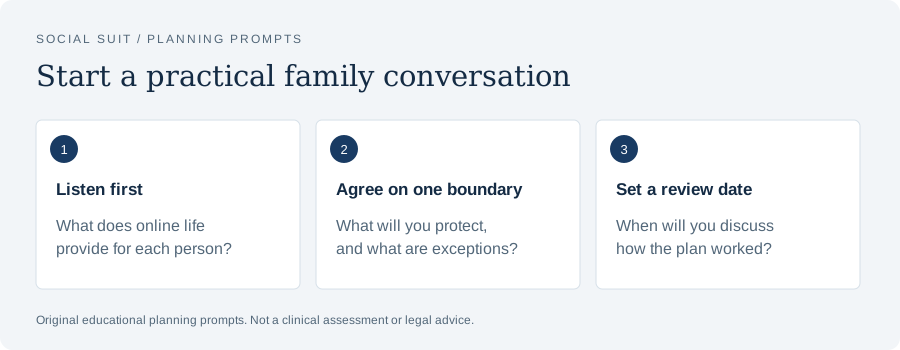
- Listen firstWhat does online life provide for each person?
- Agree on one boundaryWhat will you protect, and what are exceptions?
- Set a review dateWhen will you discuss how the plan worked?
Choose a boundary tied to a real activity
A boundary is easier to understand when it protects a specific activity. Homework, sleep, practice, a meal, a shift, or time with another friend can provide that context. “I will be offline while I finish this assignment” has a recognizable endpoint. “I need to become better at social media” is too vague to guide a tired moment. Ask which period is most affected by the chat and begin there. You do not have to redesign the teenager’s entire communication routine at once.
Preserve necessary functions. If homework requires a group message to clarify instructions, a complete messaging ban may be counterproductive. The agreement can distinguish that task from the ongoing social conversation. Our article on phone rules during homework develops this distinction. The point is to make the needed action clear, then return to the assignment. A necessary check does not have to become a reason to monitor every new message.
Make the ending realistic. A teenager may have an event with a fixed finish or a task whose duration is uncertain. If the end is uncertain, say when they will reassess rather than promising an exact minute they cannot know. Peers do not need continuous updates about the task. The boundary can be a general statement that replies will come later. The teenager should not replace one form of constant monitoring with another in which they repeatedly report their progress to justify being absent.
Review the boundary after several uses. Did the teenager complete the activity more easily? Did important plans remain available? Did the group’s response create a new concern? Those outcomes are more useful than whether the rule looked strict. A smaller boundary that works may be better than a sweeping restriction that repeatedly collapses. Adjust the timing, contact route, or wording based on the actual experience rather than assuming that the first version must remain unchanged.
Use notification controls selectively
Muting a busy group for a chosen period can reduce repeated prompts. The exact controls vary by platform and change over time, so consult current official instructions rather than relying on a remembered menu path. Discuss what the setting does: does it silence sounds, hide previews, or stop a particular kind of notification? Do not assume that one setting removes every interruption. The teenager should understand the practical effect before relying on it during an important activity.
Preserve essential contact where needed. A caregiver, employer, accessibility function, or safety arrangement may require a channel to remain available. Selective controls can sometimes help, but the capability depends on the device and account. Test an important arrangement with a nonurgent message. Do not compromise safety in pursuit of an entirely quiet screen. The goal is to reduce optional interruption while keeping required communication usable.
Remember that a muted chat can still be opened out of habit. Pair the setting with a visible next step, such as placing the device in an appropriate location or beginning the first homework question. If the teenager needs the device for the task, keep the relevant tool open and make the transition explicit. The setting supports a decision; it does not make the decision automatically. A practical routine includes both the control and the activity it protects.
Avoid turning settings into a secret test. Explain what supervision or controls are active and why, according to the teenager’s age and safety needs. If a caregiver configures a restriction, the young person should know how it affects essential communication and how to ask for an exception. Hidden or unexplained changes can make ordinary missed messages feel confusing and may lead to more conflict. The technology should make the plan clearer, not add uncertainty about what the device is allowed to do.
Protect sleep without making friendship the enemy
Late-night messages can create a conflict between sleep and belonging. Ask what the teenager fears missing: a plan, a joke, a private disclosure, or proof that others are still connected. A specific update can have a direct route. A general need for reassurance may not be satisfied by reading more messages. The distinction helps you choose a response. It also avoids suggesting that the teenager must choose between caring about friends and caring about rest.
Agree on a transition rather than a vague command to stop. The teenager might finish a message check before preparing for bed, silence nonurgent prompts overnight, and catch up at a suitable time the next day. Preserve essential contact and accessibility tools. If the phone serves as an alarm, discuss a practical arrangement that does not require leaving every social notification active. Current official instructions can help with the device’s available settings.
Help the teenager explain nighttime availability in a way that does not invite negotiation over every evening. A short statement that replies usually wait until morning may be enough. If a friend has an urgent concern, discuss what appropriate support is available rather than making the teenager the sole overnight crisis resource. A young person should not carry responsibility for another person’s safety through continuous messaging. Serious disclosures require trusted adults or qualified services, not only a friend’s availability.
If sleep remains difficult, seek appropriate healthcare guidance. Do not assume that the chat is the only cause. Workload, health, stress, environment, and other factors may contribute. Observe timing and functioning without attaching a diagnosis. The boundary can support the opportunity to sleep while keeping the larger picture open. A useful family discussion should make it easier to access help, not require the teenager to agree with a single causal explanation before support is offered.
Distinguish an active conversation from continuous checking
A teenager may enjoy participating in a lively exchange. That experience differs from repeatedly reopening the group when little has changed. Ask what happens during the checks. Are they responding to a conversation, searching for reassurance, waiting for a plan, or worried about a reaction? The purpose may change over the course of the session. Naming it helps the teenager decide whether another check is likely to provide what they need.
Use a concrete observation rather than a character judgment. The teenager might notice that they opened the chat several times while waiting for one friend’s reply. Ask whether the checks helped or simply restarted the uncertainty. A direct planning message, a chosen catch-up time, or a different activity while waiting may be worth trying. These are practical options, not treatment for anxiety or another condition. If distress is persistent or interferes substantially with life, qualified support may be useful.
Avoid measuring every interaction. A short observation of one recurring situation can reveal enough. Constant logging may become another source of pressure and guilt. You can ask the teenager to notice the moment before opening the chat during homework, rather than record every tap throughout the day. Keep private information about peers out of the record. The useful data concerns the teenager’s own routine, not an archive of other people’s conversations.
Choose a replacement action that fits the need. If they are waiting for logistics, check the direct route at the agreed time. If they want company, arrange a conversation or join a planned activity. If they are bored during a pause, choose a small available option rather than a grand lifestyle change. A replacement should be easy enough to begin under the actual conditions. Otherwise, the chat retains the practical advantage of being immediately accessible.
Handle misunderstandings in plain language
Text lacks some of the cues available in face-to-face conversation. A brief reply may be interpreted as annoyed, a joke may land badly, or a silence may be taken personally. Encourage the teenager to clarify a misunderstanding directly when it is safe and appropriate. “I was busy, not upset” may resolve a simple assumption. A voice conversation or in-person discussion can sometimes provide more context, but it is not automatically the right choice when there is harassment or coercion.
Do not require the teenager to explain themselves indefinitely. A reasonable clarification has an endpoint. If the group repeatedly rejects the explanation and demands more proof, the issue may be the expectation rather than the wording. Help the teenager notice that distinction. They can communicate availability respectfully without accepting a duty to justify every offline moment. A boundary does not become invalid because someone dislikes it.
Consider whether a public correction would intensify the conflict. A private message to one friend may be more useful than a long statement to the whole group. Conversely, a logistical clarification may need to reach everyone. Choose the audience based on the purpose. Avoid copying private exchanges into the group to win an argument. That can introduce new privacy concerns and make the disagreement harder to resolve.
If the teenager contributed to the misunderstanding, support a proportionate repair. They can acknowledge a careless comment, clarify what they meant, and change the behavior. Do not demand a dramatic apology designed for an audience. The goal is a clearer relationship, not a public performance. If the situation involves serious harm or an unsafe person, seek appropriate guidance before encouraging direct contact. Ordinary repair advice should not override a safety concern.
Recognize when the group is targeting someone
Not all unpleasant conversation is the same. Ask whether comments are mutual, whether the person can object without retaliation, and whether one member is repeatedly singled out. A teenager may describe humiliation as ordinary joking because they fear appearing sensitive. Do not decide solely from the group’s label for the behavior. Examine what happened, how often it occurs, and what happens when someone asks it to stop.
For bullying concerns, StopBullying.gov’s prevention guidance emphasizes supporting the child, addressing the behavior, and using appropriate reporting processes. Keep the response focused on the conduct and the child’s needs. A young person should not have to manage repeated targeting alone merely because it occurs in a chat. Appropriate school or platform routes may be relevant, depending on the situation.
Avoid escalating through a public family confrontation with the group. Posting accusations or entering the chat angrily can expose the teenager’s private experience and may increase pressure. Ask what information is needed for a safety response and who should receive it. If the conduct is linked to school, an appropriate school professional may help with reporting and support. If there are threats or exploitation concerns, seek suitable official guidance. The response should match the risk.
Do not make continued group membership the only measure of success. Leaving, muting, limiting contact, or using a safer channel may each be appropriate. The teenager may feel loss even when the group is harmful. Acknowledge that feeling and help identify supportive relationships elsewhere. Removing one unsafe interaction does not automatically provide belonging. The access change should be accompanied by a realistic plan for support, rather than leaving the teenager isolated after the immediate restriction.
Respond to pressure to share private material
A group may encourage someone to post a screenshot, photograph, location, or personal detail. Discuss whether the teenager has the right to share it and whether the people involved agreed to that use. A private message is not automatically public material because it is interesting or funny. A child can learn to decline a request without explaining every personal reason. “I am not sharing that” is a usable boundary.
Ask whether refusal leads to pressure or threats. Repeated demands, blackmail, or requests for intimate material are not ordinary group-chat etiquette problems. Seek appropriate safety support. Do not encourage the teenager to negotiate alone with a person who is coercing them. If the material may be illegal or involve exploitation, obtain current official guidance about handling it rather than copying or circulating it casually. General privacy advice is not enough for that situation.
Model the same care as an adult. Do not share the teenager’s story widely while telling them to protect other people’s information. Limit details to the people who need them for support or reporting. Our article about sharing family photos thoughtfully develops the adult side of this responsibility. Respectful handling of information can preserve trust even when you must involve someone else for safety.
If private material was already shared, focus on what can happen now. The teenager may be able to request removal, use a reporting process, or ask a trusted adult for help. Do not guarantee that every copy can be erased. Avoid blaming them in a way that makes future disclosure harder. Accountability for a choice and support after harm can coexist. The next step should be specific, safe, and informed by the nature of the material.
Keep a friend’s crisis from becoming one teenager’s sole responsibility
Sometimes a group member shares severe distress and expects friends to remain available. The teenager may fear that logging off will make them responsible for what happens next. Take that concern seriously. A young person can care about a friend without becoming the only source of crisis support. Help them identify a trusted adult or qualified service and explain that serious safety concerns need more help than continuous peer messaging can provide.
Do not promise to keep a dangerous disclosure secret. If someone may be in immediate danger, appropriate emergency action may be needed. In the United States, call 911 for a life-threatening emergency; the 988 Suicide & Crisis Lifeline provides suicide and mental-health crisis support. The correct action depends on the situation and location. A friend’s request for secrecy does not remove the need to seek help when safety is at stake.
Support the teenager after they involve help. They may worry that they betrayed the friend or fear a reaction from the group. Explain the purpose of the action and avoid making them handle every follow-up alone. Share information carefully with people who need it. The teenager may also need their own support after a distressing exchange. Ask how they are functioning and whether they want to speak with an appropriate professional.
For nonurgent emotional support, discuss realistic availability. A teenager can say that they can talk at a particular time, encourage broader support, and step away when needed. Do not treat kindness as unlimited access. A relationship is more sustainable when both people can sleep, attend school, and participate in other parts of life. The group’s norm should not make one young person responsible for monitoring another person’s well-being around the clock.
Plan a gradual change when an immediate exit is not necessary
If the chat is distracting but not unsafe, a gradual boundary may be more practical than leaving abruptly. Choose one protected period, preserve a route for important plans, and tell the group how the teenager will catch up. Try it for several occasions. The teenager may discover that absence has fewer consequences than expected, or identify a real logistical issue that needs another solution. Either result provides useful information.
Keep the experiment small enough to assess. Changing notifications, leaving several groups, moving the device, and announcing a new social routine all at once can make it hard to know what helped. Begin with the most affected activity. If homework is repeatedly interrupted, test that period first. If the problem is late-night checking, focus on the bedtime transition. A specific change is easier to review than a general promise to use social media less.
Ask the teenager to choose the wording where possible. They understand the group’s ordinary language. A caregiver can help make the boundary clear without scripting a formal announcement that sounds unlike them. The teenager should not have to disclose private conflict at home to justify the change. A statement about availability can be enough. If peers demand details, discuss how to decline that request respectfully.
Use the outcome to decide the next step. If the change reduces pressure and preserves connection, keep it. If the group ignores the boundary, clarify or choose a stronger limit. If the reaction becomes threatening or humiliating, reassess the safety concern rather than treating it as a failed experiment in self-control. Gradual change is an option for ordinary pressure, not a requirement to remain in an unsafe interaction.
Help the teenager leave a group when that is the right decision
Leaving can be socially difficult even when it is sensible. Discuss whether an explanation is necessary and whether it would be safe. A brief statement may work for an ordinary group. An unsafe group may not deserve a detailed announcement or direct negotiation. Seek appropriate guidance when threats, exploitation, or serious harassment are involved. The goal is a safer transition, not a perfect final message that persuades everyone to approve.
Identify which relationships the teenager wants to keep. They may be able to contact a supportive friend directly or join a different activity. Do not assume that leaving the group means rejecting every person in it. Separate useful relationships from the group’s harmful pattern where possible. This can reduce the sense that the teenager must choose between total isolation and continued pressure. A direct connection may serve the social need with fewer unwanted interactions.
Prepare for the practical information that used to arrive there. If plans, school updates, or event details relied on the group, arrange another route. Confirm that the route works. Leaving without that preparation can create avoidable problems and make the teenager feel that the boundary was unrealistic. The access change should preserve necessary logistics, not leave the young person repeatedly returning to the group because no alternative exists.
Check in after the transition without making every conversation about it. The teenager may feel relieved, sad, angry, or uncertain. Acknowledge the mixture. If distress persists or affects daily functioning, seek appropriate support. Leaving a group can stop one channel of contact, but it may not resolve school dynamics or other consequences. The plan should include relevant help for those effects rather than assuming the exit alone completes the response.
Adult involvement should be clear and proportionate
Explain what you need to know and why. A caregiver may need to understand a threat or a school-related incident without reading every unrelated message. Focused supervision protects the safety purpose and respects appropriate privacy. The level of oversight depends on age, development, history, and current risk. This guide cannot determine a universal rule for inspecting a teenager’s device. If the situation is complex, seek professional guidance familiar with the young person’s circumstances.
Avoid joining or contacting the group impulsively. An adult intervention can affect the teenager’s relationships and may expose private information. Discuss the intended action when circumstances allow. If an urgent risk requires immediate action, explain afterward as appropriate. Use official reporting or school channels where relevant rather than making the incident a public contest. The aim is protection and support, not an audience for adult anger.
Make your own availability expectations coherent. If you demand instant replies from the teenager during every school or social activity, it may be harder to explain that peers should accept delayed responses. Essential safety contact may be different, but state the purpose and route. Adults can model a respectful message that identifies urgency rather than expecting the teenager to monitor everything continuously. A family boundary should reduce uncertainty instead of recreating the same pressure from another direction.
If supervision changes, specify the scope and review point. The teenager should know which function is restricted, which contacts remain available, and how the family will assess the plan. An indefinite loss of privacy with no explanation can make the situation feel arbitrary. A clear arrangement may still be unpopular, but it provides a path. Our guide to creating a family technology agreement explains how to write purposes, exceptions, and review conditions.
Review the plan using the outcome that matters
Choose a few concrete questions. Did important plans still arrive? Was homework or sleep easier to protect? Did the teenager feel less pressure to monitor the group? Did any reaction raise a safety concern? These outcomes tell you more than the number of minutes alone. A shorter session can still be distressing, while a longer chosen conversation may be supportive. The review should distinguish the kind of interaction and its effect.
Allow the teenager to describe the experience before presenting your conclusions. They may notice a practical problem you did not see, such as a change arriving through the wrong channel. Adjust a relevant detail without treating the entire boundary as a failure. If the concern remains, choose the next specific step. A review is useful when it makes the plan more accurate, not when it becomes a hearing in which the teenager must prove that every choice was perfect.
Keep private peer information out of an ordinary tracking record. You can note that an essential update was missed or that a boundary was respected without preserving the full conversation. If evidence is needed for a safety report, handle it separately and appropriately. A household routine document should not become a collection of other children’s private messages. The information needed for planning and the information needed for formal reporting serve different purposes.
Retain what works. The teenager may need only one protected period and a direct planning route. Another situation may require leaving the group or stronger supervision. There is no value in making the rule more restrictive simply because a stricter version sounds more serious. The response should match the observed need and risk. A workable plan can preserve friendship while making availability a choice rather than an uninterrupted obligation.
Common questions about group-chat boundaries
Should my teenager leave every group chat? Not necessarily. Some groups provide useful contact and enjoyment. Examine the conduct, expectations, content, and practical role of each relevant group. A distracting but respectful chat may need a timing boundary. A threatening or coercive interaction may require a stronger safety response. Do not make the decision solely from the number of messages. The teenager’s experience and the actual behavior matter.
What if friends say the boundary is rude? Help the teenager distinguish a reasonable disappointment from a demand for continuous access. A brief explanation may clarify the situation. They do not need to defend every offline moment indefinitely. If the reaction includes humiliation or threats, treat that as a concern in its own right. A boundary can be respectful and still unpopular. The group’s approval is not the only measure of whether the plan is appropriate.
Can I require replies to my messages while asking them to ignore friends? Essential safety contact may justify a different route, but explain it clearly. State which messages need prompt attention and how urgency will be indicated. Avoid expecting immediate replies to every ordinary update. A coherent family arrangement preserves necessary contact without making the teenager monitor all channels constantly. Adults should also respect contexts where an instant response is not feasible.
How do I know whether this is anxiety or addiction? You cannot determine that from a group-chat habit alone. If distress or impairment is persistent, seek qualified assessment. Bring concrete observations about sleep, school, mood, relationships, and functioning. The practical boundary can still be useful while the larger concern is evaluated. Do not require a diagnosis to address an unworkable routine, and do not use the routine as proof that a diagnosis exists.
A first step that keeps the plan manageable
Ask the teenager to identify one period when the group creates pressure and one kind of information they need to keep available. Agree on a protected activity, a direct route for important updates, and a short statement about availability. Use current official settings if helpful. Then try the arrangement and review the outcome. This limited start can reveal whether the main issue is logistics, habit, social expectation, or conduct that needs a safety response.
If the concern involves cyberbullying, our guide to supporting a child after an upsetting online experience addresses immediate support. For serious documented social-media harm and general information about potential legal review, visit the separate Social Suit legal-options page. Reading this group-chat guide does not establish eligibility, diagnose a condition, or guarantee compensation. Keep practical routine advice distinct from individualized healthcare, safety, and legal decisions.
The aim is not to make the teenager indifferent to friends. It is to make room for friendship without requiring constant availability. A useful plan recognizes belonging, protects essential information, responds to harmful conduct, and gives the young person a clear way to step away. The caregiver’s role is to help make those choices safer and more understandable. A short, realistic boundary can be a meaningful beginning, especially when it is followed by a review rather than treated as a permanent verdict about the teenager’s character.
Consider read receipts before interpreting silence
Some groups attach meaning to whether a message appears read. Before assuming that a visible receipt proves someone deliberately ignored the group, discuss the limits of that information. A person may have opened a conversation briefly, become distracted, needed more time to answer, or been unable to respond. The teenager can apply the same patience to friends that they want for themselves. A receipt is a platform signal, not a complete explanation of another person’s intention.
If the platform offers a relevant control, consult its current official documentation before changing it. Do not promise that disabling one signal removes every form of visibility or pressure. The deeper boundary is an expectation that people may reply later. A setting can support that expectation, but it cannot make a disrespectful group behave kindly. Use the actual reaction to assess whether the issue is a technical prompt, a misunderstanding, or a pattern of coercive demands.
Sources and further reading
These primary resources provide context. Our practical examples and planning suggestions are original educational material, not validated treatment protocols. Linked organizations do not endorse Social Suit.