 Social Suit
Educational information, not individual medical or legal advice. Practical examples are hypothetical and do not describe clients or study participants. This article is not represented as reviewed by a clinician or attorney. How we prepare our guides.
Describe the pattern before deciding what it means
A social media session can change the direction of an ordinary day. You may open an app feeling relaxed and leave irritated, or arrive discouraged and enjoy an encouraging exchange. Recognizing these changes does not require diagnosing yourself or deciding that a platform is always harmful. Begin with a description of what happened. What did you see? What did you do? How did you feel before opening the service? What was different afterward? These questions provide a more useful starting point than a global statement that your feed is ruining your mood. They identify the part of the experience you might be able to change.
The timing of a change matters, but timing alone does not establish causation. If you felt upset after reading an argument, the argument may have contributed. You may also have been tired, worried about a deadline, or already disappointed by something outside the app. Several factors can exist together. A good observation leaves room for those possibilities. You can still decide to mute the argument without proving that it caused every difficult feeling. Practical boundaries do not require a complete scientific explanation. They require enough information to choose a reasonable next step and review whether it helps.
Imagine opening a feed during a difficult workday and encountering a friend's celebration. You feel worse afterward. One explanation is that the post triggered comparison. Another is that you were looking for distraction from an unresolved problem and the feed did not provide it. A third is that you miss that friend and the photograph reminded you of the distance. Each explanation suggests a different action: reducing comparison content, addressing the work problem, or making direct contact. The more specific account does not guarantee a solution, but it prevents treating one platform setting as the answer to every form of distress.
Name feelings in ordinary language
You do not need a clinical vocabulary to keep a useful record. Words such as irritated, worried, left out, encouraged, absorbed, bored, or relieved can describe a session well. Try to distinguish a feeling from a conclusion about yourself. I felt left out is an observation about experience. Nobody cares about me is a much broader conclusion that a few posts cannot establish. Both may occur in your mind, but separating them helps you decide which claim deserves further consideration. It also gives a professional or trusted person clearer information if you discuss the pattern later.
Some sessions produce mixed feelings. A support group conversation may be comforting while also bringing attention to a difficult issue. A news discussion may be informative and tiring. A humorous video may be enjoyable but leave you frustrated about the time it displaced. Avoid forcing these experiences into a single positive or negative score. Write the components instead: useful information, tense discussion, late bedtime. This account is more actionable because you can preserve one part while changing another. Perhaps you want the information through a newsletter but not the comment thread. A narrower choice can follow from a more detailed description.
Notice the difference between intensity and duration. A moment of irritation that passes quickly is different from an experience that dominates the rest of your evening. A session might be pleasant while you are using the app but repeatedly lead to regret afterward. Another may initially feel demanding but leave you glad you connected with someone. Both immediate and later observations can matter. Do not assume that the first feeling is the only relevant one. At the same time, you do not need to monitor yourself continuously. A brief check at the end of a session and later when convenient may be enough.
Record what you were seeking when you opened the app
The reason for opening a service shapes how you interpret what follows. You might have wanted a message from a friend, information about an event, entertainment, relief from boredom, or a way to postpone a task. The same content can feel different depending on the purpose. An unrelated recommendation may be a welcome discovery during leisure time and an irritating interruption when you are trying to find a specific answer. Before deciding that your mood reflects the content alone, consider whether the session delivered what you came for. A mismatch between intention and experience can itself be frustrating.
Write a purpose in a few words if that feels useful: check the group plan, answer two messages, watch a comedy clip. This is not an obligation to justify every minute online. It is a way to see whether the app steered you away from your own intention. If you repeatedly arrive for a practical reason and end up in distressing recommendations, you may want a more direct route to the original task. Bookmarks, direct messaging, or a separate communication channel could help, depending on the service. The purpose gives you a concrete behavior to preserve while changing the surrounding experience.
Consider a hypothetical person who opens an app to check a sports club's schedule and spends forty minutes reading unrelated political disputes. They leave annoyed and miss the bus. Describing the episode only as too much screen time misses several useful details. The intended task was brief, the detour involved conflict, and the session displaced a specific departure time. A helpful experiment might be to access the club's schedule directly and set a reminder for leaving. This does not diagnose the person or settle how every political discussion affects them. It addresses the pattern that was actually observed.
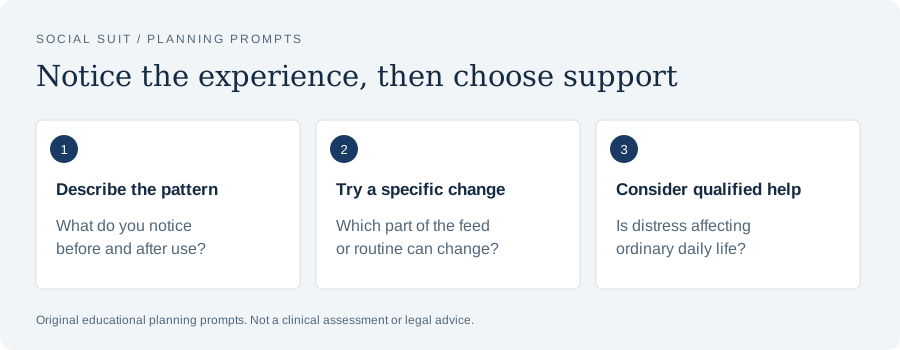
- Describe the patternWhat do you notice before and after use?
- Try a specific changeWhich part of the feed or routine can change?
- Consider qualified helpIs distress affecting ordinary daily life?
Track content categories without collecting everything
A record does not need screenshots of every post. Broad categories can be enough to identify patterns: conversations with friends, appearance focused videos, news, hobbies, shopping, conflict, or unfamiliar recommendations. Add a short detail when a particular feature matters. For example, you may find a tutorial useful but its comments discouraging. Or you may enjoy posts from a creator while feeling pressured by repeated product promotion. Separating the parts lets you consider a focused change. Saving large amounts of content can create unnecessary work and may expose private information that the record does not need.
Be cautious about recording other people's details. If your aim is to understand your own experience, you can write that a group discussion became hostile without copying names, private messages, or identifying circumstances. Keep any notes secure and limited to their purpose. If you are documenting a specific safety incident, that is a different task and may call for a more careful approach. Do not treat every unpleasant session as an evidence file. A mood observation should help you make choices, and it should not become a reason to redistribute someone else's sensitive story or repeatedly revisit upsetting material.
It may be useful to distinguish chosen content from unexpected content. You can deliberately follow a news account and still be surprised by a disturbing image inserted into another session. You can search for a topic and receive recommendations that go beyond what you requested. These paths suggest different controls. An account choice may call for unfollowing or changing subscriptions. An unexpected recommendation may call for the service's feedback, blocking, reporting, or recommendation settings. The controls vary across services and can change. Check the current help information in the app before assuming that a particular button exists or works identically everywhere.
Include the circumstances outside the screen
Sleep, work pressure, illness, relationship events, and the physical setting may influence how a session feels. You do not need to prove their effects individually. Simply note the factors that seem relevant. Browsing while waiting comfortably for a friend is different from browsing after a difficult argument at home. Looking at job announcements while employed may feel different from seeing them after a layoff. Context does not invalidate your reaction. It helps explain why the same post might affect you differently on another day, and it can keep a platform specific experiment from carrying expectations it cannot meet.
Timing can also shape practical consequences. A session near bedtime may interfere with a planned wind down even if the content is enjoyable. A tense thread immediately before a meeting may leave you distracted. Browsing during a break may be restorative if you can return to the task comfortably. Rather than declaring one time of day universally good or bad, connect the observation to your schedule. What activity followed? Did the session make that activity easier or harder? This gives the review a concrete reference point. The concern is how use fits into your day, not whether a clock time has moral significance.
If you notice that every session feels worse during an already difficult week, consider whether you need a broader change in support or workload. A feed adjustment might still help, but it may be only one part of the picture. You can tell a qualified professional or trusted person that your online experience seems connected to a wider period of stress. Include examples from both settings. This is more informative than presenting the app as the established cause of everything. It also leaves room for help with circumstances that would remain even if the platform disappeared tomorrow.
Look for repeated patterns rather than a dramatic single event
A single upsetting session can justify taking a break, especially when the material is disturbing. It does not necessarily reveal a stable pattern. To understand a routine, look at several ordinary examples, including sessions that felt neutral or helpful. If you record only the worst experiences, your notes may give an exaggerated impression of how often they occur. If you record only enjoyable sessions, they may miss an important cost. A balanced record does not require perfect sampling. It requires a deliberate effort to leave room for observations that do not match your initial explanation.
Repeated patterns should be described precisely. You might notice that recommendation browsing after dinner often runs beyond your intended stopping time and leaves you frustrated. You might find that direct conversations usually feel worthwhile, while public arguments leave you tense. Or you may see no clear difference, which is also useful information. Avoid turning a few observations into a universal rule about every platform or person. Your notes describe your experience under certain circumstances. They can guide a personal experiment without becoming a research claim or a diagnosis of a condition you have not been assessed for.
Frequency is not the only feature to consider. A rare incident may be serious enough to require safety action. Threats, harassment, or exposure to dangerous material do not become unimportant because they occur less often than pleasant interactions. Separate routine mood review from responding to a safety concern. You can report or block harmful behavior and seek support without completing a week of observations first. The record should serve your needs. It should never become an instruction to endure repeated distress so that you have a more complete set of notes.
Choose one change with a clear reason
When a pattern appears, choose a change tied to that pattern. If one account repeatedly triggers comparison, mute or unfollow it. If comments create the difficulty, view the original content without opening the thread. If a session displaces sleep, arrange a stopping cue connected to bedtime. If passive browsing leaves you feeling isolated, try a direct conversation. These are ordinary examples of matching an action to an observation. You do not need to change every part of your online life at once. A focused experiment can make it easier to understand what helped and what was inconvenient.
State the reason in practical terms. I want to finish dinner without returning to an argument is more useful than I need better digital discipline. I want to preserve messages from friends while reducing appearance focused recommendations is more informative than social media is toxic. Clear purposes prevent a change from becoming a vague test of character. They also help you evaluate tradeoffs. A setting might reduce unwanted posts but make an important community harder to find. If so, you can seek another route to the community instead of deciding that the only choices are unrestricted use or complete withdrawal.
Set a review point that fits the change. A different account list may need several ordinary sessions to judge. A new stopping cue might be reviewed after a few evenings. Avoid demanding an immediate emotional improvement as proof that the change works. Some benefits are practical: less time spent in a hostile thread, fewer interruptions during a task, or easier access to messages. Those outcomes can be valuable even if your overall mood varies. Conversely, a change that looks good in a usage report may not help if it removes the connections you rely on. Review both intended benefits and unexpected costs.
Compare reasonably similar situations
A personal experiment is easier to interpret when the situations are somewhat comparable. If you compare a relaxed holiday afternoon with an exhausted night before a deadline, many differences could explain the result. You do not need a formal study or a controlled environment. Simply notice major changes in context and avoid giving the platform adjustment all the credit or blame. You could compare two ordinary weekday evenings, or examine how a particular type of content feels at several points. The goal is useful information for your choices, not a scientific demonstration of causation.
Keep the record light enough to maintain. An entry might include the approximate time, purpose, main activity, before feeling, after feeling, and a relevant circumstance. Two or three sentences can contain all of that. If tracking itself makes you anxious or encourages constant self scrutiny, simplify it or discuss that reaction with an appropriate professional. A tool that burdens you more than it helps is not automatically worth keeping. You are trying to clarify a pattern, not meet a standard of perfect measurement. Ordinary observation can be sufficient for an ordinary decision about a feed.
When the result is unclear, identify what remains uncertain. Perhaps you felt better after muting an account, but a stressful project also ended that week. Perhaps a time limit reduced browsing but increased hurried checking before the limit. These observations do not mean the experiment was useless. They show which questions to revisit. You could retain the helpful part, modify the inconvenient part, and observe again. You can also decide that further tracking is unnecessary because the practical result is clear enough. A personal boundary can remain valid even when you cannot isolate every influence on mood.
Understand what a usage report can and cannot show
An app or device report can estimate how long a service was open, how often it was used, or when notifications arrived, depending on its design. That information may help identify sessions you did not notice. It usually does not explain the purpose, emotional tone, or social value of each minute. Messaging a friend and reading a hostile thread can produce similar totals. Treat the number as one part of a description. If you use it without context, you may overlook the activity that deserves attention or remove a useful activity simply because it takes time.
Reports can also differ in how they count use. A service open in the background, activity across several devices, or mixed work and leisure tasks may complicate interpretation. Check the current explanation supplied by the device or platform if a number seems surprising. Do not assume that a report is a precise account of attention. If your concern is that a session delayed sleep, the relevant observation may be the bedtime delay itself. If your concern is mood after particular content, the total number of minutes cannot identify which posts mattered. Match the measure to the question you are asking.
Numbers can be helpful when tied to a concrete purpose. You might want a reminder after enough time to answer messages, or a way to see whether a session extends beyond a planned break. The number becomes a cue for action rather than a label for the person using the device. A high total does not establish a diagnosis, and a low total does not rule out distressing experiences. The more useful discussion combines amount, content, timing, choice, and impact. This keeps a simple measurement from being mistaken for a complete account of your relationship with social media.
Recognize comparison, conflict, and uncertainty as different experiences
Comparison often concerns what a post appears to say about your own life. Conflict concerns an exchange with others or a discussion you are observing. Uncertainty concerns not knowing what an online signal means, such as an unanswered message or a changing recommendation. These experiences can overlap, but the distinctions help you choose an action. Muting comparison content may help with one pattern. Leaving a repetitive argument may help with another. Asking a friend directly about a plan may resolve uncertainty more effectively than checking their activity status. A single instruction to use the app less may miss these differences.
When comparison appears, ask what standard you are applying. Are you comparing an ordinary private moment with someone else's selected public update? Are you comparing your circumstances with a person whose resources differ substantially? Are you assuming that visible popularity reflects the quality of a relationship? These questions do not tell you how to feel. They help test whether the interpretation goes beyond what you can observe. If the content remains distressing even after you recognize those limits, you can still reduce exposure. Accurate interpretation and practical boundaries can work together.
For conflict, consider whether another response would serve a defined purpose. If the thread has become repetitive, your continued attention may no longer contribute anything useful. For uncertainty, consider whether reliable information is available through a direct, appropriate channel. Refreshing a feed often supplies more signals without resolving the underlying question. If a situation involves harassment or threats, switch from ordinary discussion to safety steps and support. Do not frame every difficult interaction as a mood management issue. Some behavior requires a response to the behavior itself, regardless of how calmly you can observe it.
Protect helpful parts while reducing difficult parts
A feed may contain valuable connections alongside material you would prefer to avoid. Before making a broad change, list the benefits you want to keep. These might include a family group, an accessibility community, creative collaboration, or practical information. Then identify the specific cost: unwanted recommendations, late night arguments, comparison, or interruptions. This separates the function you value from the route that creates difficulty. You may be able to access a group directly, move a conversation to another channel, or adjust subscriptions. The possibilities depend on the platform, but the question remains useful across services.
For example, a person may rely on a neighborhood group for notices about local services while finding the general recommendation feed upsetting. They could check whether the group has a direct link, an email summary, or another available communication route. If a narrow adjustment works, they preserve the information without the same browsing pattern. If it does not, they can decide whether another source meets the need. This is an ordinary problem of access and tradeoffs. There is no need to treat keeping a useful online resource as evidence that a concern was exaggerated.
Sometimes a serious cost makes a larger change appropriate. If a space repeatedly exposes you to threats or targeted abuse, the existence of occasional useful information should not require continued participation. Seek help with safety and preserve relevant information carefully when necessary. A balanced review is not an obligation to find something positive in every harmful situation. It means recognizing actual benefits and actual costs without allowing either to erase the other. The scale of the response should fit the circumstances, and urgent needs should not wait for a gradual experiment with settings.
Discuss the pattern with someone who can help interpret it
A trusted person can sometimes notice a pattern you missed or help you describe it more accurately. Choose someone who is likely to listen rather than immediately impose a broad judgment. You might say that certain evening sessions leave you tense and that you are trying to preserve contact with friends while changing the browsing around it. Give a specific example. This invites a practical conversation about the experience. It is clearer than saying the internet is bad for you and waiting for the other person to infer what happened.
If you speak with a health professional, include the wider context. Explain the feelings, their duration, their effect on daily functioning, and what else has been happening. Mention the helpful parts of online life as well as concerns. You do not need to arrive with a self diagnosis or proof that the platform caused the issue. A provider can consider sleep, stress, relationships, mood, and other relevant factors. The purpose of preparation is to make the conversation informative. A usage graph can be included if helpful, but a few concrete examples may communicate more about the concern.
The National Institute of Mental Health offers general resources about mental health and finding support. If symptoms persist, worsen, or interfere with everyday life, seek qualified help rather than waiting until you have perfected your feed. This article offers a method of observation and practical choice, not an individual assessment or treatment plan. In an immediate safety emergency, contact relevant emergency services. In the United States, calling or texting 988 can connect you with the Suicide and Crisis Lifeline. Use appropriate local crisis resources elsewhere. Routine app adjustments are not an emergency response.
Avoid making tracking another source of pressure
Some people find that recording every emotional change becomes exhausting. They begin checking whether they feel better yet, interpreting each fluctuation as a failure, or fearing that one difficult session has undone progress. If that happens, reduce the level of detail. You might review the week in a few sentences instead of tracking every visit. You can focus on observable actions, such as whether you left an argument when intended or reached a friend directly. The record is optional. Its value depends on whether it helps you understand and act, not on how complete it appears.
Do not compare your notes with someone else's ideal routine. Different people have different responsibilities, access needs, and sources of connection. A remote worker's usage total, a student's group project, and a caregiver's coordination messages may reflect different purposes. Your plan should fit your own circumstances. If a popular recommendation creates problems for you, investigate why and adjust it. A public claim that everyone should use the same limit cannot account for every context. You can learn from other people's ideas without treating their experience as a rule that your life must reproduce.
The language you use can reduce unnecessary pressure. Instead of saying you failed because you browsed longer than planned, describe the sequence: a notification led to a thread, the thread continued, and the stopping cue did not occur. This account suggests things to change. You might silence that notification, leave the thread, or choose a cue linked to another activity. It also avoids assigning a broad identity to a single event. Accountability can be specific and useful. You can acknowledge a choice you want to change without turning it into a judgment about your character.
A worked example: preserving art while reducing comparison
Imagine a hypothetical person named Priya who follows artists and enjoys learning techniques. Recently, sessions have ended with a sense of inadequacy. Priya begins a light record for several evenings. The notes show that instructional posts remain useful, but recommendation streams of finished portfolios lead to comparisons with years of professional work. Priya also notices that this usually happens late at night when tired. The record does not establish that art content causes a mental health condition. It identifies a specific combination of content and timing that deserves a practical change.
Priya decides to save tutorials from a few chosen creators and access them directly during a planned weekend practice session. They mute several accounts whose posts repeatedly prompt unhelpful comparison and stop opening the recommendation stream near bedtime. After two weeks, the result is mixed. Art practice feels more satisfying, but Priya still sometimes compares their work unfavorably with others. They conclude that the feed change helped with exposure but did not resolve every concern about confidence. That distinction is useful. A boundary can provide a benefit without becoming a cure for a broader issue.
Priya next joins a small group focused on beginner practice rather than polished portfolios. The group provides specific feedback on a sketch and makes room for questions. Priya keeps the tutorials, leaves a competitive discussion that feels unpleasant, and reviews whether the new arrangement fits. If persistent distress affects other activities, Priya can discuss it with a professional. The example illustrates a process: describe the experience, separate its parts, test a focused change, and review the tradeoffs. It does not promise that the same content choices will produce the same result for every person.
A worked example: noticing a news and notification loop
Consider another hypothetical person, Mateo, who opens social media for updates about a local transportation disruption. The information is useful, but the app also supplies urgent national headlines and heated replies. Mateo repeatedly checks for changes, feels unsettled, and loses track of a work task. A brief note shows that the original practical question was answered early in the session. Further browsing mostly added uncertainty about events Mateo could not act on that day. This observation suggests changing the route to information rather than assuming that all news must be avoided.
Mateo looks for the transportation agency's official alert page and checks it at times connected to travel. They turn off some optional notifications and choose a separate time to read broader news. The change reduces interruptions, but one day a serious local event still requires more attention. Mateo allows for that exception instead of treating it as proof that the plan failed. A routine should accommodate real circumstances. The useful question is whether the extra attention served a specific need, and whether normal patterns can resume afterward. Flexibility can prevent a helpful boundary from becoming an impractical rule.
At the review point, Mateo notices fewer detours during work but still feels worried about the broader news. They decide to discuss that worry with someone they trust and to consider professional support if it continues to interfere with daily life. The platform changes addressed interruptions and information access. They did not establish that every concern originated online or that every concern could be solved through notification settings. A detailed description allowed Mateo to see both what improved and what remained. That is the value of observing a pattern without oversimplifying it.
Develop a review that leads to a decision
A review should end with something you can use: keep the change, adjust it, try another route, or seek support. Avoid collecting notes indefinitely without asking what they show. If direct conversations consistently feel useful, make them easier to access. If a particular category repeatedly causes distress, reduce exposure and see whether the cost changes. If the results are mixed, identify the parts that matter most. If the pattern extends beyond social media, include that fact in a broader conversation. The decision does not need to be permanent. It can be the next reasonable step based on current information.
Write down the main tradeoff in plain language. For instance, fewer notifications made concentration easier, but I missed the group plan. That statement points toward a more selective notification arrangement or a direct reminder from the group. Or the time limit shortened browsing, but it made me rush through messages I valued. That suggests adjusting the route or purpose rather than tightening the number automatically. A plan improves when it responds to what happened. It does not improve merely by becoming stricter. The purpose is to support your day and relationships while addressing the observed cost.
Finally, allow positive findings to count. An encouraging conversation, a satisfying creative exchange, or a useful answer is part of the record. Recognizing benefits does not weaken a concern about harmful content. It helps you protect what is worthwhile. Social media experiences can contain both, and a clear account makes that complexity manageable. Ask what you intended, what occurred, what changed, and what you want to do next. These ordinary questions can turn an indistinct feeling about a feed into a practical choice, while leaving health assessment and treatment decisions to qualified professionals.
Keep interpretation separate from someone else's intention
A post can affect you without its author intending that effect. A friend may share a celebration to update people, while you experience the post as a reminder of something you miss. A creator may discuss a difficult subject, while the timing of your encounter makes it overwhelming. Separating effect from intention helps you choose a response that fits the evidence. You can mute a post or change when you view updates without accusing the person of trying to hurt you. If an interaction is directly targeted or abusive, describe the behavior clearly and address it through appropriate safety steps.
This distinction is also useful when discussing a change with a friend. You might explain that certain updates have been difficult for you lately and that you are adjusting your feed while keeping direct contact. You do not have to demand that the friend stop sharing their own life. Nor do you have to disclose private circumstances simply to justify a quiet setting change. Choose the amount of explanation that serves the relationship. A boundary can concern your exposure rather than someone else's right to have an experience. Keeping that focus may make an ordinary adjustment less likely to become a personal conflict.
When a public discussion is involved, consider whether your reaction concerns the content, the manner of discussion, or the audience. A topic may be important but presented through insults. A reasonable disagreement may become uncomfortable because strangers are watching. A familiar group may feel different after several new members join. These details can point toward changing the discussion format, selecting a smaller group, or leaving a particular thread. They also show why a general category such as political content or lifestyle content may be too broad to explain the pattern. Look for the actual feature that changes your experience.
Finally, remember that other people's reactions are their own information. If a friend enjoys a feed you find distressing, the difference does not disprove your observation. If another person dislikes an account you find useful, their experience does not automatically require you to abandon it. Compare the purposes, contexts, and content each of you encounters. Shared discussion can reveal possibilities, but it should not replace your account with someone else's conclusion. Use what you learn to make a proportionate choice, and seek qualified help when concerns persist or interfere with daily functioning.
Sources and further reading
These primary resources provide context. Our practical examples and planning suggestions are original educational material, not validated treatment protocols. Linked organizations do not endorse Social Suit.