 Social Suit
Educational information, not individual medical or legal advice. Practical examples are hypothetical and do not describe clients or study participants. This article is not represented as reviewed by a clinician or attorney. How we prepare our guides.
Separate a relatable story from an assessment of your situation
An influencer's account can offer words for an experience you have found difficult to describe. It can help you feel less alone, introduce a useful question, or point toward a source of support. Those benefits do not mean that the creator has assessed your health. A story describes one person's experience as they choose to present it. Your circumstances may differ in ways a short video never asks about. When you recognize yourself in a post, treat that recognition as a reason to consider a question, rather than as proof that the explanation applies to you.
A creator may move quickly from describing a feeling to naming a condition or recommending a solution. Pause at that transition. What information would be necessary to understand your situation? How long has the concern been present? What else is happening? How does it affect everyday life? What have you tried? A public video usually cannot gather or interpret those details for each viewer. You can value the description while reserving individual conclusions for a qualified professional who can consider the broader picture. Relatability and assessment are different functions, and both should be judged according to what they can reasonably provide.
Imagine a creator describing how they stayed online late at night during a stressful period. You recognize the behavior. The creator says that one specific diagnosis explains it for everyone and sells a program as the answer. Your recognition establishes that you share a behavior, not that you share the explanation. Late browsing can occur in many contexts. A useful next step might be to note the pattern and discuss it with an appropriate provider if it concerns you. The post can help start that conversation without becoming the final authority on what is happening.
Decide what kind of help you are seeking
Support can mean information, companionship, practical guidance, assessment, treatment, or urgent assistance. These needs call for different sources. A peer community may offer encouragement and shared experience. A reliable public health page may explain a general topic. A qualified provider may assess individual concerns and discuss care. Emergency services or crisis resources may be appropriate in an immediate danger. Before following a creator's advice, identify which need you are trying to meet. A friendly video may serve one function well and still be unsuitable for another. Clarity about the need makes the source easier to evaluate.
If you want information, look for an explanation that defines terms, identifies evidence, and describes limits. If you want companionship, consider whether a community offers mutual interaction rather than only access to a personality. If you want an assessment, look for a professional relationship with appropriate qualifications and processes. If you need urgent help, do not wait for a creator to answer a comment or message. Social media response times and personal availability are uncertain. The right channel is the one that can provide the function you need, not simply the one that feels most familiar.
You may need more than one type of support. Someone can enjoy a peer group while receiving professional care. They can learn from a creator's account while checking general claims against reliable information. They can ask a trusted friend for help arranging an appointment without asking the friend to diagnose them. These roles can complement one another when their limits remain clear. Problems arise when one source claims to replace every other route or demands that you distrust anyone who asks questions. A source of support should leave room for appropriate help beyond itself.
Examine qualifications in a way that matches the claim
A credential matters because it can tell you something about training and authorized practice. It does not automatically make every statement correct or every online interaction a professional service. Identify the actual qualification, where it is recognized, and whether it relates to the subject being discussed. A title that sounds impressive may refer to coaching, experience, a course, or a professional license. Those are not interchangeable. If a person offers individual clinical services, verify their status through the relevant official licensing or registration body rather than relying only on a profile description.
The relevant rules vary by jurisdiction and profession. Do not infer that a credential in one place authorizes every service everywhere. If you are considering an appointment, ask whether the provider can serve someone in your location, what the relationship includes, and how confidentiality and records are handled. These questions concern a real service, beyond the creator's public content. A qualified person may share useful general education online, but a post is still different from an individual consultation. The public audience does not receive an assessment merely because the speaker has professional training.
For general information, evaluate the claim as well as the speaker. Does the post link to relevant evidence? Does it explain which people or circumstances the evidence concerns? Does it acknowledge uncertainty? Can you distinguish a personal opinion from a supported conclusion? A qualification is one piece of credibility, and the quality of the explanation is another. If the claim is outside the person's area or stronger than the cited source supports, the credential does not resolve that gap. Careful support should make it possible to understand why an idea is being offered.
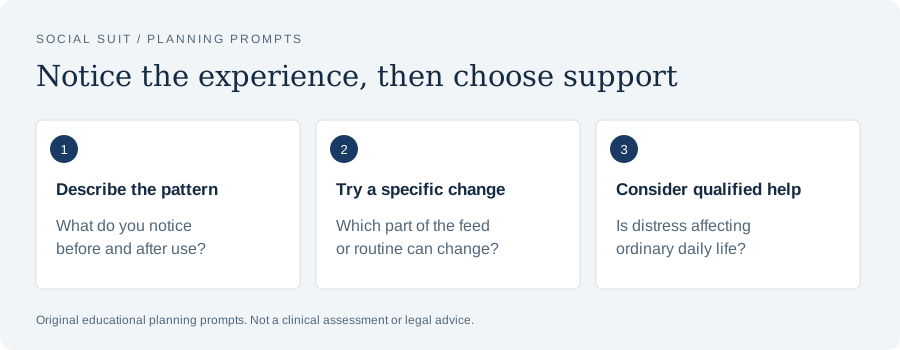
- Describe the patternWhat do you notice before and after use?
- Try a specific changeWhich part of the feed or routine can change?
- Consider qualified helpIs distress affecting ordinary daily life?
Check whether the evidence supports the actual statement
A source link can create an impression of reliability without supporting the words in the video. Open the source when a claim matters. Look for the question it addresses, the population, the outcome, and the limitations. A study about one age group does not automatically establish a rule for everyone. An association does not necessarily show that one factor caused another. A recommendation may depend on evidence from several sources and additional judgment. You do not need to become a researcher to notice when a post turns a limited finding into a universal explanation.
Primary information can help orient you. Public health agencies and professional sources often distinguish general education from individual care. The National Institute of Mental Health provides information about mental health topics, psychotherapies, and ways to find help. These resources can give you vocabulary and questions for a conversation. They do not diagnose you through a webpage. Use the same distinction when evaluating creator content: what is the source offering, and what is it not able to know about you? A reliable explanation should make the boundary visible rather than imply that a brief checklist settles an individual concern.
Be alert to precise claims that have no visible basis. A creator may promise that a behavior proves a condition, that a method works for everyone, or that improvement will occur within a fixed number of days. Ask where that certainty comes from and whether the evidence supports it. If the source merely describes a personal success, the claim should remain a personal account. If the post uses a frightening label to sell immediate access, slow down. You can investigate the question through a more appropriate source without accepting the urgency created by the presentation.
Notice commercial interests without assuming that payment proves wrongdoing
Creators may earn money through advertising, sponsorships, subscriptions, products, courses, or appointments. Commercial interests can influence which topics are emphasized and how solutions are framed. Their presence does not prove that every idea is false. It does mean that you should identify what is being sold and how the recommendation relates to it. Is the creator describing an option, or claiming that the product is the only trustworthy route? Are costs and conditions clear? Does the content leave room for alternatives? These questions help separate the information from the sales process.
The Federal Trade Commission provides guidance about endorsements and the disclosure of material connections in advertising. For a viewer, a practical habit is to look for clear information about sponsorship and other interests, then evaluate the claim independently. A disclosure is useful context, but it is not a guarantee of quality. An undisclosed interest may be difficult to detect, which is another reason not to rely on a confident presentation alone. If you are considering a purchase, review the actual service, refund terms, costs, and limits through reliable information rather than a stream of enthusiastic testimonials.
Testimonials describe selected experiences. They may omit circumstances, other support, unsuccessful users, or later changes. Even an authentic account does not establish what will happen for you. If a program promises individualized health results, ask what qualified assessment and care it actually provides. Do not allow an expiring offer to substitute for understanding. A genuine need for help deserves a suitable route, and commercial urgency does not determine that route. You can pause a purchase, gather information, and seek another opinion while continuing to address the concern that brought you to the content.
Recognize pressure that narrows your choices
Some advice becomes concerning because of how it treats alternatives. A creator may say that professionals cannot be trusted, that family members who question the advice are enemies, or that only the creator understands the truth. Such claims can make support dependent on loyalty rather than inquiry. A useful source should be able to explain its limits and tolerate reasonable questions. It should not require you to surrender independent judgment to belong. If the content encourages secrecy or isolation from appropriate help, consider stepping back and discussing it with someone you trust.
Pressure can also appear in requests for disclosure. A creator may invite viewers to post sensitive health details in comments to receive an informal assessment. A public audience is not a confidential care setting. You do not know who will save, share, or interpret the information. You can ask a general question without providing a personal record, or choose a professional channel where the relevant processes are explained. The desire to be seen and understood is valid. It should not require exposing more information than the service needs or accepting a diagnosis from a short exchange.
Urgent sales language deserves particular attention. If the creator says that failing to buy now will inevitably worsen your health or prove that you do not want to recover, the claim may be using fear to drive a decision. The appropriate response is not to debate your worth with the seller. Clarify what you need and seek information or support through a suitable route. A health concern can be important without making a specific product necessary. Immediate danger requires urgent assistance, but a countdown on a course page is not the same kind of urgency.
Use a creator's story as a question generator
A helpful way to keep the value of a story is to turn it into questions. The creator described difficulty stopping at bedtime; what happens in your own evenings? They mentioned feeling isolated after browsing; are your sessions mostly observation or direct interaction? They found a community useful; what kind of community would fit your interests and circumstances? These questions keep the post connected to your actual experience. They avoid borrowing the creator's complete explanation. You can explore an observation without accepting every conclusion or commercial recommendation attached to it.
Write a few concrete examples before seeking more advice. Describe what you intended to do, what happened, and what was affected. Include useful online activities as well as concerns. If the pattern involves missed responsibilities, explain those consequences. If it involves distress, describe its duration and context in ordinary language. A record should be short enough to use and private enough to protect sensitive details. It does not need to collect every video that seemed relevant. The goal is to prepare information about you, rather than build a library of other people's labels.
For example, instead of saying that a video proved you have an addiction, you could say that you often plan to answer messages for ten minutes but stay in recommendations until much later, and this has delayed sleep several evenings. That description allows a professional to ask useful follow up questions. It also gives you a practical pattern to consider while arranging support. The label may be debated or used differently across sources. The observable concern remains understandable without it. Keeping the description concrete can make the next conversation more productive.
Find professional support through a route you can verify
If you want an individual assessment or help with ongoing distress, begin with an appropriate health care provider or a reputable service that explains its professionals and processes. Depending on your circumstances, a primary care provider, insurer directory, local health service, or recognized professional locator may be a starting point. The National Institute of Mental Health's finding help resources can orient you to available routes. Verify the current details directly. Availability, cost, location, and eligibility can change. A social media profile should not be the only evidence that a service exists or is suitable for you.
Ask practical questions before an appointment. What kind of assessment is offered? Who provides it? Are they qualified to work with someone in your location? What does the service cost? How are confidentiality, records, and urgent concerns handled? What happens if the provider is not a good fit? These questions do not require you to know the clinical answer in advance. They help establish whether the route can provide the kind of support you are seeking. A reputable service should be able to explain its arrangements clearly enough for you to make an informed choice.
If access is difficult, tell the service what the barrier is. Cost, transportation, scheduling, language, disability access, and technology may affect what is possible. Ask about available alternatives or referrals rather than assuming that the first route is the only one. Online care may be useful in some circumstances, but it still needs appropriate qualifications and processes. A creator's popularity does not remove those requirements. You can seek a format that fits your life while maintaining the distinction between professional care and general content shared with an audience.
Prepare for a conversation without diagnosing yourself first
You do not need to know which condition, if any, explains your concern before asking for help. Tell the professional what has been happening and what you hope to change. Mention when the pattern began, how often it occurs, and how it affects sleep, work, school, relationships, or other activities. Include relevant circumstances outside social media. A provider may consider several possibilities, and an assessment should not be constrained by the label a creator used. Your preparation gives the conversation a starting point while leaving room for professional judgment.
It is reasonable to bring a post that prompted a question, but explain why it caught your attention. You might say that the creator described a behavior you recognize and that you want to understand whether the explanation applies. The professional can discuss the claim and your circumstances. Avoid presenting the video as a completed diagnosis that the provider must simply endorse. Also avoid withholding information that does not match the video's story. A fuller account is more useful than a carefully selected one. The purpose is understanding, rather than proving that you belong to a category.
Ask how the assessment will consider the broader situation and what options may fit. If a recommendation is unclear, request an explanation of its purpose, benefits, limits, and next steps. You can also ask how progress would be reviewed. This turns the conversation toward a process you can understand. A short public post often leaves those details out. Professional support should make space for them in a way suited to your circumstances. This article cannot specify your care, but it can help you prepare the questions that allow appropriate care to be discussed.
Keep peer support valuable without making it a clinical authority
Peer support can offer recognition, practical encouragement, and a sense that you are not the only person facing a concern. A group may help you exchange everyday ideas or navigate the process of seeking help. Its members' experiences remain their own. Be cautious when the group turns personal accounts into instructions about what you must do medically. A supportive space should allow differences and appropriate professional care. It should not require every member to accept the same diagnosis, discontinue care, or purchase a product to demonstrate commitment.
Review the group's moderation and boundaries. Are sensitive disclosures treated carefully? Do moderators address harassment? Are commercial promotions clear? Can people decline advice? Is there a way to report concerns without becoming a target? These details affect whether participation is manageable. A group may be busy and emotionally expressive while still lacking safeguards. You can observe before joining, contribute modestly, and leave if the pattern does not fit your needs. Your decision can concern the group's actual conduct, rather than whether its members have good intentions in general.
You can make your own role clear. If you share a strategy that helped you, present it as a personal experience and encourage others to consider their circumstances. Avoid diagnosing another member from a post or promising that your method will produce the same result. If someone describes a serious concern, point them toward appropriate help rather than taking responsibility for an assessment you cannot provide. Mutual support is stronger when people understand what they can offer. A community can remain warm and useful without pretending to be a substitute for every form of care.
Protect privacy in comments, messages, and intake forms
Before sharing personal information, identify who will receive it and why it is needed. A public comment, a direct message, and a professional intake form have different purposes and processes. None should be treated as automatically confidential merely because the interface feels personal. Review the service's explanation of privacy and records when considering care. For ordinary creator interactions, keep disclosures limited. You can ask about a general topic without providing identifying health information, documents, financial details, or information about another person who has not agreed to be involved.
Be alert when a private message asks for credentials, payment through unusual routes, or verification codes. A friendly exchange does not establish identity. If someone claims to represent a provider or platform, verify through an independently found official contact route. Do not use the suspicious message's link as the only way to check itself. If you have already shared sensitive information, seek appropriate advice about the specific exposure and use relevant reporting or account security tools. The next step depends on what was shared; a vague instruction to delete the app may not address the actual risk.
If a creator offers individual advice through messaging, ask what service this is. Who is providing it? What qualifications apply? What relationship is being established? What are its limits and costs? If the answers are unclear, do not assume that the exchange has the protections of professional care. You can decline and choose another route. The platform's private interface does not itself create informed consent, a clinical record process, or emergency support. Those arrangements need to be explained by the service. Treating them explicitly helps prevent familiarity from substituting for understanding.
Evaluate a proposed change by its demands and limits
General suggestions can range from a modest routine adjustment to a sweeping instruction about health. Consider what the proposal asks you to do, what it might displace, and whether the person explains its limits. Choosing a different time to browse is different from changing prescribed treatment. Trying a clearer stopping cue is different from adopting an unverified supplement. If advice concerns medication, treatment, or an individual health decision, discuss it with an appropriate qualified provider. Do not make such a change simply because a creator presents a personal success story with confidence.
For an ordinary routine idea, choose a purpose and a review point. You might want fewer interruptions during work or a more direct route to messages. Test the idea in a way that preserves useful activities, then observe the practical result. Do not require the experiment to establish a diagnosis or cure a broader problem. If the idea creates pressure, removes important support, or fails to fit your circumstances, adjust or stop it. An online suggestion is a possibility to evaluate, not an obligation. You remain entitled to ask whether it is useful for your actual life.
Notice whether the creator accepts unsuccessful outcomes. A responsible explanation can acknowledge that a strategy does not fit everyone and that further help may be needed. A seller who says every failure proves the user's lack of commitment may be protecting the claim from scrutiny. That framing can make people keep paying or blaming themselves rather than reconsidering the service. Ask what evidence would lead the creator to revise the recommendation. You do not need to conduct a debate, but you can use the answer or lack of one when deciding whether to rely on the advice.
Avoid turning a content feed into an assessment process
After watching one health related video, a feed may offer many similar posts. The repetition can make a label feel increasingly certain. What you are seeing is more content, not a sequence of independent assessments of your situation. Recommendation systems may respond to viewing and interaction patterns, and their detailed behavior varies by service. Do not interpret the frequency of a topic as evidence that the platform knows your diagnosis. A series of confident statements can feel persuasive while still lacking the information needed to evaluate you individually.
If repeated posts become overwhelming, change the exposure where possible. Use relevant feedback, mute or block accounts, adjust subscriptions, or step away from recommendation browsing. Check current platform guidance for available controls. Keep a reliable source bookmarked if you still want general information without the same stream of speculation. You can also write the question that prompted the browsing and take it to a professional. This preserves the concern while changing the way you pursue it. The aim is to move from accumulating labels toward obtaining information or care through a route suited to the question.
It may help to stop searching once you have enough information to choose the next step. If the next step is arranging an appointment, ten more videos may not make that arrangement easier. If the next step is asking about a general term, a reliable explanation may be sufficient for now. Continuing to browse can sometimes add uncertainty rather than resolve it. Notice the difference between gathering necessary information and seeking a level of certainty that the feed cannot provide. You can act on a practical plan while acknowledging that the individual assessment has not yet occurred.
Discuss creator content with people in your support network
A trusted friend or family member can help you evaluate the way advice is being presented. They do not need to decide your diagnosis. You could ask whether a claim seems to rely on pressure, whether the purchase terms are clear, or whether the post encourages appropriate help. Keep the conversation focused on the specific concern. If the other person dismisses all online experience, explain the value you found as well as the limits you are investigating. A balanced discussion can preserve useful recognition while questioning an unsupported conclusion.
If you are helping someone else, avoid treating their interest in a creator as evidence that they are foolish. Ask what the content gave them: language, companionship, hope, or a practical idea. Then discuss the distinction between that benefit and individual care. You might help locate a reliable source, verify a professional, or prepare questions for an appointment. A direct attack on the creator may make the person defend the whole relationship instead of considering the claim. Focus on what support the person needs and what the source can actually provide.
Respect privacy in this conversation too. Do not share the person's comments or disclosures with a wider audience to criticize the influencer. If there is a safety concern, seek appropriate assistance through a careful route. Otherwise, let the person participate in decisions about their own information and support. The goal is to improve access to help and understanding, not to win another online argument. You can disagree with a claim while remaining attentive to why it mattered to the person who encountered it. That attention often makes a more useful conversation possible.
Know when waiting for content is the wrong next step
If distress persists, worsens, or interferes with everyday life, seek qualified help rather than relying on a stream of general tips. The NIMH resources about mental health and finding help can provide an orientation, and a provider can assess your circumstances. You do not need to wait until you can prove that the creator was wrong or that social media caused the issue. The concern itself is enough to begin a conversation. Describe the observable effects and ask what support may be appropriate. More content is not a prerequisite for asking for care.
Immediate danger requires an urgent route. If you or another person is in a safety emergency, contact relevant emergency services. In the United States, calling or texting 988 can connect you with the Suicide and Crisis Lifeline. Use appropriate local resources elsewhere. A creator's comments, direct messages, or paid community are not a dependable emergency response system unless a specific qualified service clearly provides an appropriate process, and even then its stated limits matter. Do not assume that a large audience means someone will respond quickly or be able to intervene.
After an urgent situation, ordinary support may still be important. A peer community or trusted relationship can provide companionship, while professional follow up addresses care needs. Keep the roles clear. The existence of useful online support should not delay appropriate assessment, and receiving professional help does not require abandoning every meaningful online connection. The question is which source serves which need, with what limitations. A clear division of roles can make the support network more understandable and reduce the pressure placed on one personality, group, or platform.
A worked example: keeping recognition while questioning a diagnosis
Imagine a hypothetical viewer named Noor who watches a creator describe feeling unable to stop checking messages. The story feels familiar and relieving. Noor had struggled to explain the behavior and now has language for it. The creator then claims that a single condition explains every instance and advertises a course. Noor pauses before buying. They write down their own pattern: repeated checking while waiting for a friend's reply, especially during a stressful week, and difficulty returning to a task. The description preserves the useful recognition without accepting the universal claim.
Noor checks a reliable general resource and arranges a conversation with a qualified provider because the pattern is affecting daily life. They bring the concrete examples and mention the video as the source of a question. The provider considers wider circumstances, and Noor asks how the assessment will address them. Meanwhile, Noor mutes some repetitive diagnostic content and keeps direct contact with friends. The result is not a verdict on every creator. It is a shift from a public story to an appropriate individual conversation, with a practical boundary around content that was increasing uncertainty.
If Noor later finds the creator's general discussion helpful, they can still watch selectively. They can also decide that the sales pressure makes the account unsuitable. Either choice can be based on observed conduct and current needs. The important point is that gratitude for a relatable story does not create an obligation to accept a product or diagnosis. Noor can acknowledge that the post helped them name a concern while choosing another route to understand it. A source can contribute one useful piece without becoming the authority for the whole situation.
A worked example: evaluating a paid support community
Consider a hypothetical person named Alex who wants companionship and finds a creator's paid community. The community advertises shared activities and weekly discussions. Alex asks about the schedule, moderation, cost, cancellation, and the kind of support offered. The answer explains that it is a peer activity group, not professional care. That clarity allows Alex to evaluate it according to the actual need. If the group fits their interests and budget, it may be a useful social option. If Alex needs an assessment of ongoing distress, they must seek that through another route.
Now imagine a different response: the seller says the group can diagnose members, discourages outside care, and refuses to explain qualifications or privacy. The problem is not simply that a fee exists. It is that the service claims functions without explaining the processes needed to provide them. Alex can decline the purchase and look for a clearer source of companionship or care. They do not need to prove fraud in order to decide that the offer does not meet their requirements. A service should be understandable before a person commits money or sensitive information to it.
Alex can also ask whether the community's format is accessible. A live discussion may not fit their work hours, language needs, or comfort with speaking. A text group may be easier, but it still needs respectful moderation. Reviewing these ordinary details prevents the creator's popularity from eclipsing practical fit. The best advertised community is not useful if Alex cannot participate or feels pressured to disclose too much. Support should be evaluated through what actually happens, what it costs, and what it can provide, rather than through a promise that belonging to the audience will solve everything.
A checklist that stays focused on the next decision
When you encounter advice, identify the claim, the evidence, the person's relevant qualification, any commercial interest, and the action being requested. Then identify your need. Is this information, peer support, assessment, treatment, or urgent assistance? Ask whether the source can provide that function. If the answer is unclear, do not fill the gap with assumptions created by a friendly tone. Seek the missing information or use a more suitable route. The checklist is meant to guide one decision, not to create a permanent investigation of every post you see.
For a modest routine idea, a careful personal experiment may be enough. For a health decision, ask an appropriate provider. For a purchase, review the actual offer and terms. For a suspicious request, verify identity independently and protect information. For a crisis, use urgent help. Matching the action to the need makes the process more manageable. You do not have to choose between trusting everything and dismissing every online story. You can recognize value, question unsupported claims, and choose the route that has the qualifications and processes your situation requires.
Finally, keep the question about you visible. What has been difficult? What do you want to preserve? What would useful support allow you to do? A feed can supply endless explanations, but those explanations are valuable only when they help you reach understanding or appropriate assistance. A creator's account may be a beginning. It should not become a barrier to asking questions, protecting privacy, or seeking qualified help. Support that is more than advice gives you a clear process, realistic limits, and room for your circumstances to be considered.
Sources and further reading
These primary resources provide context. Our practical examples and planning suggestions are original educational material, not validated treatment protocols. Linked organizations do not endorse Social Suit.