 Social Suit
Educational information, not individual medical or legal advice. Practical examples are hypothetical and do not describe clients or study participants. This article is not represented as reviewed by a clinician or attorney. How we prepare our guides.
Start with the connection you are actually missing
Loneliness can make a social media feed feel both inviting and disappointing. There are people everywhere, yet the experience may still leave you wishing that someone knew how your day really went. The number of available accounts is different from the presence of a relationship. Before changing your phone routine, try describing the kind of connection that feels absent. You may want companionship during an ordinary evening, someone who shares an interest, a person who understands a difficult circumstance, or a dependable conversation with someone already important to you. Those needs point toward different actions. Watching more videos cannot necessarily provide the same thing as hearing from a familiar friend.
Online relationships can be meaningful. A person who cannot easily travel, lives far from family, has a demanding schedule, or belongs to a small local community may rely on digital contact for important companionship. The useful question is how the contact functions in that person's life. Does it allow conversation, mutual understanding, shared activity, and a reasonable sense of continuity? Or does it mostly create the feeling of looking through a window at other people's lives? Neither answer is a judgment about your worth. It is information that can help you choose an experience that better fits what you need today.
Imagine that you open an app after moving to a new town. You see photographs of old friends together and feel left out. Your first explanation might be that social media always makes you lonely. A more specific explanation is that this particular session emphasized the distance between you and people you miss. That detail changes the next step. A message arranging a call with one friend could help more than deleting every account. At the same time, if certain posts repeatedly leave you upset, you can reduce exposure while keeping direct contact. Preserving useful relationships and changing a painful browsing pattern can happen together.
Give the session a modest purpose
A clear purpose does not have to turn friendship into a productivity exercise. It simply gives you a way to recognize whether the app is helping. Before opening it, you might decide to ask a friend how their appointment went, respond to a community discussion about a shared hobby, or arrange a short conversation for later. These purposes are small enough to complete. They also involve another person rather than an endless supply of content. When the action is finished, you have a natural stopping point. You do not have to keep browsing until a feeling disappears, which may be an expectation no feed can reliably meet.
Choose an action that matches your available energy. If you are exhausted, a demanding public introduction in a large group may be too much. A brief message to someone you know could be more manageable. If you want to meet new people, a group with a recurring activity may offer a clearer opening than a general feed. You might comment on the book everyone is reading, ask about a beginner's question, or share a picture of something you made. A concrete subject gives both people something to discuss. It also reduces the pressure to explain your entire life in the first exchange.
Purpose is especially useful when you notice repeated checking. Suppose you sent a message and keep reopening the app to see whether the recipient has answered. The original purpose was to make contact, and you have already done that. Further checking does not make the other person available sooner. You could decide when you will look again and spend the interval on a separate activity. This is a practical boundary, not a rule that you must feel calm immediately. Waiting can still feel uncomfortable. The boundary helps keep that discomfort from becoming an entire evening of refreshing the same screen.
Distinguish presence from participation
Watching a community can be a legitimate first step. It helps you learn the group's tone, understand its rules, and decide whether you want to join. There is no requirement to become visibly active on the first visit. The distinction to notice is whether observing remains useful or has become a substitute for the contact you want. If you have spent several weeks reading conversations but still feel unknown, another hour of observation may not change that. A small contribution could. You can test participation without promising to become a regular member or sharing information that you prefer to keep private.
Participation does not mean posting a dramatic personal story. It can mean answering a question within your knowledge, thanking someone for a useful explanation, joining a scheduled discussion, or asking a specific question of your own. A knitting group might provide a conversation about fixing an uneven edge. A language group might offer practice around a short passage. A neighborhood group might help you learn about a library event. These interactions may not become close friendships, but they create opportunities for recognition. The aim is to make room for mutual exchange instead of assuming that meaningful connection will emerge from passive exposure alone.
Consider what happens after you contribute. Did another person respond to what you actually said? Was the conversation respectful? Did you feel able to leave without being pressured? Were you interested in returning for the subject itself? These observations tell you more than the popularity of your post. A thoughtful answer from one person may meet your need better than dozens of reactions that do not develop into conversation. If a group repeatedly rewards conflict or humiliation, its activity level is not evidence that it is a good place for you. You can look elsewhere without treating the mismatch as personal failure.
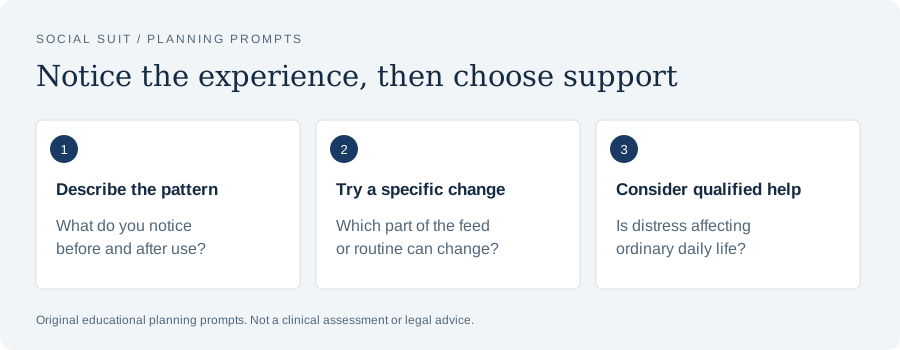
- Describe the patternWhat do you notice before and after use?
- Try a specific changeWhich part of the feed or routine can change?
- Consider qualified helpIs distress affecting ordinary daily life?
Make direct contact easy to answer
A message can open a door without requiring the recipient to manage your whole emotional situation. Specific invitations are often easier to respond to than vague expressions of distress. For example, you could ask whether a friend would like a twenty minute call sometime this weekend, or whether they want to exchange updates about a shared project. The exact wording should fit the relationship. You do not need to pretend everything is fine, but you can explain your wish in a way that leaves the other person a manageable choice. This also helps you understand what a response means.
A familiar person may care about you and still be unavailable. Work, illness, family responsibilities, time zones, and their own need for rest can shape when they answer. Try not to treat the app's activity indicator as a complete account of their circumstances. Someone may open the service briefly without having the attention for a conversation. A delayed answer can feel painful, particularly when you are already lonely, but it does not by itself show rejection. If there is a repeated pattern that matters to the relationship, discuss it directly when both of you have time, instead of building conclusions from scattered online signals.
You can also make invitations more sustainable by giving alternatives. A friend who cannot join a call may be able to exchange voice messages. Someone who finds long conversations tiring may enjoy watching the same film and discussing it afterward. A relative who rarely checks social media may prefer a text or phone call. The platform should serve the relationship, rather than forcing every relationship to use its preferred format. If one route is not working, consider whether the problem is the channel, the timing, or the expectations. That is different from deciding that the relationship has no value.
Look for communities organized around an activity
A group organized around a shared activity can make connection easier because the conversation has a starting point. You do not need to invent an interesting identity each time you participate. The activity might be drawing, gardening, a game, reading, music, local volunteering, or a professional interest. What matters is that it gives people a reason to return and something concrete to do together. Repeated interaction can create familiarity over time. There is no guarantee of friendship, but it offers a more observable process than hoping that scrolling through unrelated recommendations will eventually make you feel included.
Before joining, review how the community handles ordinary disagreement and new members. Are rules understandable? Do moderators intervene when people target someone? Can members ask basic questions without ridicule? Is there pressure to reveal personal details, buy products, or prove loyalty? A community can appear welcoming while expecting more disclosure or commitment than you want to provide. You are allowed to keep your involvement limited. Joining a group does not authorize strangers to direct your health choices, financial decisions, or private relationships. Warmth and enthusiasm are worthwhile qualities, but they are not substitutes for sensible boundaries.
An activity also provides a useful test of fit. Suppose a photography group promises friendship, but most conversations revolve around expensive purchases and ranking members' equipment. If you hoped to share local walks and learn simple techniques, the group may not serve that purpose. Another smaller group could be a better match. When evaluating the experience, look at actual interactions rather than its name or stated mission. Ask whether you had a chance to exchange ideas, whether people made space for newcomers, and whether returning seems inviting. Your decision can be about compatibility instead of success or failure.
Keep privacy inside the plan for connection
Feeling understood can make it tempting to disclose more than you originally intended. A conversation may feel intimate even when the audience is large or the relationship is new. Before posting a vulnerable account, consider who can see it, how long it may remain available, and whether it identifies other people. You can share the part relevant to the conversation without including your address, workplace schedule, financial details, or a child's identifying information. Choosing limits does not make the story dishonest. It allows you to participate while protecting parts of your life that the community does not need to know.
Think carefully about moving from public discussion to private messaging. A private channel may be useful, but it is not proof that the recipient is trustworthy or that the message cannot be copied. If someone quickly asks for secrecy, intimate material, money, login codes, or personal documents, step back. The need for companionship should not require accepting pressure. You can decline a request, block an account, or talk to someone you trust about an interaction that feels confusing. Do not keep an uncomfortable exchange going just to avoid disappointing a person whose intentions you do not understand.
Consider a hypothetical member of a chronic hobby group who says they have an exclusive offer for people who feel isolated. They insist that only paying for a private program will bring real friendship. You do not need to establish whether every claim is false before deciding that the request is unsuitable. Friendship should not depend on surrendering financial information under pressure. Verify any commercial claim through an independent channel if you are considering it. More generally, separate the value of a friendly conversation from the credibility of a sale. The FTC's consumer resources discuss social media scams, and its guidance can provide a useful starting point for evaluating suspicious requests.
Notice how comparison changes the experience
Comparison can arise without an obvious intention to compare. A feed shows reunions, holidays, celebrations, and polished accounts of social life, while your own ordinary evening may be quiet. That difference can feel like evidence that everybody else belongs somewhere. What you can actually observe is a selection of posts. You usually cannot see the full relationship, the difficult moments around the photograph, or what was left out. Remembering this limit may help you interpret the experience more accurately. It does not require dismissing other people's happiness or telling yourself that you should not feel affected.
If certain accounts repeatedly leave you feeling excluded, experiment with a narrower adjustment. You might mute their posts for a while, keep messaging access, or choose to view updates when you have more energy. The goal is to alter exposure that appears unhelpful while preserving whatever contact you value. Explain the change only if explanation is useful for the relationship. You do not need to make a public announcement about every feed decision. A quiet adjustment can be enough. Afterward, observe whether your sessions contain more of the conversations and activities you intended to seek.
A useful comparison question is whether you are learning something actionable. Seeing a friend join a local club might inspire you to investigate an activity available to you. Seeing hundreds of social events you cannot attend may simply intensify a sense of distance. The distinction is not that one emotion is acceptable and another is wrong. It concerns what the information allows you to do. When content repeatedly leaves you with an impossible assignment to reproduce someone else's life, consider stepping away from it. You can appreciate other people's experiences while making room for choices suited to your circumstances.
Plan around the moments that feel hardest
Loneliness may be more noticeable at particular times: after work, during weekends, when a household becomes quiet, or after an interaction that did not go as hoped. A plan can focus on one such moment instead of trying to redesign your entire life. For instance, you might arrange a regular check in with a friend on an evening that usually feels empty. Or you could identify a moderated discussion that occurs at a predictable time. The benefit is predictability. You know what contact is available, and you do not have to discover it anew while already feeling discouraged.
Prepare an alternative for when the contact does not happen. People cancel, communities pause, and connections fail. Your alternative does not have to remove loneliness. It can simply prevent the cancellation from turning into hours of unplanned browsing. You might listen to a familiar program, make a meal, work on a small project, or spend time in a public place if that is accessible and comfortable. These are ordinary examples, not treatment instructions. The point is to keep one missed interaction from becoming the sole event around which the evening is organized.
If you are coordinating across time zones, make the arrangement explicit. A friend may interpret later as later that day, while you mean later that week. Agreeing on a time and format can prevent unnecessary uncertainty. It may also help to choose a duration that both people can maintain. A short call that occurs regularly could be more useful than a large plan that is repeatedly postponed. Reliability is built through choices that fit actual schedules. You can begin with a modest agreement and adjust it after seeing how it works, rather than treating the first plan as permanent.
Allow a relationship to grow at an ordinary pace
An enjoyable exchange can create hope, especially if you have been feeling isolated for a long time. It is reasonable to value that hope, but try to leave room for the relationship to develop gradually. One good conversation does not establish that another person can provide every kind of support you need. Learn how they behave over several interactions, what they are comfortable sharing, and whether communication feels mutual. A relationship becomes more understandable through experience. You do not have to decide immediately whether this is a close friendship, a useful acquaintance, or simply a pleasant conversation about a shared subject.
Mutuality does not mean perfectly equal message counts. People have different communication styles and periods of availability. It means that each person has room to contribute, decline, and be considered. Notice whether you are asked about your interests as well as asked to provide support. Notice whether disagreement can occur without threats or punishment. Notice whether your limits are respected. These qualities matter more than constant contact. A relationship that requires you to stay continuously available may become difficult to maintain, even if it initially feels reassuring. You can enjoy connection and still preserve ordinary boundaries around sleep, work, and private time.
Sometimes a promising online friendship remains limited to one activity. That is not necessarily a disappointment. Someone can be an excellent partner for a weekly game without becoming the person you call about a family problem. Different relationships can meet different needs. By recognizing these differences, you avoid placing a burden on one person that neither of you agreed to carry. You also create room for a wider network of contact over time. The question becomes which connections are dependable for which purposes, rather than whether a single person can solve the whole experience of loneliness.
Use online contact to support accessible offline opportunities
Online interaction can help you discover opportunities beyond the feed. A community calendar, a library group, a class announcement, or an invitation from someone you know may create a concrete next step. If in person participation is possible for you, investigate the practical details before committing. Transportation, cost, physical access, timing, and the event's expectations can affect whether it is manageable. An appealing photograph does not tell you these things. Asking a few questions can turn a vague wish to get out more into a decision you can realistically make.
Do not assume that offline activity is automatically better or equally available to everyone. Disability, caregiving, geography, safety concerns, and financial limitations may shape your choices. A remote gathering can be the accessible option that actually allows participation. If someone recommends an activity you cannot attend, you can explain the relevant constraint or look for another version. The quality of connection depends on what happens between people, not merely on whether they occupy the same room. A thoughtful online conversation may be more meaningful than being physically present at an event where you remain ignored or uncomfortable.
If you decide to meet someone from an online community, use ordinary safety planning. Verify the event or organization independently, tell a trusted person your plan if appropriate, and choose arrangements that let you leave. Avoid feeling obligated to meet privately because the online conversation was friendly. You may prefer an established group event in a public setting. Keep personal information limited until you have reason to share it. These steps are about making the transition manageable. They do not require treating every new acquaintance as dangerous, and they do not guarantee that an event will feel socially rewarding.
Support someone else without becoming their only support
Connection often involves helping another person. Listening to a friend, answering a question, or remembering something that matters to them can make a relationship feel more mutual. At the same time, you do not have to accept responsibility for another person's entire well being in order to belong. If someone expects instant responses at every hour or tells you that leaving the app will cause harm, the interaction needs more support than a private friendship can reliably provide. Encourage appropriate help and involve trusted support when the situation calls for it. Do not promise a level of availability you cannot maintain.
You can be clear and kind about your limits. For example, you might say that you can listen for a while this evening but will be offline afterward. Or you could explain that a particular issue would be better discussed with a qualified professional. This does not diminish the value of the friendship. It describes what you can offer honestly. A boundary that is stated before you become exhausted may be easier to sustain than one imposed after resentment builds. The other person may feel disappointed, but disappointment does not automatically mean that your limit was inappropriate.
If a friend describes an immediate danger, treat the situation as urgent rather than as a test of friendship. Contact local emergency help when necessary and encourage the person to reach appropriate crisis support. In the United States, the 988 Suicide and Crisis Lifeline is available by calling or texting 988. Location and circumstances matter, so use relevant local services outside the United States. Ordinary social media messages are not a dependable emergency response system. You can care about someone while recognizing that a serious safety situation requires people and services with the ability to respond.
Review the experience without turning it into a score
A brief review can help you decide what to keep. After a few sessions, ask what actually occurred. Did you exchange messages, join an activity, learn someone's perspective, or simply scroll? Did the experience fit your purpose? Did it displace something important? Were there interactions you would like to repeat? You do not need a detailed diary or a numerical rating for every mood. A few concrete observations may be enough. The review should clarify your choices, rather than create another task that feels impossible to complete correctly.
Separate the immediate feeling from the longer pattern. A meaningful conversation can include sadness because you talked about a difficult event. A cheerful session may be enjoyable without providing the connection you hoped for. It helps to ask both how you felt and what the interaction contributed. You might leave a conversation tired but grateful that someone listened. You might leave a funny video session amused but still wishing to speak with a person. Neither experience needs to be labeled entirely good or bad. They serve different purposes, and knowing that distinction can guide your next choice.
For a simple experiment, choose one change and observe it under reasonably similar circumstances. You could replace a usual fifteen minute browse with a direct message or a scheduled community activity. Then note whether the action was practical and whether it produced the kind of exchange you wanted. A single result does not establish a medical conclusion or prove that a strategy will always work. It simply provides information about this arrangement. If it helps, repeat it. If it does not, consider the timing, person, or activity before assuming that every possibility for connection has failed.
Know when a broader conversation would help
Loneliness can have many contexts, and a social media routine may address only part of the situation. A move, bereavement, relationship change, illness, discrimination, or an ongoing mental health difficulty may call for support beyond the platform. If distress persists, worsens, or interferes with everyday life, consider talking to a qualified health professional. You do not need to establish that social media caused the problem before asking for help. Describe what you are experiencing and how it affects your days. The professional can consider the broader circumstances instead of relying on an app's usage total.
The National Institute of Mental Health provides general information about caring for mental health and finding help. Those resources can orient you to available kinds of support, but they do not assess your individual situation through this article. A useful preparation step is to collect a few examples: a time when you wanted contact, what you did, what happened afterward, and what has been difficult to change. Mention useful online relationships as well as troubling patterns. This gives a provider a more complete account of what you hope to preserve and what you want help understanding.
You may also want support from a trusted person who knows you outside the platform. That conversation can be practical rather than dramatic. You could explain that evenings have felt difficult and ask whether they would be willing to make a regular plan. If the first person cannot provide what you need, their limitation does not settle whether support exists. Different people have different capacities. Continue looking for an appropriate route while keeping the requests specific. When professional help is needed, do not wait for an online friendship to become capable of providing care it was never designed to offer.
Build a small plan that can survive an imperfect week
A workable plan might include one person to contact, one activity to try, one boundary around browsing, and one alternative when the original plan falls through. Keep each part specific enough to use. Contact a friend about a weekend call is clearer than be more social. Join the group's next beginner session is clearer than make friends online. Close the app after answering messages is clearer than stop wasting time. Specificity lets you evaluate the plan without declaring your whole social life successful or unsuccessful. It also makes adjustment easier when circumstances change.
An imperfect week is normal. You may forget to send a message, find a group awkward, or spend an evening browsing despite your intention. Use the event to improve the arrangement. Was the plan too demanding? Did you choose a time when you were usually tired? Did you need an easier way to begin? A boundary may work better when it is connected to a real next activity, rather than an empty instruction to stop. Revise the part that caused difficulty. There is no need to erase everything you learned because one evening did not match the plan.
You can also decide when to review your choices. After several attempts, consider whether the interactions became easier, whether the contact felt mutual, and whether the plan fits your life. Keep the parts that are useful. Remove commitments that create pressure without providing connection. Add support when the need extends beyond what the plan can address. The measure is whether you are creating more opportunities for the relationships you value, not whether you can eliminate loneliness on command. Social media can be one channel for that work, alongside other relationships, activities, and appropriate professional support.
A worked example: changing a lonely Sunday evening
Consider a hypothetical person named Jordan who regularly spends Sunday evening watching friends' updates. Jordan misses a former roommate and also wants to meet people who enjoy cooking. The usual browse supplies reminders of both wishes but does not act on either. Jordan decides to separate them. On Thursday, they send the former roommate a specific invitation for a short Sunday call. They also find a moderated cooking group with a weekly discussion about simple meals. The plan contains two routes for contact, each connected to an existing interest or relationship, rather than a requirement to become instantly outgoing.
The former roommate cannot talk on the first Sunday, but offers another time. Jordan accepts it and joins the cooking discussion for twenty minutes. The exchange is pleasant but not deeply personal. Jordan notes that this was still a useful first interaction and that the group respected newcomers. Afterward, they close the app and prepare a meal. The evening still contains some loneliness. The change is that Jordan made contact, learned about a community, and created a later conversation. These observable outcomes are more informative than asking whether the plan cured the feeling in one attempt.
Over the next few weeks, Jordan discovers that one cooking thread becomes competitive and unpleasant, while another remains welcoming. They choose the second discussion and stop following the first. The roommate calls remain occasional because both schedules vary. Jordan also notices that persistent low mood is affecting other parts of life and decides to speak with a professional. None of these choices requires deciding that online connection is either wholly helpful or wholly harmful. Jordan preserves what works, changes what does not, and seeks another kind of support for concerns that extend beyond the platform.
Questions to take into your next interaction
Before your next session, identify one person or group and one action you can complete. Consider what information you are comfortable sharing and how you will recognize pressure. Think about whether the conversation is likely to involve the kind of exchange you want. If you are seeking companionship, direct interaction may be more relevant than a feed. If you are looking for a shared activity, a recurring group may fit. If you need an individual assessment of distress, a qualified professional is the appropriate route. Different needs deserve different channels, and no single app must carry all of them.
Afterward, ask whether the experience made space for you as a participant. Could you speak, listen, leave, and return without unreasonable demands? Did the interaction have a subject or relationship you value? Did it support your day or crowd out something necessary? Use these questions as a guide, not a verdict. You are allowed to enjoy casual entertainment as well as pursue companionship. The point is to notice which you are choosing and whether that choice matches the moment. A small, deliberate contact can be worthwhile even when the larger work of building connection continues.
Make room for different communication styles
Not everyone experiences a busy group conversation as welcoming. Fast replies, unfamiliar slang, and several conversations happening at once can make it difficult to participate. If that describes your experience, try a format that gives you more time. A discussion board, an email exchange, or a small scheduled call may suit you better than a live stream. You can ask whether the community offers a slower channel or a beginner session. Choosing a format that works for you is a practical accommodation to how you communicate. It does not establish that you are bad at friendship or that a community is necessarily unkind.
Accessibility details can also affect connection. Captions, readable text, descriptions of images, and predictable meeting times may determine whether a person can join comfortably. If you are organizing a gathering, ask participants what would make the activity usable without requiring them to disclose a diagnosis. Offer the information people need in advance, including the platform, likely duration, and expected participation. A person may want to listen first, use text instead of voice, or leave early. A flexible plan can allow contact that a more demanding format would exclude. The value is in participation people can actually sustain.
Language differences deserve similar consideration. A delayed or brief response may reflect the effort of writing in another language rather than a lack of interest. Ask clear questions, avoid assuming that everyone knows a local reference, and leave room for clarification. If a misunderstanding occurs, check what the person intended before treating it as rejection. At the same time, you do not have to accept repeated disrespect under the explanation that communication is difficult. Look at the broader pattern of willingness to understand and respond. Patience and boundaries can operate together in an online relationship.
Finally, give yourself permission to have a social style that includes quiet contact. Sharing an article with a friend, exchanging photographs of a garden, or working together on a game can be a meaningful interaction even without a long emotional conversation. The relevant question is whether both people understand and enjoy the exchange. If you need deeper discussion, ask for it clearly instead of expecting every casual message to carry that need. A range of ordinary interactions can support belonging while leaving space for the more serious conversations that require attention, privacy, and an appropriate source of help.
Sources and further reading
These primary resources provide context. Our practical examples and planning suggestions are original educational material, not validated treatment protocols. Linked organizations do not endorse Social Suit.