 Social Suit
Educational information, not individual medical or legal advice. Practical examples are hypothetical and do not describe clients or study participants. This article is not represented as reviewed by a clinician or attorney. How we prepare our guides.
Decide what the discussion is supposed to accomplish
A comment section can make a disagreement feel unfinished forever. Someone adds a reply, another person challenges the wording, and a notification invites you back. The presence of a new comment does not create an obligation to answer. Before continuing, identify your purpose. You might want to correct an inaccurate statement, understand another person's view, defend someone being targeted, or explain your own experience. These are different goals. Some can be served by one careful contribution. Others require a setting with more trust and attention than a public thread provides. Naming the goal gives you a way to decide whether further participation is useful.
Ask what a realistic successful outcome would look like. If you are correcting a date, success might mean placing a reliable source where readers can see it. It does not have to mean making every participant agree. If you are explaining a personal experience, success might mean expressing it clearly without disclosing information you would prefer to keep private. If you want a friend to understand a concern, a public thread may be the wrong place for the conversation. You could contact the friend separately. The goal should be within the scope of what a reply can reasonably do.
Consider a hypothetical discussion about a local event. You notice that someone posted the wrong location. You provide the organizer's official address and a link. Another participant disputes an unrelated detail and asks you to respond. Your original purpose may already be complete. You can leave without accepting a new assignment. A thread often shifts subjects as people arrive, and the person who contributed accurate information does not become responsible for maintaining the entire discussion. Recognizing the completed task can help you stop at a useful point rather than following every branch simply because it mentions your comment.
Separate disagreement from conduct that requires safety steps
Ordinary disagreement can be frustrating, but it is different from threats, targeted harassment, impersonation, or attempts to expose private information. If the concern involves safety, focus on the behavior and the affected person's support. You do not need to win an argument with someone who is threatening you. Use appropriate reporting and blocking tools, preserve relevant information carefully when useful, and seek help from trusted people or relevant professionals. In an immediate danger, contact local emergency services. The goal changes from persuading another participant to protecting people and obtaining assistance that can address the situation.
Be precise about what occurred. Someone disagreed with my interpretation is different from someone posted my home address and encouraged people to contact me. A factual description helps you choose the next action and explain the concern to others. It also avoids making the response depend on how upset you feel in the moment. A person can feel relatively calm while facing serious harassment, or deeply upset by an ordinary disagreement. Both feelings deserve attention, but the safety response should consider the actual conduct. Do not minimize a concrete threat because you think you should be able to handle a discussion.
StopBullying.gov provides information about cyberbullying and responding to it, including support and reporting routes. A public comment argument may not meet every definition used in that guidance, but the distinction between responding to harmful behavior and arguing with its author remains practical. If a child or teenager is involved, include an appropriate trusted adult rather than expecting the young person to manage the issue alone. Do not encourage retaliation or a public campaign against another person. Repeated exposure and amplification can create further problems even when participants initially intend to provide support.
Notice when the exchange has become repetitive
A repetitive thread often has recognizable features. Participants restate the same point without addressing the response, move to a different claim whenever one is answered, or focus on winning a reaction rather than clarifying the subject. You may notice that your next reply adds no new information. At that point, continued participation can become a habit of checking and defending rather than a discussion with a plausible outcome. You do not need to prove that the other person is acting in bad faith before leaving. It is enough to recognize that the exchange is no longer serving your purpose.
Repetition can also come from the structure of the audience. New participants may ask a question already answered because they have not read earlier comments. The same explanation may be requested several times. You can link to your earlier answer or leave a concise reference instead of recreating the entire discussion. More importantly, you can decide that your contribution is already available to readers. A public thread does not require one person to deliver a personalized response to everyone who arrives. Availability of information and continued availability of your attention are separate matters.
Suppose you have explained that a photograph was taken at a different event and supplied the original source. Several replies then accuse you of supporting a position you never discussed. You could spend an hour distinguishing the claims, but that may not help the original factual question. A short clarification might be appropriate once. After that, leaving can be a reasonable decision. The thread's movement away from the subject is evidence about the discussion, not evidence that you must work harder. Your time can be used elsewhere even if the final reply is not yours.
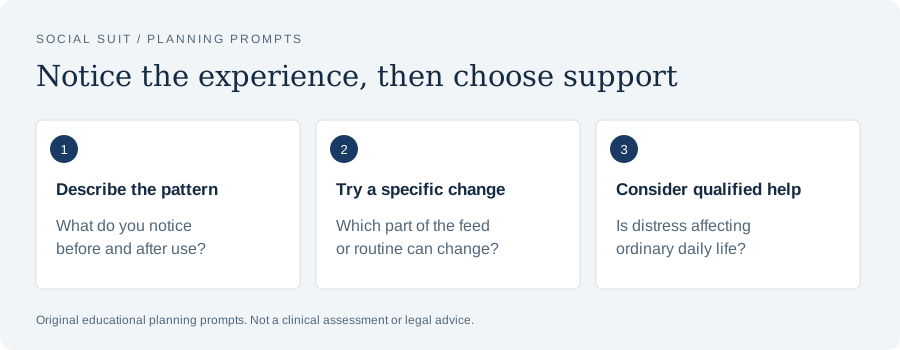
- Describe the patternWhat do you notice before and after use?
- Try a specific changeWhich part of the feed or routine can change?
- Consider qualified helpIs distress affecting ordinary daily life?
Recognize the pressure created by visible reactions
Public reactions can change the emotional stakes of a discussion. Likes, reposts, replies, and follower counts make participation visible and measurable. They can encourage the feeling that leaving would concede defeat or disappoint an audience. Those numbers do not establish the accuracy of a claim or the quality of an argument. They may reflect timing, audience composition, humor, familiarity, or many other features. If you notice that your attention has shifted from the subject to how the audience sees you, pause. The discussion may be asking you to perform a role rather than accomplish the purpose you originally chose.
You can write for silent readers without chasing visible approval. A concise correction with a reliable source may be useful to someone who never reacts. Conversely, a highly popular insult may supply little information. Evaluate the substance of what you contribute. Does it state a relevant claim? Does it distinguish fact from opinion? Does it avoid revealing private details? Is there a clear reason for another reader to find it useful? These questions offer a more stable standard than whether the comment receives immediate support. You cannot control how every audience interprets a public exchange.
If you feel drawn back by reaction counts, consider reducing the cues that invite checking. Mute the thread, disable optional notifications, or leave the app for a planned activity. The available controls depend on the service and may change, so use its current help information when needed. A setting does not decide whether your point was valid. It changes whether the platform continues asking for your attention. You can preserve a contribution while ending the stream of invitations to monitor it. That distinction can make a pause easier to choose.
Take a pause before composing the next reply
A pause creates space between feeling provoked and publishing something that may remain available. You might put down the device, change rooms, finish a routine task, or wait until you have the attention to read the comment carefully. There is no universally correct duration. The useful question is whether you can make a deliberate choice instead of responding automatically. If the situation is urgent because someone is in danger, use relevant safety channels rather than delaying necessary action. For an ordinary debate, a slower reply is usually possible. The thread's speed does not have to determine your response.
During the pause, identify the exact claim you would answer. Sometimes a hostile comment contains no meaningful question. Sometimes it combines several issues that cannot be addressed clearly in a short reply. Sometimes it attributes a view to you that you do not hold. You can decide whether a brief clarification would help or whether the thread has become unsuitable. A pause is not merely a technique for making the same response more polite. It gives you the option to choose a different action, including no further public participation.
Drafting outside the reply box may help if you want to organize a complex point. Keep the draft private and avoid including identifying details you do not need. Read it once for purpose: what does each sentence contribute? Read it again for audience: could an unfamiliar person understand it without the whole conversation? If the answer is no, you might need a shorter explanation or a different venue. You are not obligated to publish the draft because you invested time in it. The work may clarify that the discussion is no longer worth continuing.
Use factual corrections with a limited scope
When correcting a factual statement, identify the specific error and provide a source that supports the correction. Avoid expanding the reply into claims you have not checked. If the disputed issue concerns health, law, or another high stakes subject, reliable primary information is especially important. A source should support the point you make, not merely have an authoritative name. If you cannot verify the claim, say what remains uncertain or refrain from correcting it. A confident tone does not compensate for missing evidence, and the pressure of a thread is not a reason to guess.
Keep the correction proportionate. A wrong time for an event may require one sentence and the organizer's page. A claim about research may require explaining which population or outcome the study actually examined. A legal allegation may require distinguishing a filing from a court finding. The necessary detail depends on the error. Avoid turning every correction into an account of the other person's character. That shift can obscure the useful information and invite a wider conflict. You can state a correction clearly without establishing why the mistake was made.
Decide in advance how much follow up is useful. You may be willing to answer one genuine question or clarify one ambiguity. You do not need to respond to every insult that follows. If new information appears, reconsider the point honestly. Taking a break does not require treating your original position as permanently correct. A factual discussion can benefit from revision. The boundary concerns the amount and setting of participation, while accuracy concerns the substance. You can correct yourself, leave a source, and stop participating without framing any of those actions as a loss.
Protect personal information while explaining your position
People sometimes disclose private details to establish credibility in an argument. They may reveal a health history, a workplace, a child's circumstances, financial information, or private conversations. Before doing so, ask whether the information is necessary and whether you are comfortable with an unknown audience retaining it. A stranger's demand for proof does not create an obligation to provide your records. You can describe the relevant point in general terms or decline to discuss private circumstances. The fact that a thread challenges your credibility does not remove your right to set limits around disclosure.
Be equally careful with other people's information. A private message may seem like persuasive evidence, but posting it can expose someone who did not agree to participate in the dispute. If a safety incident requires documentation, preserve relevant information securely and share it through appropriate channels. That is different from publishing it to persuade an audience. Avoid adding identifying details about children, victims, or people whose private circumstances are involved. A public victory can have costs that are not visible in the thread. Consider those costs before making the information part of an argument.
You can also refuse demands that move the exchange into a more private or risky channel. If someone insists that you must send documents, join a private call, or contact an unfamiliar account to continue, evaluate the request separately. The thread does not authorize access to your account or personal information. Do not share login codes or credentials. If a request looks like impersonation or fraud, verify it through an independent route and use relevant reporting tools. Connection and persuasion should not depend on surrendering information that the discussion does not require.
Leave without needing a final performance
You may want to announce that you are leaving a thread. Sometimes a brief statement is useful, especially in a conversation with people you know. You could say that you have shared the source and will not continue the discussion today. The statement should describe your boundary rather than invite another dispute about who won. It is also acceptable to leave silently. Public comment sections do not require a closing ceremony. If announcing your departure reliably generates more replies that draw you back, a quiet exit may better serve your purpose.
Avoid using the exit as one more attack. A final insult can prolong the exchange and make it harder to stay away. It may also distract readers from the information you wanted to provide. A simple boundary is easier to understand: you are no longer participating. You do not need to characterize every other participant or predict what they will do next. The point is to end your involvement, not to make the audience approve of the ending. An unresolved thread can remain unresolved while you return to your day.
After leaving, use the service's tools to reduce invitations back. Muting a conversation may preserve your comment while stopping notifications, depending on the platform. Blocking may be appropriate when you do not want contact from a particular account. Reporting can address conduct that violates the service's rules. These actions serve different purposes, and none guarantees that the material will disappear or that every participant will stop. Review the relevant help information and keep expectations realistic. A boundary is useful even when it controls only your own participation and access.
Choose a next activity that gives the pause structure
An instruction to stop checking can feel empty if the rest of the evening has no shape. Choose a concrete next activity: make dinner, return to a task, speak with a friend, read something unrelated, or take a break from the device. The activity does not have to improve your mood immediately. Its purpose is to shift attention to something you chose. If you leave the app but continue composing replies in your head, notice that without demanding instant relief. You can still follow through on the next activity while the emotional reaction gradually changes.
If the argument disrupted a responsibility, prioritize the practical consequence. You may need to return a call, finish a work task, prepare for sleep, or clarify a plan. Repairing the concrete interruption can be more useful than analyzing the entire debate. Afterward, consider what cue might have helped you stop earlier. A scheduled event, a device reminder, or silenced notifications may create a clearer boundary next time. The aim is to learn from the sequence, not to punish yourself for having been drawn in. The next choice can be specific even if the broader pattern takes time to change.
Some people benefit from telling a trusted person that they are stepping away from a difficult thread. That can provide perspective and an ordinary conversation outside the public audience. Keep the account factual and avoid asking the person to attack participants on your behalf. Support does not require recruiting a crowd. You might explain what bothered you, what you decided, and what you need now. If the situation involves a serious safety concern, seek assistance suited to that concern. For an ordinary argument, a private conversation can help you return to your own priorities.
Handle discussions with friends differently from discussions with strangers
A public disagreement with a friend may affect a relationship you value. Ask whether the thread is helping you understand each other or encouraging both of you to speak for an audience. If the issue matters, suggest a private conversation at a suitable time. Private does not automatically mean easy or confidential, but it can remove some pressure to perform. Be clear about the topic you want to discuss. A message asking to understand what you meant is different from a demand to continue every point from the public exchange.
Allow the friend to choose when they have capacity for the conversation. A meaningful discussion may require more attention than either of you has during a busy day. If you disagree, identify which part remains unresolved without assuming that the disagreement defines the whole relationship. Some friendships can tolerate different views while maintaining respect. Other disagreements reveal behavior or values that require a boundary. The decision should be based on the actual pattern of the relationship, not simply on which comment received more approval. A public audience is not a reliable measure of private trust.
For strangers, you may have less reason to continue beyond one useful contribution. You do not share the same context, and the other person may interpret your words through assumptions you cannot easily correct. That limit does not make public discussion worthless. It means expectations should fit the setting. A concise source, a clear question, or an account of your perspective may still help readers. But establishing full mutual understanding with an unknown account can be an unrealistic task for a comment thread. You can decide that the available information is enough and leave.
Distinguish support from joining a pile on
When someone is being targeted, you may feel a strong urge to respond publicly. First consider what would help the affected person. They may want reporting, a private check in, help preserving relevant material, or a way to reduce exposure. They may not want their situation amplified to another audience. Ask when appropriate, and avoid assuming that a visible confrontation is the only meaningful support. A public defense can sometimes add useful context, but it can also attract more attention to the person being harmed. Consider their preferences and safety before making them the center of another thread.
Do not reproduce harmful material unnecessarily. Quoting an insult to condemn it may spread it further. Sharing an identifying screenshot can expose private information to people who would not otherwise see it. A report to the platform or a careful private record may serve the purpose with less amplification. If documentation is necessary, keep original material secure and limit access. Do not obtain evidence by entering someone else's account without authority. The goal is to support and address conduct, not to create an expanding public archive of a person's distress.
Avoid organizing retaliation. Encouraging followers to contact, shame, or investigate another account can escalate the situation and create harm for additional people. You can state that behavior is unacceptable, report it, and offer support without directing a crowd. If the conduct involves threats, stalking, or another serious concern, seek appropriate assistance rather than attempting to solve it through public confrontation. The scale of online attention can change quickly, and people outside the original exchange may lack context. Support is more useful when it remains connected to the affected person's needs.
Review the cost without making a diagnosis
If comment arguments repeatedly affect sleep, concentration, relationships, or responsibilities, describe those consequences directly. You do not need to call the pattern an addiction to ask for help or make a change. A professional conversation can consider the behavior alongside stress, mood, and other circumstances. The National Institute of Mental Health offers general resources on caring for mental health and finding support. These resources do not assess your individual situation through a comment history. Bring concrete examples if you seek an assessment, including what you intended to do and what happened instead.
Notice both useful and difficult experiences. Perhaps some discussions provide valuable learning, while late night disputes are consistently draining. Or perhaps a particular community has changed in tone. The answer may be a narrower boundary rather than abandoning every online discussion. At the same time, if a space repeatedly harms you, you do not have to preserve it because it once offered benefits. A review should identify current value and current cost. It should not become a requirement to justify a difficult environment or a demand to find a universal explanation for every session.
If distress persists beyond the thread or interferes with everyday life, seek qualified support rather than waiting for a perfect notification routine. A break from arguments may reduce one stressor, but it is not an individual treatment plan. If there is immediate danger or a crisis, contact relevant local help. In the United States, the Suicide and Crisis Lifeline can be reached by calling or texting 988. Emergency services are appropriate for an immediate safety emergency. The existence of a platform report button should not lead you to delay help that the platform cannot provide.
Build a simple participation boundary before the next thread
A boundary can specify the kind of discussion you are willing to enter, the amount of follow up you will offer, and the point at which you will stop. For example, you may choose to contribute factual information with a source, answer one clarifying question, and leave if the discussion turns into personal attacks. Or you may decide not to debate while preparing for sleep. Keep the rule connected to your life and purpose. An elaborate system can be difficult to remember in the moment. A short, concrete agreement with yourself is easier to use.
Decide how to handle notifications in advance. If the app allows a thread to be muted after a reply, you could use that option immediately when you do not need follow up. If you want to see genuine questions, choose a later time to review rather than responding to every alert. Check what the current controls actually do; similar labels may behave differently across services. The purpose is to create an interval in which you can choose when to participate. Continuous notification is not necessary for a contribution to remain available to readers.
Review the boundary after trying it. Did it preserve useful discussion? Did you miss something important? Was the stopping condition clear enough? If the rule was too broad, adjust it. If one platform consistently makes the boundary difficult, consider a different route to the same topic. A smaller group, a long form discussion, or an offline conversation may provide more context. The boundary is a tool for participation, not a permanent identity as someone who never disagrees online. You can remain interested in public issues while choosing settings that make discussion manageable.
A worked example: leaving after a factual contribution
Imagine a hypothetical person named Elena who sees a public thread about a school event. Several comments repeat an incorrect registration date. Elena checks the school's official page and posts the correct date with the source. A participant replies with a criticism of the school's policy and accuses Elena of defending it. Elena feels an urge to explain every part of her position. Before answering, she identifies the original purpose: make sure families have the right registration information. That purpose has been served. The new argument concerns a different issue and does not require Elena's continued involvement.
Elena adds one short clarification that her comment concerns the date, then mutes the thread. She returns to preparing her own registration. Later, she checks the official page again because that is the relevant source for the practical decision. The public thread continues without her. Leaving does not erase the correction or make the accusations accurate. It means Elena declined to take responsibility for a discussion beyond her purpose. The example illustrates how a clear task can provide a stopping point even when the audience keeps producing new prompts.
If Elena later learns that the official date changed, she can update her comment or share the new source. That is a matter of accuracy, separate from rejoining the argument. A boundary should not prevent correcting relevant information. It should prevent unrelated pressure from expanding a limited contribution into an open ended obligation. The same distinction applies to many factual discussions. You can remain accountable for what you said while declining to answer every claim someone attaches to it. A useful public contribution can be brief, revisable, and complete.
A worked example: moving a friendship conversation out of public replies
Consider a hypothetical person named Sam who disagrees with a friend about a community issue. Their public replies become sharper as strangers react. Sam notices that each response focuses more on defending tone than on understanding the original concern. They decide that the relationship matters more than continuing the performance in front of an audience. Sam sends a brief private invitation to talk later, explaining the subject without repeating accusations. The friend accepts for another day. Sam leaves the public thread and follows through on an ordinary evening plan instead of monitoring reactions.
In the later conversation, Sam asks what the friend intended and explains which statement caused concern. They discover agreement on one point and a continuing difference on another. The conversation does not resolve every issue, but it provides more information about the relationship than the public replies did. Both agree not to use strangers' comments as evidence of what the other person believes. This is a hypothetical example, not a promise that moving a discussion privately will produce agreement. The value is choosing a setting that better fits a genuine wish to understand.
If the friend refuses respectful discussion or repeatedly targets Sam, a stronger relationship boundary may be necessary. Sam does not have to preserve contact at any cost. The point is to assess the actual interaction rather than assume that every disagreement is harmless or every heated thread ends a friendship. A pause can reveal which concern deserves attention: the subject, the conduct, the setting, or the relationship itself. Once the concern is clearer, the next action can be proportionate. Continuing to type in the same thread is only one option among several.
When your work requires public replies
Some people participate in comment sections as part of a job, volunteer role, or community responsibility. Their ability to leave may be shaped by duties rather than personal preference alone. Clarify what the role requires. A community organizer may need to answer logistical questions but not debate every criticism. A moderator may need to apply rules consistently but should have support for threatening behavior. A service account may need an escalation route for private issues. The boundary should be established through the organization when possible, so one person's attention is not treated as an unlimited resource.
Use clear handoffs. If a question belongs with another team or requires confidential information, direct it through the appropriate official channel without requesting sensitive details in public comments. If a situation involves safety, follow the relevant process and seek support. Keep personal reactions separate from the account's responsibilities, while recognizing that the work can still be emotionally demanding. A break, rotation, or review with a colleague may help make the role sustainable. These are practical workflow examples, not a statement that every organization offers the same tools or protections.
For recurring conflicts, keep a record of the topic and response pattern rather than improvising from scratch each time. A clear public explanation or frequently asked questions page may answer ordinary questions more efficiently. It should remain accurate and understandable, and it should not be used to dismiss a legitimate concern. The purpose is to provide information without requiring endless individualized debate. If the organization lacks a process for abusive replies, raise that issue through an appropriate internal route. Responsibility for a public account should include realistic support for the people operating it.
Let the pause remain a choice you can renew
Taking a break does not require announcing that you will never participate in online disagreement again. You can choose to return when there is a clear purpose, a suitable setting, and enough attention to contribute responsibly. You can also decide that a particular thread is finished for you. The decision can be specific to today. This flexibility matters because an absolute promise may become another source of pressure. A useful boundary allows deliberate participation and deliberate withdrawal, with neither treated as proof of courage or failure. The relevant question is what serves your purpose and circumstances now.
When you return, begin with the subject rather than the unresolved emotional residue of the earlier thread. Read what is actually being discussed and verify claims before responding. If you are still composing a defense against yesterday's audience, you may want more distance before entering another exchange. You can remain informed through a primary source, a thoughtful article, or a conversation with someone you trust. Public replies are one channel for engagement, and they are not the only way to care about an issue. Choose the channel that gives you a realistic way to act.
The next time a notification asks for another reply, pause long enough to name the task. Have you already provided the relevant information? Is there a genuine question? Is the behavior safe and respectful enough to continue? What would the next response add? If the answers do not support continued participation, you can mute, leave, and return to a chosen activity. A comment section may continue indefinitely. Your involvement can have a beginning, a purpose, and an ending that you decide. That ordinary structure is often the most useful part of taking a break.
Keep one reply from becoming the whole evening
It can help to decide what portion of your day a thread is allowed to occupy. You might review replies once after finishing a task, then stop for the evening. The exact arrangement should fit your responsibilities. A planned review is different from repeatedly checking because a new response might appear. If you keep missing the review boundary, identify the cue that pulls you back. It may be a notification, an open tab, or the expectation that you must answer quickly. Change the cue where possible instead of relying only on repeated instructions to yourself.
You can also preserve a useful source outside the thread. Save the official page you consulted so that you do not have to reenter the argument to find it. If your purpose was learning, summarize the one point you learned and decide whether further reading is needed. If your purpose was arranging something, complete that arrangement through the relevant channel. These actions bring the discussion back to its practical value. The goal is to leave with information or a decision that belongs in your life, rather than with an expanding obligation to monitor other people's reactions.
When another participant follows you into unrelated spaces, reassess the behavior. A disagreement in one thread does not authorize repeated unwanted contact elsewhere. Use relevant account controls and seek support if the pattern becomes threatening or intrusive. Keep a factual record when appropriate, limit unnecessary exposure, and avoid reciprocal pursuit. The response should fit the new conduct rather than remain trapped in the original debate. A boundary around a thread can become an account or safety boundary when circumstances change.
Sources and further reading
These primary resources provide context. Our practical examples and planning suggestions are original educational material, not validated treatment protocols. Linked organizations do not endorse Social Suit.